



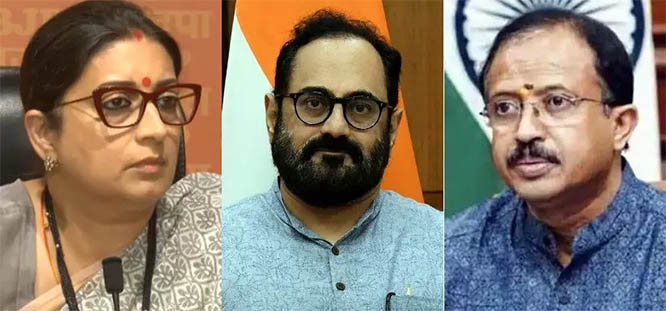
Smriti Irani to Rajeev Chandrasekhar: List of union ministers who miserably lost 2024 polls

News Network
June 5, 2024

ministers.jpg

BJP heavyweights Smriti Irani, Arjun Munda and Ajay Mishra Teni, among others, were unseated in the 2024 Lok Sabha elections. These losses, particularly in the Hindi heartland, have forced the BJP to lean on its NDA partners to form the government. 

This marks a deviation from the sweeping mandates of 2014 and 2019, when the BJP garnered 282 and 303 seats respectively, achieving a majority on its own.

The Election Commission of India has declared the results for 542 out of the 543 Lok Sabha constituencies so far. The BJP has secured 240 seats, while the Indian National Congress trails with 99.

The Ones Who Lost

Smriti Irani: One of the most high-profile defeats was that of Smriti Irani in Amethi. Ms Irani, who had famously defeated Rahul Gandhi in 2019, lost to Congress candidate Kishori Lal Sharma by a margin of 1,67,196 votes. This defeat marked the end of an era in Amethi, which had briefly been a BJP bastion under Ms Irani's stewardship.

Ajay Mishra Teni: The Union Minister of State for Home Affairs, embroiled in the controversial Lakhimpur Kheri incident, was defeated by the Samajwadi Party's Utkarsh Verma by over 34,329 votes.

Arjun Munda: The Union Tribal Affairs Minister faced a crushing defeat in Jharkhand's Khunti constituency, losing to Congress candidate Kalicharan Munda by 1,49,675 votes. 

Kailash Choudhary: In Rajasthan's Barmer, Minister of State for Agriculture and Farmers' Welfare, Kailash Choudhary, finished third, trailing by 4.48 lakh votes behind the victorious Ummeda Ram Beniwal of the Congress.

Rajeev Chandrasekhar: In Kerala's Thiruvananthapuram, the Union Minister of State for Electronics and Information Technology, Rajeev Chandrasekhar, lost to Congress stalwart Shashi Tharoor by over 16,077 votes. 

The BJP's setbacks weren't limited to these prominent figures. Ministers such as Mahendra Nath Pandey, Kaushal Kishore, Sadhvi Niranjan Jyoti, Sanjeev Balyan, Rao Saheb Danve, RK Singh, V Muraleedharan, L Murugan, Subhas Sarkar and Nishith Pramanik also faced defeats in the polls.

Mahendra Nath Pandey, the Union Minister of Heavy Industries lost his Chandauli seat in Uttar Pradesh. Minister of State for Housing and Urban Affairs, Kaushal Kishore lost against Samajwadi Party's RK Chaudhary by 70,292 votes in Mohanlalganj.

Sadhvi Niranjan Jyoti, the Union Minister of State for Consumer Affairs, Food, and Public Distribution, lost in UP's Fatehpur. Rao Saheb Danve, the Minister of State for Railways, lost the Jalna seat in Maharashtra to Congress' Kalyan Vaijnath Rao Kale. Cabinet Minister Rk Singh lost to CPI(ML)'s Sudama Prasad from Bihar's Arrah.

Union Minister Sanjeev Balyan was defeated in the Muzaffarnagar Lok Sabha seat by Samajwadi Party's Harendra Singh Malik by a margin of over 24,000 votes.

V Muraleedharan, the Union Minister of State for External Affairs and Parliamentary Affairs, was defeated in Kerala's Thiruvananthapuram. L Murugan, the Minister of State for Fisheries, Animal Husbandry, and Dairying, lost to DMK's A Raja in Tamil Nadu's Nilgiris by a substantial margin of 2,40,585 votes.

Nishith Pramanik, the Union Minister of State for Home Affairs, lost the Cooch Behar seat in West Bengal to TMC's Jagadish Chandra Basunia by over 39,000 votes.

Minister of State for Education Subhas Sarkar was defeated by Trinamool Congress candidate Arup Chakraborty in the Bankura Lok Sabha seat of West Bengal by a margin of 32,778 votes.

Comments

Add new comment

  • Coastaldigest.com reserves the right to delete or block any comments.
  • Coastaldigset.com is not responsible for its readers’ comments.
  • Comments that are abusive, incendiary or irrelevant are strictly prohibited.
  • Please use a genuine email ID and provide your name to avoid reject.
News Network
February 1,2026

Bengaluru: The Karnataka High Court has refused to quash an investigation against a WhatsApp group administrator accused of allowing the circulation of obscene and offensive images depicting Hindutva politicians and idols in 2021.

Justice M Nagaprasanna observed that, prima facie, the ingredients of the offence under Section 295A of the Indian Penal Code were made out. “The offence under Section 295A of the IPC is met to every word of its ingredient, albeit prima facie,” the judge said.

The petitioner, Sirajuddin, a resident of Belthangady taluk in Dakshina Kannada district, had challenged the FIR registered against him at the CEN (Cyber, Economics and Narcotics) police station, Mangaluru, for offences under Section 295A of the IPC and Section 67 of the Information Technology Act. Section 295A relates to punishment for deliberate and malicious acts intended to outrage the religious feelings of any class of citizens.

According to the complaint filed by K Jayaraj Salian, also a resident of Belthangady taluk, he received a WhatsApp group link from an unknown source and was added to the group after accessing it. The group reportedly had six administrators and around 250 participants, where obscene and offensive images depicting Hindu deities and certain political figures were allegedly circulated repeatedly.

Sirajuddin was arrested in connection with the case and later released on bail on February 16, 2021. He argued before the court that he was being selectively targeted, while other administrators—including the creator of the group—were neither arrested nor investigated. He also contended that the Magistrate could not have taken cognisance of the offence under Section 295A without prior sanction under Section 196(1) of the CrPC.

Rejecting the argument, Justice Nagaprasanna held that prior sanction is required only at the stage of taking cognisance, and not at the stage of registration of the crime or during investigation.

The judge noted that the State had produced the entire investigation material before the court. “A perusal of the material reveals depictions of Hindu deities in an extraordinarily obscene, demeaning and profane manner. The content is such that its reproduction in a judicial order would itself be inappropriate,” the court said, adding that the material, on its face, had the tendency to outrage religious feelings and disturb communal harmony.

Observing that the case was still at the investigation stage, the court said it could not interdict the probe at this juncture. However, it expressed concern that the investigating officer appeared to have not proceeded uniformly against all administrators. The court clarified that if the investigation revealed the active involvement of any member in permitting the circulation of such content, they must also be proceeded against.

“At this investigative stage, any further observation by this Court would be unnecessary,” the order concluded.

Comments

Add new comment

  • Coastaldigest.com reserves the right to delete or block any comments.
  • Coastaldigset.com is not responsible for its readers’ comments.
  • Comments that are abusive, incendiary or irrelevant are strictly prohibited.
  • Please use a genuine email ID and provide your name to avoid reject.
News Network
January 20,2026

Mangaluru: In a major step towards strengthening rural innovation, the Office of the Principal Scientific Adviser (PSA) to the Government of India is supporting the establishment of RuTAGe Smart Village Centres (RSVCs) across the country through collaborations with academic institutions, civil society organisations and philanthropic partners.

As part of this national initiative, Nitte (Deemed to be University) will set up the first RSVCs in the region at Nitte GP in Udupi district and at the Nitte Health Centre, Sevanjali Trust, Farangipete, in Dakshina Kannada district. The centres will be inaugurated on January 21. In South India, the programme is being implemented by the Section Infin-8 Foundation (SI-8).

Speaking to reporters on Monday, SI-8 founder-director Vishwas US said experts from Nitte University and SI-8 would work closely with farmers, students, youth and local entrepreneurs to adapt and deploy technologies tailored to local needs.

Project head Prof Iddya Karunasagar, representing Nitte DU, said the RSVCs at Nitte and Farangipete would serve as demonstration hubs for a wide range of agriculture, energy, skill-development and assistive technologies. These include solar dryers for fruits, vegetables and crops; soil-testing solutions; power weeders and women-friendly farm tools; wind-powered devices for rural artisans; grain storage systems; grass-cutting and tree-climbing equipment; and liquid fertiliser production using cowshed waste.

SI-8 CEO Aravind C Kumar said the centres would also provide access to digital and knowledge-based platforms such as ISRO applications, government scheme portals, market linkage tools and gamified learning resources, along with assistive technologies for persons with visual impairments.

Highlighting the broader impact of the initiative, Principal Scientific Adviser Prof Ajay Kumar Sood said it demonstrated how applied research could bridge the rural–urban divide and help create self-reliant, technology-enabled villages.

The initiative has been made possible through philanthropic support from Dr NC Murthy of ACM Business Solutions, LLC, USA. Dr Sapna Poti, Director (Strategic Alliances) at the Office of the Principal Scientific Adviser, said the long-term objective is to build self-sufficient, technology-driven communities capable of generating sustainable livelihoods on their own.

Comments

Add new comment

  • Coastaldigest.com reserves the right to delete or block any comments.
  • Coastaldigset.com is not responsible for its readers’ comments.
  • Comments that are abusive, incendiary or irrelevant are strictly prohibited.
  • Please use a genuine email ID and provide your name to avoid reject.
News Network
February 1,2026

Bengaluru, Feb 1: For travelers landing at Kempegowda International Airport (KIA), the sleek, wood-paneled curves of Terminal 2 promise a world-class welcome. But the famed “Garden City” charm quickly withers at the curb. As India’s aviation sector swells to record numbers—handling over 43 million passengers in Bengaluru alone this past year—the “last mile” has turned into a marathon of frustration.

The Bengaluru Logjam: Rules vs Reality

While the city awaits the 2027 completion of the Namma Metro Blue Line, the interim has been chaotic. Recent “decongestion” rules at Terminal 1 have pushed app-based cab pickups to distant parking zones, forcing weary passengers into a 20-minute walk with luggage.

“I landed after ten months away and felt like a stranger in my own city,” says Ruchitha Jain, a Koramangala resident. “My driver couldn’t find me, staff couldn’t guide me, and the so-called ‘Premium’ lane is just a fancy tax on convenience.”

•    The Cost of Distance: A 40-km cab ride can now easily cross ₹1,500, driven by demand pricing and airport surcharges.

•    The Bus Gap: While Vayu Vajra remains a lifeline, its ₹300–₹400 fare is often cited as the most expensive airport bus service in the country.

A National Pattern of Disconnect

The struggle is not unique to Karnataka. From Chennai’s coast to Hyderabad’s plateau, India’s airports tell a familiar story: brilliant runways, broken exits.

City:    Primary Issue   |    Recent Development

Bengaluru:    Cab pickup restrictions & distance  |    App-based taxis shifted to far parking zones; long walks and fare spikes reported

Chennai:    Multi-Level Parking (MLCP) hike  |    Passengers report 40-minute walks to reach cab pickup points

Hyderabad:    “Taxi mafia” & touting  |    Over 440 touting cases reported; security presence intensified

Mumbai:    Fare scams  |     Tourists charged ₹18,000 for just 400 metres, triggering police action

In Hyderabad, travelers continue to battle entrenched local groups that intimidate Uber and Ola drivers, pushing passengers toward overpriced private taxis. Chennai flyers, meanwhile, complain that reaching the designated pickup zones now takes longer than short-haul flights from cities like Coimbatore.

The ‘Budget Day’ Hope

As Finance Minister Nirmala Sitharaman presents the Union Budget 2026 today, the aviation sector is watching closely. With the government’s renewed emphasis on multimodal integration, there is cautious hope for funding toward seamless airport-metro-bus hubs.

The vision is clear: a future where planes, trains, and metros speak the same language. Until then, passengers at KIA—and airports across India—will continue to discover that the hardest part of flying isn’t the thousands of kilometres in the air, but the last few on the ground.

Comments

Add new comment

  • Coastaldigest.com reserves the right to delete or block any comments.
  • Coastaldigset.com is not responsible for its readers’ comments.
  • Comments that are abusive, incendiary or irrelevant are strictly prohibited.
  • Please use a genuine email ID and provide your name to avoid reject.