



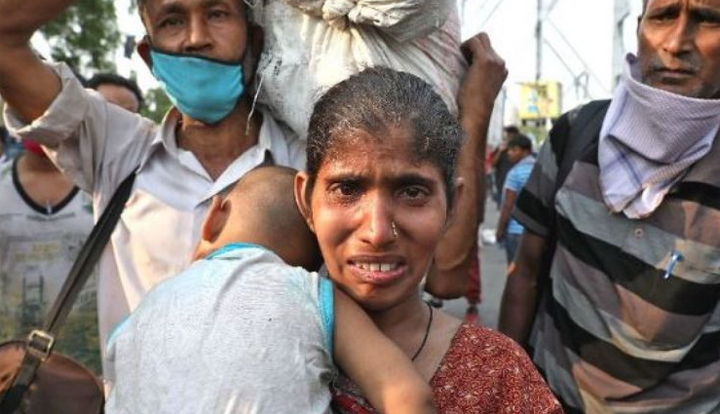
Social boycott, depression, money trouble, govt apathy: The faces of India’s covid crisis as deaths near 1 lakh-mark

News Network
October 1, 2020

covidindia.JPG

New Delhi, Oct 1: Eight months after the novel coronavirus arrived in India, the death count due to COVID-19 is inching towards the 100,000-mark. Nearly 6.5 million people have been infected in total, second only to the number in the United States.

Reuters met and interviewed relatives of 30 people who died of the virus in India, from coastal Kerala on the country's southern tip to the Himalayan region of Kashmir in the north.

The 30 victims were ordinary people from all walks of life, and included police officers and doctors on the frontlines of the fight against the virus.

In what is still a conservative and developing country, some of the relatives said they faced ostracism after their loved ones caught the virus. Others said they have suffered from depression and money troubles. All said more could have been done to save the people who died.

Life after

Javed Ali, a 42-year-old doctor in New Delhi, died in July. His wife, Hena Kausar, also a doctor and now the sole carer for their two children, said she doesn't know what she will do without him.

"Our whole life has changed," she said. "I still want to be a doctor (but) I have to choose between my job and kids."

Nineteen-year-old student Fardeen Khan was orphaned after his mother Noor Jahan died in June. His father had died in 2018.

"I have no financial support now," he said. "I have no job"

Some relatives said they found the reaction from authorities and neighbours after their bereavements difficult to bear.

Sunita Patil's husband Vivek, a 46-year-old music teacher, died suddenly at home in Mumbai before a bed at a local hospital became available. The next morning, she said, municipal workers came to the house shouting for them to come outside to be taken to a quarantine centre.

"They were not sensitive to the fact that there has been a death in the family just a day back, and we are in mourning," she said.

Nadeem Akhtar's sister Shabana Ahmed, a 52-year-old architect, died in New Delhi in April.

"What really upsets me more than the healthcare system was the behaviour of society," he said.

"My sister's neighbourhood boycotted her family. There was no emotional or moral support even after her death. Society failed us."

Chances missed

India's rudimentary healthcare system has at times struggled to cope with the huge number of coronavirus cases.

Many of the victims' relatives said there were missed opportunities to cure the infected.

Jamal Khan, a 41-year-old farmer, developed a fever in August in the Bijnor district of Uttar Pradesh.

His brother, Asim, said local doctors failed to realise he was COVID-positive. It was only when he was transferred to Delhi, ten days after he first became ill, that he was diagnosed.

By then, his lungs were badly damaged, and he died soon after, according to Asim.

"If he would have been diagnosed on time in his own native place, he would have surely survived," Asim said.

Rekha Khandait's 58-year-old husband Jayant is one of more than 200 police officers who died from the virus in the western state of Maharashtra alone. She was one of several people who said a lack of oxygen contributed to the death.

"I can't believe that six months have passed, she said. "I still haven't told our son yet about his death."

Tilak Raj, a 38-year-old software engineer, said when his mother Krishna Devi was hospitalized, there was no oxygen in the ambulance. When they arrived at the hospital, the cylinder that was provided was empty in five minutes.

"If we had a better health system, my mother would have survived," he said.

Comments

Add new comment

  • Coastaldigest.com reserves the right to delete or block any comments.
  • Coastaldigset.com is not responsible for its readers’ comments.
  • Comments that are abusive, incendiary or irrelevant are strictly prohibited.
  • Please use a genuine email ID and provide your name to avoid reject.
News Network
December 2,2025

Puttur: The long-cherished dream of a government medical college in Puttur has moved a decisive step closer to reality, with the Karnataka State Finance Department granting its official approval for the construction of a new 300-bed hospital.

Puttur MLA Ashok Kumar Rai announced the crucial development to reporters on Monday, confirming that the official communication from the finance department was issued on November 27. This 300-bed facility is intended to be the cornerstone for the establishment of the government medical college, a project announced in the state budget.

Fast-Track Implementation

The MLA outlined an aggressive timeline for the project:

•    A Detailed Project Report (DPR) for the hospital is expected to be ready within 45 days.

•    The tender process for the construction will be completed within two months.

Following the completion of the tender process, Chief Minister Siddaramaiah is scheduled to lay the foundation stone for the project.

"Setting up a medical college in Puttur is a historical decision by the Congress government in Karnataka," Rai stated. The project has an estimated budget allocation of Rs 1,000 crore for the medical college.

Focus on Medical Education Department

The MLA highlighted a key strategic move: requesting the government to implement the hospital construction through the Medical Education Department instead of the Health and Family Welfare Department. This is intended to streamline the entire process of establishing the full medical college, ensuring the facilities—including labs, operation theatres, and other necessary infrastructure—adhere to the strict guidelines set by the Medical Council of India (MCI). The proposed site for the project is in Bannur.

Rai also took the opportunity to address political criticism, stating that the government has fulfilled its promise despite "apprehensions" and "mocking and criticising" from opposition parties who had failed to take similar initiatives when they were in power. "Chief Minister Siddaramaiah has kept his word," he added.

Comments

Add new comment

  • Coastaldigest.com reserves the right to delete or block any comments.
  • Coastaldigset.com is not responsible for its readers’ comments.
  • Comments that are abusive, incendiary or irrelevant are strictly prohibited.
  • Please use a genuine email ID and provide your name to avoid reject.
News Network
December 6,2025

pilot.jpg

New Delhi: IndiGo, India’s largest airline, faced major operational turbulence this week after failing to prepare for new pilot-fatigue regulations issued by the Directorate General of Civil Aviation (DGCA). The stricter rules—designed to improve flight safety—took effect in phases through 2024, with the latest implementation on November 1. IndiGo has acknowledged that inadequate roster planning led to widespread cancellations and delays.

Below are the key DGCA rules that affected IndiGo’s operations:

1. Longer Mandatory Weekly Rest

Weekly rest for pilots has been increased from 36 hours to 48 hours.

The government says the extended break is essential to curb cumulative fatigue. This rule remains in force despite the current crisis.

2. Cap on Night Landings

Pilots can now perform only two night landings per week—a steep reduction from the earlier limit of six.

Night hours, defined as midnight to early morning, are considered the least alert period for pilots.

Given the disruptions, this rule has been temporarily relaxed for IndiGo until February 10.

3. Reduced Maximum Night Flight Duty

Flight duty that stretches into the night is now capped at 10 hours.

This measure has also been kept on hold for IndiGo until February 10 to stabilize operations.

4. Weekly Rest Cannot Be Replaced With Personal Leave

Airlines can no longer count a pilot’s personal leave as part of the mandatory 48-hour rest.

Pilots say this closes a loophole that previously reduced actual rest time.

Currently, all airlines are exempt from this rule to normalise travel.

5. Mandatory Fatigue Monitoring

Airlines must submit quarterly fatigue reports along with corrective actions to DGCA.

This system aims to create a transparent fatigue-tracking framework across the industry.

The DGCA has stressed that these rules were crafted to strengthen flight safety and align India with global fatigue-management standards. The temporary relaxations are expected to remain until February 2025, giving IndiGo time to stabilise its schedules and restore normal air travel.

Comments

Add new comment

  • Coastaldigest.com reserves the right to delete or block any comments.
  • Coastaldigset.com is not responsible for its readers’ comments.
  • Comments that are abusive, incendiary or irrelevant are strictly prohibited.
  • Please use a genuine email ID and provide your name to avoid reject.
News Network
November 26,2025

students.jpg

Bengaluru, Nov 26: Karnataka is taking its first concrete steps towards lifting a three-decade-old ban on student elections in colleges and universities. Deputy Chief Minister D.K. Shivakumar announced Wednesday that the state government will form a small committee to study the reintroduction of campus polls, a practice halted in 1989 following incidents of violence.

Speaking at a 'Constitution Day' event organised by the Karnataka Congress, Mr. Shivakumar underscored the move's aim: nurturing new political leadership from the grassroots.

"Recently, (Leader of the Opposition in Lok Sabha) Rahul Gandhi wrote a letter to me and Chief Minister (Siddaramaiah) asking us to think about restarting student elections," Shivakumar stated. "I'm announcing today that we'll form a small committee and seek a report on this."

Student elections were banned in Karnataka in 1989, largely due to concerns over violence and the infiltration of political party affiliates into campus life. The ban effectively extinguished vibrant student bodies and the pipeline of young leaders they often produced.

Mr. Shivakumar, who also serves as the Karnataka Congress president, said that former student leaders will be consulted to "study the pros and cons" of the re-introduction.

Acknowledging the history of the ban, he added, "There were many criminal activities taking place back then. We’ll see how we can conduct (student) elections by regulating such criminal activities."

The Deputy CM reminisced about his own journey, which began on campus. He recalled his political activism at Sri Jagadguru Renukacharya College leading to his first Assembly ticket in 1985 at the age of 23. "That's how student leadership was at the time. Such leadership has gone today. College elections have stopped," he lamented, adding that for many, college elections were "like a big movement" where leaders were forged.

The move, driven by the Congress high command's push to cultivate young talent, will face scrutiny from academics and university authorities who have, in the past, expressed concern that the return of polls could disrupt the peaceful academic environment and turn campuses into political battlegrounds.

Comments

Add new comment

  • Coastaldigest.com reserves the right to delete or block any comments.
  • Coastaldigset.com is not responsible for its readers’ comments.
  • Comments that are abusive, incendiary or irrelevant are strictly prohibited.
  • Please use a genuine email ID and provide your name to avoid reject.
