



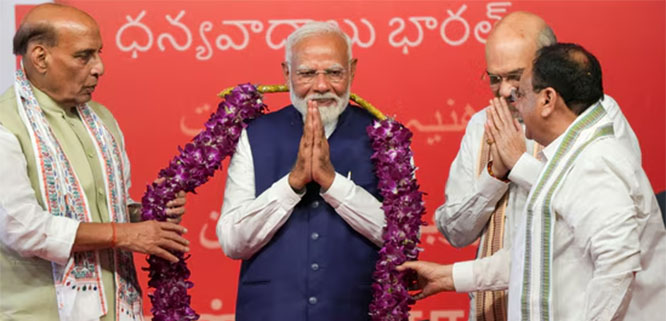
In surprising poll results, Modi and BJP finally discover hype doesn’t always work

News Network
June 5, 2024

modibjp.jpg

India is unpredictable. This is an incontrovertible fact that Indians themselves seem to have forgotten over the past decade.

Ever since Prime Minister Narendra Modi stormed into office with an unexpected and unprecedented outright legislative majority in 2014, many have assumed the country’s politics had changed forever.

The age of coalitions was over; India seemed to be heading inexorably toward one-party dominance.

To stock traders and pro-government pundits, the country’s trajectory seemed so clear: It was destined to see steady 8 per cent growth, happy voters, and a prime minister going from strength to strength at home and abroad.

Indian voters chose to disagree. With votes still being counted in the country’s massive general elections and several races still hanging in the balance, Modi’s Bharatiya Janata Party looks almost certain to have fallen short of a parliamentary majority. 
That means it will have to depend, for the first time, on fickle smaller parties to hold onto power.

This was what Indian politics looked like for decades prior to Modi’s emergence. Many thought we were living in a new normal. Instead, the old normal has reasserted itself.

In these surprising elections, Modi and the BJP appear to have discovered the limits of hype. An apparently unified public sphere, solidly pro-government media, and impressive growth numbers had left many assuming that Modi’s performance in power had few holes.

Observers should have paid more attention to contrary indicators. Employment growth under Modi has been marginal at best. Social inclusion has been patchy.

While much of the country looks very different from it did in 2014, even more of it looks largely unchanged.

Small-town India has not seen the sort of revolution in infrastructure that cities of equivalent size in China or Southeast Asia have enjoyed over recent decades.

Big metropolises were transformed during the boom years of the 2000s; they have mostly stagnated since then.

Whatever the GDP growth numbers are, whether they are believable or not, one thing is clear: Voters do not believe enough of that growth has reached their wallets.
It’s not surprising such facts have been overlooked. The Modi government and its allies have completely dominated messaging over the past decade.

They sought to maintain, week in and week out, the frenetic pace and outsize enthusiasm that marked the Prime Minister’s initial march to power.

The government thought that the lesson of its sweeping re-election in 2019 was that social conservatism and welfare delivery was enough to maintain control.

But Modi and the BJP have reached the limits of welfare-first politics and saturation advertising. Without real change on the ground, he or any successor may struggle to retain power over the next five years. They will have to pay more attention to governance than to marketing.

There’s a lot that needs attention. Modi came into power promising manufacturing jobs and private-sector-friendly reforms. In this campaign, he instead argued that loans to small-scale entrepreneurs had gone up, proving that jobs were being created — and that increases in share prices for public-sector companies validated his economic performance.

This is clearly a retreat from the ambitions of a decade ago. Any new government must recapture those ambitions; voters clearly expect it.

If India’s politics have indeed returned to normal, its government must, too. Repression of the opposition does not work, not in a country this large and variegated.

For 10 years, Modi has promised to wipe out his principal rivals in the Indian National Congress party. Yet, in this election, the Congress demonstrated that it is not going anywhere.

The government arguably misused investigative agencies to go after opposition leaders in two states in particular, Maharashtra and West Bengal; both have decisively voted against the BJP.

Modi’s personal popularity is such that he and his government can survive the sort of relatively mild rebuke the electorate has delivered. To retain power for a third term, even if dependent on allies, is an historic achievement.

This result is only startling because the Modi hype had completely detached itself from reality.

We do not live, it appears, in a post-truth world. Even the most adept populists must eventually reckon with reality. None of them are immune to the most fundamental rule of politics: If you don’t perform, you perish.


Comments

Add new comment

  • Coastaldigest.com reserves the right to delete or block any comments.
  • Coastaldigset.com is not responsible for its readers’ comments.
  • Comments that are abusive, incendiary or irrelevant are strictly prohibited.
  • Please use a genuine email ID and provide your name to avoid reject.
News Network
February 1,2026

Bengaluru, Feb 1: For travelers landing at Kempegowda International Airport (KIA), the sleek, wood-paneled curves of Terminal 2 promise a world-class welcome. But the famed “Garden City” charm quickly withers at the curb. As India’s aviation sector swells to record numbers—handling over 43 million passengers in Bengaluru alone this past year—the “last mile” has turned into a marathon of frustration.

The Bengaluru Logjam: Rules vs Reality

While the city awaits the 2027 completion of the Namma Metro Blue Line, the interim has been chaotic. Recent “decongestion” rules at Terminal 1 have pushed app-based cab pickups to distant parking zones, forcing weary passengers into a 20-minute walk with luggage.

“I landed after ten months away and felt like a stranger in my own city,” says Ruchitha Jain, a Koramangala resident. “My driver couldn’t find me, staff couldn’t guide me, and the so-called ‘Premium’ lane is just a fancy tax on convenience.”

•    The Cost of Distance: A 40-km cab ride can now easily cross ₹1,500, driven by demand pricing and airport surcharges.

•    The Bus Gap: While Vayu Vajra remains a lifeline, its ₹300–₹400 fare is often cited as the most expensive airport bus service in the country.

A National Pattern of Disconnect

The struggle is not unique to Karnataka. From Chennai’s coast to Hyderabad’s plateau, India’s airports tell a familiar story: brilliant runways, broken exits.

City:    Primary Issue   |    Recent Development

Bengaluru:    Cab pickup restrictions & distance  |    App-based taxis shifted to far parking zones; long walks and fare spikes reported

Chennai:    Multi-Level Parking (MLCP) hike  |    Passengers report 40-minute walks to reach cab pickup points

Hyderabad:    “Taxi mafia” & touting  |    Over 440 touting cases reported; security presence intensified

Mumbai:    Fare scams  |     Tourists charged ₹18,000 for just 400 metres, triggering police action

In Hyderabad, travelers continue to battle entrenched local groups that intimidate Uber and Ola drivers, pushing passengers toward overpriced private taxis. Chennai flyers, meanwhile, complain that reaching the designated pickup zones now takes longer than short-haul flights from cities like Coimbatore.

The ‘Budget Day’ Hope

As Finance Minister Nirmala Sitharaman presents the Union Budget 2026 today, the aviation sector is watching closely. With the government’s renewed emphasis on multimodal integration, there is cautious hope for funding toward seamless airport-metro-bus hubs.

The vision is clear: a future where planes, trains, and metros speak the same language. Until then, passengers at KIA—and airports across India—will continue to discover that the hardest part of flying isn’t the thousands of kilometres in the air, but the last few on the ground.

Comments

Add new comment

  • Coastaldigest.com reserves the right to delete or block any comments.
  • Coastaldigset.com is not responsible for its readers’ comments.
  • Comments that are abusive, incendiary or irrelevant are strictly prohibited.
  • Please use a genuine email ID and provide your name to avoid reject.
News Network
January 31,2026

Roy.jpg

Bengaluru: The shooting incident involving CJ Roy, founder of the Confident Group, has once again put the spotlight on a businessman whose life has swung between flamboyant global success and persistent controversy at home.

Though Roy’s business interests extended across continents, his roots lay firmly in Karnataka. An alumnus of Christ School in Bengaluru, he later moved to Tumakuru to pursue an engineering degree. Those familiar with his early years describe him as intensely ambitious, beginning his career as a salesman at a small electronics firm dealing in computers.

Roy’s entry into large-scale real estate came through the Crystal Group, where he worked closely with Latha Namboothiri and rose from manager to director. However, the launch of the Confident Group in 2005 was clouded by industry speculation. Insiders speak of a fallout involving alleged “benami” properties and claims of deception that ultimately led to his independent venture—an episode Roy spent years trying to distance himself from, according to associates.

A tale of two cities

Roy’s professional trajectory diverged sharply across geographies.

In Dubai, he built a reputation as a bold and efficient developer, completing massive luxury residential projects in record time—some reportedly within 11 months. His rapid project delivery and lavish lifestyle in the Emirates earned him admiration and visibility in the real estate sector.

In Bengaluru, however, his image remained far more fractured. Sources say Roy stayed away from the city for several years amid disputes over unpaid dues to vendors and suppliers. Several projects were allegedly stalled, with accusations of unfulfilled commitments to cement and steel suppliers continuing to follow him.

Roy’s return to Bengaluru’s business and social circles began around 2018, marked by a conscious attempt at rebranding. His appointment as Honorary Consul of the Slovak Republic added diplomatic legitimacy, which he complemented with visible CSR initiatives, including ambulance donations and high-profile charity events.

Heavy police presence in Langford Town

Following the incident, police personnel from the Central division were deployed outside the Confident Group building in Langford Town, which also houses the Slovak Honorary Consulate in Bengaluru.

The otherwise busy premises near Hosur Road wore a deserted look on Friday, reflecting the shock and uncertainty that followed the tragedy.

Comments

Add new comment

  • Coastaldigest.com reserves the right to delete or block any comments.
  • Coastaldigset.com is not responsible for its readers’ comments.
  • Comments that are abusive, incendiary or irrelevant are strictly prohibited.
  • Please use a genuine email ID and provide your name to avoid reject.
News Network
January 23,2026

oscar.jpg

The Voice of Hind Rajab, inspired by the tragic final moments of a young Palestinian girl killed by Israeli fire in Gaza, has been nominated for an Academy Award in the Best International Feature Film category.

Directed by Tunisian filmmaker Kaouther Ben Hania, the film recounts the true story of five-year-old Hind Rajab, who lost her life in January 2024 while fleeing Israeli bombardment with her family.

The film features the real audio of Hind’s desperate call to the Palestinian Red Crescent Society, where she pleaded for help moments before the vehicle she was in was struck by 355 bullets.

The haunting narrative begins with a brief call made from the besieged Tel al-Hawa neighborhood of Gaza, where gunfire and armored vehicles drowned out every sound.

After witnessing the brutal killing of her family, she made a trembling call, her voice reduced to a whisper as she spoke of the massacre and her unbearable loneliness as the sole survivor.

Premiering at the Venice International Film Festival in September 2025, The Voice of Hind Rajab garnered widespread acclaim, receiving a record-setting 23-minute standing ovation and the Silver Lion Grand Jury Prize, the festival’s second-highest honor.

In her acceptance speech, Ben Hania dedicated the film to humanitarian workers and first responders in Gaza, emphasizing that Hind's voice symbolizes countless civilians affected by war.

She aims to give voice to victims often reduced to mere statistics, highlighting the broader suffering of civilians in war zones.

The film’s Oscar nomination underscores its powerful storytelling and ethical approach to depicting real-life tragedy, making it a crucial piece of contemporary cinema.

It serves not only as a narration of individual tragedy but also as an artistic and documentary response to the silence and censorship that often overshadow West Asian struggles and wars.

Using an innovative method she calls docufiction, Ben Hania bridges unvarnished reality and narrative structure, creating a work that is both artistically valuable and socially impactful.

Born in 1977 in Sidi Bouzid—later the epicenter of the Arab revolution—her background profoundly influenced her worldview and artistic approach.

She is a graduate of the Higher School of Audiovisual Arts of Tunis, Pantheon-Sorbonne University, and La Fémis in Paris, where her studies equipped her with the technical and theoretical tools needed to address complex subjects. 

Comments

Add new comment

  • Coastaldigest.com reserves the right to delete or block any comments.
  • Coastaldigset.com is not responsible for its readers’ comments.
  • Comments that are abusive, incendiary or irrelevant are strictly prohibited.
  • Please use a genuine email ID and provide your name to avoid reject.
