Wistron violence could sour Apple's 'Make in India' plans

News Network
December 16, 2020

apple.JPG

Violence at a Wistron Corp factory in southern India is likely to stall the company's and its client Apple Inc's drive to expand local manufacturing, while forcing the government to redouble efforts to encourage foreign investors.

Thousands of contract workers angry over the alleged non-payment of wages, destroyed equipment and vehicles at a Wistron plant in southern India on Saturday, causing an estimated $60 million in damages.

The Taiwanese company, one of Apple's top suppliers, had been hiring in significant numbers at the plant that became operational earlier this year.

It assembled the second-generation iPhone SE there and was expected to start producing newer models, but the violence has led the company to shut the site and file a police complaint against more than 5,000 contract workers for destruction of property.

Wistron has not disclosed details, but one source familiar with the situation, speaking on condition of anonymity, said the area where smartphones are assembled and lines where delicate components, such as printed circuit boards, are mounted, have been damaged.

The company did not respond to a request for comment from Reuters. It said in a regulatory filing in Taiwan that it was doing its best to get the plant running again.

Apple also did not respond to a request for comment.

Two sources close to the situation, who asked not to be named because they were not authorised to speak to the press, said restarting could be difficult.

"It disrupts business for Wistron massively," one of the sources said.

"The company was looking to hire between 15,000 to 20,000 workers over the next one year, had plans to assemble another iPhone device but the company could take several weeks, or even months to get back on its feet again."

Wistron committed earlier this year to invest roughly 13 billion rupees ($176.74 million) for smartphone manufacturing over the next five years to qualify for the federal government's production-linked incentive plan.

Three sources familiar with the matter said Wistron could lose most of this year's incentives if operations stay suspended, although they did not give figures.

An Apple investigation into whether Wistron flouted supplier guidelines and a labour department enquiry into the alleged non-payment of wages could add to its problems in India.

'MAKE IN INDIA' CAMPAIGN

Wistron's issues are also a setback to Apple, which has in turn committed to expanding manufacturing in India and lobbied for incentives.

Apple has used India as a base to widen assembly beyond China as it adapts to a trade war between Beijing and Washington.

In India, it uses Foxconn's unit in southern Tamil Nadu state as well as Wistron's factory to make smartphones for the domestic market and for export.

Industry executives and tech analysts said Apple may seek to deepen ties with other contract manufacturers in India.

Pegatron Corp, another of Apple's Taiwan-based global suppliers, is expected to begin India operations soon.

Apart from any inconvenience to the companies, the fall-out from Saturday's violence in the southern Indian hub for automobile and electronics production, is a blow to Prime Minister Narendra Modi's Make In India campaign to lure international manufacturers.

Officials are already working to limit the damage.

The technology ministry said in a statement the Wistron plant was an aberration.

Officials from New Delhi and the government of Karnataka state, where the plant is located, said they have assured Wistron of their support.

Analysts predict India can prevail.

"The episode could dent India's potential as a source base for larger corporations, but the overall attractiveness of this market will stand the test," said Abheek Barua, the chief economist at top Indian private lender HDFC Bank.

"I also believe it will induce companies like Apple to take a closer look at their vendors and their policies, instead of driving them to an exodus."

Comments

Add new comment

  • Coastaldigest.com reserves the right to delete or block any comments.
  • Coastaldigset.com is not responsible for its readers’ comments.
  • Comments that are abusive, incendiary or irrelevant are strictly prohibited.
  • Please use a genuine email ID and provide your name to avoid reject.
News Network
December 7,2025

envoy.jpg

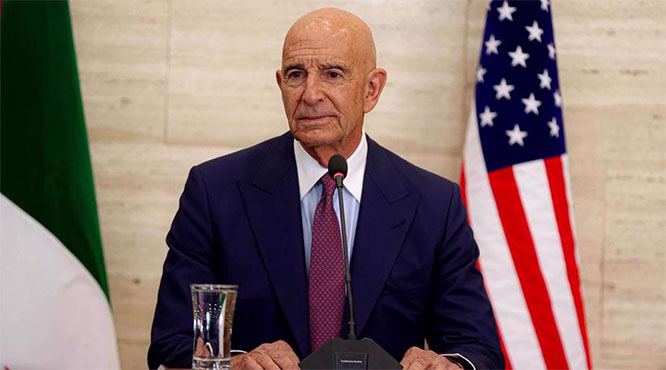
Since 1946, the United States has attempted 93 coups or “regime change” operations across the world — including two in Iran, US Special Envoy for Syria Tom Barrack has admitted.

Speaking to the UAE-based IMI Media Group, in remarks published by The National, Barrack said Washington tried twice to overthrow the Iranian government but failed both times. 

“For (Trump) then to be imputed with regime change — we had two regime changes in Iran already. Neither one worked. So I think wisely leave it to the region to solve,” said Barrack, who also serves as the US ambassador to Turkey.

His comments come six months after the US joined Israel in airstrikes against Iran during ongoing indirect nuclear negotiations between Tehran and Washington.

On June 13, Israel launched an attack on Iran that killed at least 1,064 people and hit civilian infrastructure. Days later, the United States targeted three nuclear facilities — Fordow, Natanz and Isfahan — in what Iran called a clear violation of international law. Iranian retaliation eventually forced a halt to the assault on June 24.

Barrack further claimed that US President Donald Trump and Foreign Secretary Marco Rubio are “not into regime change” and prefer a regional approach driven by Middle Eastern countries themselves. According to him, regional dialogue and non-interference by outside powers offer a more durable path forward.

He added that Washington is still open to an agreement with Tehran if Iranian authorities show “seriousness” and willingness to engage constructively.

However, Iran maintains the US has not shown readiness for meaningful talks. In an interview with Japan’s Kyodo News, Iranian Foreign Minister Abbas Araghchi said negotiations could advance only if Washington acknowledges Iran’s right to peaceful nuclear energy and lifts unilateral sanctions.

Comments

Add new comment

  • Coastaldigest.com reserves the right to delete or block any comments.
  • Coastaldigset.com is not responsible for its readers’ comments.
  • Comments that are abusive, incendiary or irrelevant are strictly prohibited.
  • Please use a genuine email ID and provide your name to avoid reject.
News Network
November 26,2025

students.jpg

Bengaluru, Nov 26: Karnataka is taking its first concrete steps towards lifting a three-decade-old ban on student elections in colleges and universities. Deputy Chief Minister D.K. Shivakumar announced Wednesday that the state government will form a small committee to study the reintroduction of campus polls, a practice halted in 1989 following incidents of violence.

Speaking at a 'Constitution Day' event organised by the Karnataka Congress, Mr. Shivakumar underscored the move's aim: nurturing new political leadership from the grassroots.

"Recently, (Leader of the Opposition in Lok Sabha) Rahul Gandhi wrote a letter to me and Chief Minister (Siddaramaiah) asking us to think about restarting student elections," Shivakumar stated. "I'm announcing today that we'll form a small committee and seek a report on this."

Student elections were banned in Karnataka in 1989, largely due to concerns over violence and the infiltration of political party affiliates into campus life. The ban effectively extinguished vibrant student bodies and the pipeline of young leaders they often produced.

Mr. Shivakumar, who also serves as the Karnataka Congress president, said that former student leaders will be consulted to "study the pros and cons" of the re-introduction.

Acknowledging the history of the ban, he added, "There were many criminal activities taking place back then. We’ll see how we can conduct (student) elections by regulating such criminal activities."

The Deputy CM reminisced about his own journey, which began on campus. He recalled his political activism at Sri Jagadguru Renukacharya College leading to his first Assembly ticket in 1985 at the age of 23. "That's how student leadership was at the time. Such leadership has gone today. College elections have stopped," he lamented, adding that for many, college elections were "like a big movement" where leaders were forged.

The move, driven by the Congress high command's push to cultivate young talent, will face scrutiny from academics and university authorities who have, in the past, expressed concern that the return of polls could disrupt the peaceful academic environment and turn campuses into political battlegrounds.

Comments

Add new comment

  • Coastaldigest.com reserves the right to delete or block any comments.
  • Coastaldigset.com is not responsible for its readers’ comments.
  • Comments that are abusive, incendiary or irrelevant are strictly prohibited.
  • Please use a genuine email ID and provide your name to avoid reject.
News Network
November 28,2025

ministerPM.jpg

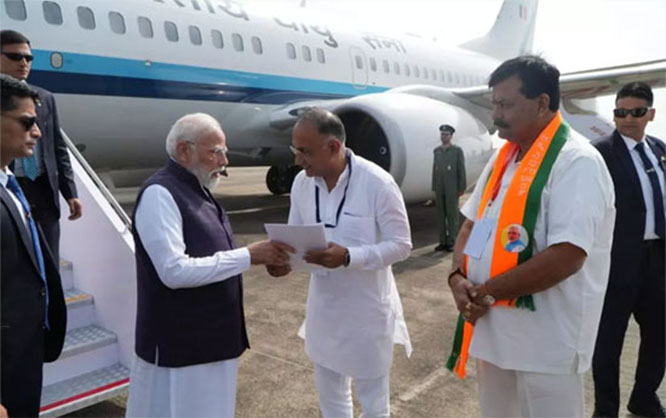
Mangaluru, Nov 28: Karnataka Health Minister and Dakshina Kannada district in-charge minister Dinesh Gundu Rao on Friday handed over Chief Minister Siddaramaiah’s letter to Prime Minister Narendra Modi, highlighting the severe distress faced by farmers due to crashing crop prices.

PM Modi arrived at the Mangaluru International Airport en route to Udupi, where Gundu Rao welcomed him and submitted the letter. The chief minister’s message stressed that farmers are suffering heavy losses because maize and green gram are being bought far below the Minimum Support Price (MSP). The state urged the Centre to immediately begin procurement at MSP.

According to the letter, Karnataka has a bumper harvest this year—over 54.74 lakh metric tons of maize and 1.98 lakh metric tons of green gram—yet farmers are unable to secure fair prices. Against the MSP of ₹2,400/MT for maize and ₹8,768/MT for green gram, market rates have plunged to ₹1,600–₹1,800 and ₹5,400 respectively.

The chief minister has requested the Centre to:

• Direct NAFED, FCI and NCCF to start MSP procurement immediately.
• Ensure ethanol units purchase maize directly from farmers or FPOs.
• Increase Karnataka’s ethanol allocation, citing high production capacity.
• Stop maize imports, which have depressed domestic prices.
• Relax quality norms for green gram, allowing up to 10% discoloration due to rains.

The letter stresses that MSP is crucial for farmer dignity and income stability and calls for swift central intervention to prevent a deepening crisis.

Comments

Add new comment

  • Coastaldigest.com reserves the right to delete or block any comments.
  • Coastaldigset.com is not responsible for its readers’ comments.
  • Comments that are abusive, incendiary or irrelevant are strictly prohibited.
  • Please use a genuine email ID and provide your name to avoid reject.