



Uniform Civil Code Bill tabled in Uttarakhand Assembly – Here’s a brief introduction

News Network
February 6, 2024

uttarakhand.jpg

The Uniform Civil Code (UCC) bill — which proposes uniform marriage, divorce, land, property and inheritance laws for all citizens irrespective of their religion in Uttarakhand — was tabled in the Assembly on February 6.

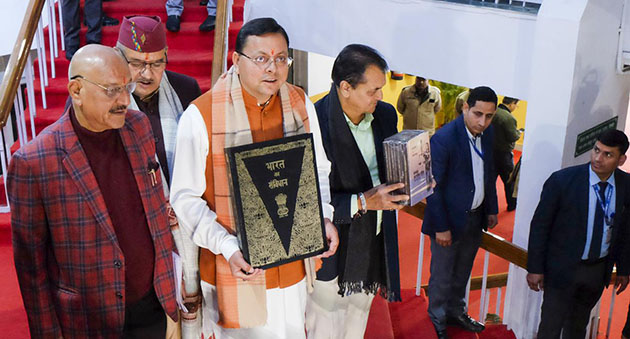
Chief Minister Pushkar Singh Dhami presented the Bill in the House. In a symbolic gesture, he entered the Assembly with an original copy of the Constitution.

Treasury benches welcomed the tabling of the Bill with thumping of desks and chants of "Jai Sri Ram" and "Vande Mataram".

The Bill will now be debated in the Assembly before being passed.

Once it becomes an Act, Uttarakhand will become the first State in the country after Independence to adopt the UCC. It has been operational in Goa since the days of Portuguese rule.

Earlier, there were protests inside the House by Opposition members who said they were not given time to study the Bill’s provisions.

"It seems the government wants to pass the Bill without a debate in violation of the legislative traditions," Leader of Opposition Yashpal Arya said.

Slogans were also raised by the Opposition members who were pacified after Speaker Ritu Khanduri assured them that they would get enough time to study the Bill.

The ongoing Assembly session was convened especially for the passage of the UCC Bill.

Passing a legislation on the UCC will fulfil a major promise made by the BJP to the people of the State in the run-up to the 2022 Assembly poll, which saw the saffron party storm to power with a landslide victory for the second consecutive term.

Several BJP-ruled States in the country, including Gujarat and Assam, have expressed their keenness to follow the Uttarakhand UCC as a model.

What is the Uniform Civil Code?

A Uniform Civil Code is conceptualised as a set of laws that govern personal matters, including marriage, divorce, adoption, inheritance, and succession, for all citizens regardless of religion. The UCC aims to replace the existing diverse personal laws that vary based on religious affiliations.

What is the Uniform Civil Code Uttarakhand 2024 Bill?

The Uttarakhand government had formed a panel - led by retired Supreme Court judge Ranjana Prakash Desai - to prepare a draft for the UCC in 2022. The panel comprising retired justice Pramod Kohli, social activist Manu Gaur, former Uttarakhand Chief Secretary Shatrughan Singh, and Vice Chancellor of Doon University, Surekha Dangwal prepared a draft report of over 740 pages and has four volumes.

To prepare the report, the panel collected lakhs of feedback, written and online, held several public forums and 43 public outreach programs, and engaged with over 60,000 people. According to CM Dhami, the UCC Bill is an outcome of public dialogue, deliberation, and suggestions.

Reportedly, the UCC Uttarakhand 2024 Bill includes recommendations such as a complete ban on polygamy and child marriage. According to a report by India Today, some of the key features of the Bill include - equal property rights for sons and daughters, elimination of the distinction between legitimate and illegitimate children, equal property rights after death, and inclusion of adopted and biological children.

Comments

Add new comment

  • Coastaldigest.com reserves the right to delete or block any comments.
  • Coastaldigset.com is not responsible for its readers’ comments.
  • Comments that are abusive, incendiary or irrelevant are strictly prohibited.
  • Please use a genuine email ID and provide your name to avoid reject.
News Network
December 13,2025

New Delhi: School-going children are picking up drug and smoking habits and engaging in consumption of alcohol, with the average age of introduction to such harmful substances found to be around 13 years, suggesting a need for earlier interventions as early as primary school, a multi-city survey by AIIMS-Delhi said.

The findings also showed substance use increased in higher grades, with grade XI/XII students two times more likely to report use of substances when compared with grade VIII students. This emphasised the importance of continued prevention and intervention through middle and high school.

The study led by Dr Anju Dhawan of AIIMS's National Drug Dependence Treatment Centre, published in the National Medical Journal of India this month, looks at adolescent substance use across diverse regions.

The survey included 5,920 students from classes 8, 9, 11 and 12 in urban government, private and rural schools across 10 cities -- Bengaluru, Chandigarh, Delhi, Dibrugarh, Hyderabad, Imphal, Jammu, Lucknow, Mumbai, and Ranchi. The data were collected between May 2018 and June 2019.

The average age of initiation for any substance was 12.9 (2.8) years. It was lowest for inhalants (11.3 years) followed by heroin (12.3 years) and opioid pharmaceuticals (without prescription; 12.5 years).

Overall, 15.1 per cent of participants reported lifetime use, 10.3 per cent reported past year use, and 7.2 per cent reported use in the past month of any substance, the study found.

The most common substances used in the past year, after tobacco (4 per cent) and alcohol (3.8 per cent), were opioids (2.8 per cent), followed by cannabis (2 per cent) and inhalants (1.9 per cent). Use of non-prescribed pharmaceutical opioids was most common among opioid users (90.2 per cent).

On being asked, 'Do you think this substance is easily available for a person of your age' separately for each substance category, nearly half the students (46.3 per cent) endorsed that tobacco products and more than one-third of the students (36.5 per cent) agreed that a person of their age can easily procure alcohol products.

Similarly, for Bhang (21.9 per cent), ganja/charas (16.1 per cent), inhalants (15.2 per cent), sedatives (13.7 per cent), opium and heroin (10 per cent each), the students endorsed that these can be easily procured.

About 95 per cent of the children, irrespective of their grade, agreed with the statement that 'drug use is harmful'.

The rates of substance use (any) among boys were significantly higher than those of girls for substance use (ever), use in the past year and use in the past 30 days. Compared to grade VIII students, grade IX students were more likely, and grade XI/XII students were twice as likely to have used any substance (ever).

The likelihood of past-year use of any substance was also higher for grade IX students and for grade XI/XII students as compared to grade VIII students.

About 40 per cent of students mentioned that they had a family member who used tobacco or alcohol each. The use of cannabis (any product) and opioid (any product) by a family member was reported by 8.2 per cent and 3.9 per cent of students, respectively, while the use of other substances, such as inhalants/sedatives by family was 2-3 per cent, the study found.

A relatively smaller percentage of students reported use of tobacco or alcohol among peers as compared to among family members, while a higher percentage reported inhalants, sedatives, cannabis or opioid use among peers.

Children using substances (past year) compared to non-users reported significantly higher any substance use by their family members and peers.

There were 25.7 per cent students who replied 'yes' to the question 'conflicts/fights often occur in your family'. Most students also replied affirmatively to 'family members are aware of how their time is being spent' and 'damily members are aware of with whom they spend their time'.

Comments

Add new comment

  • Coastaldigest.com reserves the right to delete or block any comments.
  • Coastaldigset.com is not responsible for its readers’ comments.
  • Comments that are abusive, incendiary or irrelevant are strictly prohibited.
  • Please use a genuine email ID and provide your name to avoid reject.