Indian govt flouting global laws by taxing international air tickets: IATA

Agencies
June 4, 2018

Sydney, Jun 4: The International Air Transport Association (IATA) on Monday castigated India for taxing international tickets, as it asked governments to facilitate the growth of worldwide connectivity by avoiding creeping re-regulation, maintaining the integrity of global standards and addressing a capacity crisis.

“We must take governments to task. It is unacceptable that global standards are being ignored by the very governments that created them,” IATA’s Director General and CEO Alexandre de Juniac said.

Asserting that India was taxing international tickets in contravention of the resolutions of the UN body International Civil Aviation Organisation (ICAO), de Juniac said, “India helped develop ICAO resolutions prohibiting tax on international tickets.”

“Yet it persists in taxing international travel,” he said, apparently referring to the imposition of Goods and Services Tax (GST) and enhancement of its rates on international air tickets, especially business class.

The Indian government had announced the implementation of the GST from July 1, 2017. The tax covers airline products and services including tickets, ancillary, change, refund and other products and fees.

De Juniac was presenting a report on the air transport industry at the opening session of the 74th IATA Annual General Meeting and World Air Transport Summit, which began here today.

“On aviation’s core mission to deliver safe, secure, accessible and sustainable connectivity, the state of our industry is strong and getting stronger. And with 'normal' levels of profitability we are spreading aviation’s benefits even more widely.

“But there are challenges. Smarter regulation needs to counter the trend of creeping re-regulation. Global standards must be maintained by the states that agreed (upon) them. And we need to find efficient solutions to the looming capacity crisis,” he said.

Alluding to the recent announcements by the Trump administration in the US on imposition of hefty tariffs on import of steel and other products, he warned that “the spectre of a trade war looms” which would hit the aviation industry as well, specifically in terms of cargo movements and business travel.

“The forces of protectionism are gathering strength. Sanctions, tariffs and geopolitical conflicts are the mainstay of daily news. The spectre of trade war looms. Debates on migration and immigration rage. And trust among nations is showing fragility,” the IATA chief said.

He said airlines flew over four billion passengers in 2017 while more than 60 million tonnes of cargo was delivered by air, accounting for a third of the value of goods traded globally.

“Every day, goods, people, investment and ideas are connected by aviation. That directly supports 63 million jobs and improves the quality of life for all,” de Juniac said.

However, it is “a challenging industry to operate”, he said, adding “high taxes, costly and ill-conceived regulation, infrastructure capacity constraints, market shifts and the demands of labour are the ‘normal’ repertoire.”

“Protectionism could derail successful international joint ventures. And fuel costs are expected to be up 25 per cent on 2017,” he said.

However, despite such a scenario, the aviation industry’s financial foundation has “grown stronger”, he said, projecting that the airlines would make nearly USD 40 billion this year as passenger demand is expected to grow 7 per cent and cargo by 4 per cent.

“There are challenges. We will meet them head-on. How? By building the partnerships and understanding needed to further the reach and expand the benefits of the amazing industry... I will say it proudly again, we are the business of freedom,” de Juniac said.


Comments

Add new comment

  • Coastaldigest.com reserves the right to delete or block any comments.
  • Coastaldigset.com is not responsible for its readers’ comments.
  • Comments that are abusive, incendiary or irrelevant are strictly prohibited.
  • Please use a genuine email ID and provide your name to avoid reject.
News Network
December 6,2025

pilot.jpg

New Delhi: IndiGo, India’s largest airline, faced major operational turbulence this week after failing to prepare for new pilot-fatigue regulations issued by the Directorate General of Civil Aviation (DGCA). The stricter rules—designed to improve flight safety—took effect in phases through 2024, with the latest implementation on November 1. IndiGo has acknowledged that inadequate roster planning led to widespread cancellations and delays.

Below are the key DGCA rules that affected IndiGo’s operations:

1. Longer Mandatory Weekly Rest

Weekly rest for pilots has been increased from 36 hours to 48 hours.

The government says the extended break is essential to curb cumulative fatigue. This rule remains in force despite the current crisis.

2. Cap on Night Landings

Pilots can now perform only two night landings per week—a steep reduction from the earlier limit of six.

Night hours, defined as midnight to early morning, are considered the least alert period for pilots.

Given the disruptions, this rule has been temporarily relaxed for IndiGo until February 10.

3. Reduced Maximum Night Flight Duty

Flight duty that stretches into the night is now capped at 10 hours.

This measure has also been kept on hold for IndiGo until February 10 to stabilize operations.

4. Weekly Rest Cannot Be Replaced With Personal Leave

Airlines can no longer count a pilot’s personal leave as part of the mandatory 48-hour rest.

Pilots say this closes a loophole that previously reduced actual rest time.

Currently, all airlines are exempt from this rule to normalise travel.

5. Mandatory Fatigue Monitoring

Airlines must submit quarterly fatigue reports along with corrective actions to DGCA.

This system aims to create a transparent fatigue-tracking framework across the industry.

The DGCA has stressed that these rules were crafted to strengthen flight safety and align India with global fatigue-management standards. The temporary relaxations are expected to remain until February 2025, giving IndiGo time to stabilise its schedules and restore normal air travel.

Comments

Add new comment

  • Coastaldigest.com reserves the right to delete or block any comments.
  • Coastaldigset.com is not responsible for its readers’ comments.
  • Comments that are abusive, incendiary or irrelevant are strictly prohibited.
  • Please use a genuine email ID and provide your name to avoid reject.
News Network
December 16,2025

bengal.jpg

The deletion of over 58 lakh names from West Bengal’s draft electoral rolls following a Special Intensive Revision (SIR) has sparked widespread concern and is likely to deepen political tensions in the poll-bound state.

According to the Election Commission, the revision exercise has identified 24 lakh voters as deceased, 19 lakh as relocated, 12 lakh as missing, and 1.3 lakh as duplicate entries. The draft list, published after the completion of the first phase of SIR, aims to remove errors and duplication from the electoral rolls.

However, the scale of deletions has raised fears that a large number of eligible voters may have been wrongly excluded. The Election Commission has said that individuals whose names are missing can file objections and seek corrections. The final voter list is scheduled to be published in February next year, after which the Assembly election announcement is expected. Notably, the last Special Intensive Revision in Bengal was conducted in 2002.

The development has intensified the political row over the SIR process. Chief Minister Mamata Banerjee and her Trinamool Congress have strongly opposed the exercise, accusing the Centre and the Election Commission of attempting to disenfranchise lakhs of voters ahead of the elections.

Addressing a rally in Krishnanagar earlier this month, Banerjee urged people to protest if their names were removed from the voter list, alleging intimidation during elections and warning of serious consequences if voting rights were taken away.

The BJP, meanwhile, has defended the revision and accused the Trinamool Congress of politicising the issue to protect what it claims is an illegal voter base. Leader of the Opposition Suvendu Adhikari alleged that the ruling party fears losing power due to the removal of deceased, fake, and illegal voters.

The controversy comes amid earlier allegations by the Trinamool Congress that excessive work pressure during the SIR led to the deaths by suicide of some Booth Level Officers (BLOs), for which the party blamed the Election Commission. With the draft list now out, another round of political confrontation appears imminent.

As objections begin to be filed, the focus will be on whether the correction mechanism is accessible, transparent, and timely—critical factors in ensuring that no eligible voter is denied their democratic right ahead of a crucial election.

Comments

Add new comment

  • Coastaldigest.com reserves the right to delete or block any comments.
  • Coastaldigset.com is not responsible for its readers’ comments.
  • Comments that are abusive, incendiary or irrelevant are strictly prohibited.
  • Please use a genuine email ID and provide your name to avoid reject.
News Network
December 7,2025

envoy.jpg

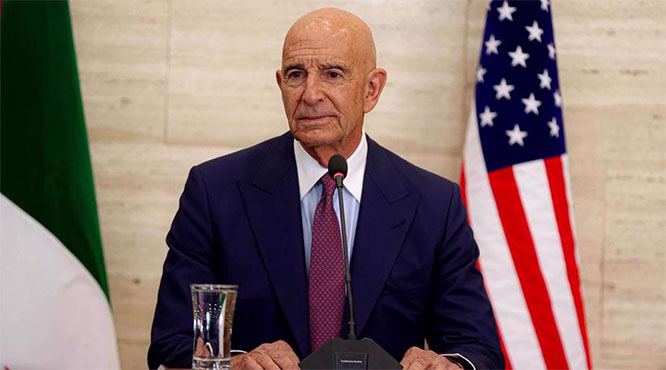
Since 1946, the United States has attempted 93 coups or “regime change” operations across the world — including two in Iran, US Special Envoy for Syria Tom Barrack has admitted.

Speaking to the UAE-based IMI Media Group, in remarks published by The National, Barrack said Washington tried twice to overthrow the Iranian government but failed both times. 

“For (Trump) then to be imputed with regime change — we had two regime changes in Iran already. Neither one worked. So I think wisely leave it to the region to solve,” said Barrack, who also serves as the US ambassador to Turkey.

His comments come six months after the US joined Israel in airstrikes against Iran during ongoing indirect nuclear negotiations between Tehran and Washington.

On June 13, Israel launched an attack on Iran that killed at least 1,064 people and hit civilian infrastructure. Days later, the United States targeted three nuclear facilities — Fordow, Natanz and Isfahan — in what Iran called a clear violation of international law. Iranian retaliation eventually forced a halt to the assault on June 24.

Barrack further claimed that US President Donald Trump and Foreign Secretary Marco Rubio are “not into regime change” and prefer a regional approach driven by Middle Eastern countries themselves. According to him, regional dialogue and non-interference by outside powers offer a more durable path forward.

He added that Washington is still open to an agreement with Tehran if Iranian authorities show “seriousness” and willingness to engage constructively.

However, Iran maintains the US has not shown readiness for meaningful talks. In an interview with Japan’s Kyodo News, Iranian Foreign Minister Abbas Araghchi said negotiations could advance only if Washington acknowledges Iran’s right to peaceful nuclear energy and lifts unilateral sanctions.

Comments

Add new comment

  • Coastaldigest.com reserves the right to delete or block any comments.
  • Coastaldigset.com is not responsible for its readers’ comments.
  • Comments that are abusive, incendiary or irrelevant are strictly prohibited.
  • Please use a genuine email ID and provide your name to avoid reject.