



Israeli forces kill four Palestinians amid border protests

Agencies
March 31, 2019

Five rockets were launched from the Gaza Strip into Israel, prompting Israeli tanks to respond by firing on Hamas military posts early on Sunday, hours after a massive Palestinian protest along the border between Israel and Gaza.

The rocket attack and Israeli response did not cause any casualties, according to the Israeli army and witnesses in Gaza.

The Israeli tanks fired at Hamas posts in the central Gaza Strip and east of Gaza City, witnesses said.

Tens of thousands of Gazans earlier gathered at the Israeli border to mark a year since protests and clashes erupted there, but fears of mass bloodshed were averted after late Egyptian-led negotiations.

Four Palestinians were killed by Israeli fire, one during a demonstration ahead of the main rally and three 17-year-olds in clashes later Saturday, the health ministry in Gaza City said. Another 316 Gazans were wounded.

But fears of a repeat of similar protests and clashes to those that saw more than 60 Palestinians killed on May 14, when the United States transferred its Israel embassy to Jerusalem, did not materialise.

Israel deployed several thousand troops along the border, with the anniversary coming at a sensitive time ahead of its April 9 elections.

Egypt tried to mediate between Israel and Gaza's Islamist rulers Hamas to rein in violence.

Hamas officials say an understanding was reached that would see Israel ease its crippling blockade of Gaza in exchange for the protests remaining calm.

Tens of thousands gathered at five protest points along the frontier but the vast majority stayed away from the border fence.

East of Gaza City, small groups of young men approached the fence and sought to break it multiple times but were forced back by Israeli tear gas and live fire.

The protesters threw stones at the Israeli soldiers.

An Egyptian security delegation visited the protest site east of Gaza City, as did Hamas leaders Ismail Haniya and Yahya Sinwar.

Israel's army said around 40,000 "rioters and demonstrators" had gathered in spots throughout the border.

It said grenades and explosive devices were hurled at troops, who responded "in accordance with standard operating procedures".
Protesters were marking the first anniversary of often violent weekly demonstrations in which around 200 Palestinians and an Israeli soldier have been killed.

At least 50 Palestinian children have been killed in Gaza since the protests began, charity Save the Children said.
In the run-up to the anniversary, long-time mediator Egypt had shuttled back and forth in a bid to avoid major bloodshed.

Senior Hamas official Bassem Naim called Saturday's protest "a very important message" that thousands had gathered "peacefully to raise their voice against aggression and the imposed siege on Gaza".

He confirmed that Egypt had made progress towards a deal that media reports said would see Israel allow more Qatari aid into the strip and ease some restrictions.

In exchange Hamas would maintain calm at the border protests.

Khalil al-Hayya, another senior figure in the Islamist movement, said they were expecting to receive a timetable from Israel on Sunday. There was no Israeli comment on the alleged agreement.

Israel goes to the polls in a keenly contested general election on April 9 in which Prime Minister Benjamin Netanyahu faces a stiff challenge from centrist former military chief Benny Gantz.

He is widely seen as wanting to avoid a major escalation, but has faced accusations of being soft on Hamas, including from former defence minister Avigdor Lieberman, who resigned in November the day after an Egyptian-brokered ceasefire was agreed.

The anniversary came only days after another severe flare-up between Israel and Hamas, sparked by a rare long-range rocket strike from Gaza that struck north of Tel Aviv. An Egyptian-brokered ceasefire restored calm.

The demonstrators are calling for Palestinians to be allowed to return to land their families fled or were expelled from during the 1948 war that accompanied Israel's creation.

Israel says any such mass return would spell the end of a Jewish state and that its actions have been necessary to defend the border.

It accuses Hamas of orchestrating violence, but its soldiers' use of live fire has come under heavy criticism.

In February a United Nations probe said Israeli soldiers had intentionally fired on civilians in what could constitute war crimes.

Two million Palestinians live in impoverished Gaza, crammed between Israel, Egypt and the Mediterranean.

Analysts highlight desperate living conditions and lack of freedom of movement as driving forces behind the protests.

Israel, which has fought three wars with Hamas, has blockaded the enclave for more than a decade, and Egypt often closes Gaza's only other gateway to the outside world.

Hamas is considered a terrorist group by the United States, European Union and others.

Many protesters over the past year have remained far back from the fence and demonstrated peacefully, but others have approached in numbers and clashed with soldiers.

Small groups have attached incendiary devices to balloons to float them over the border in an attempt to set fire to nearby Israeli homes and farmland.

Comments

Add new comment

  • Coastaldigest.com reserves the right to delete or block any comments.
  • Coastaldigset.com is not responsible for its readers’ comments.
  • Comments that are abusive, incendiary or irrelevant are strictly prohibited.
  • Please use a genuine email ID and provide your name to avoid reject.
News Network
January 23,2026

Karnataka Governor Thaawarchand Gehlot read only three lines from the 122-paragraph address prepared by the Congress-led state government while addressing the joint session of the Legislature on Thursday, effectively bypassing large sections critical of the BJP-led Union government.

The omitted portions of the customary Governor’s address outlined what the state government described as a “suppressive situation in economic and policy matters” under India’s federal framework. The speech also sharply criticised the Centre’s move to replace the Mahatma Gandhi National Rural Employment Guarantee Act (MGNREGA) with the Viksit Bharat–Guarantee for Rozgar and Ajeevika Mission (Gramin) Act, commonly referred to as the VB-GRAM (G) Act.

Governor Gehlot had earlier conveyed his objection to several paragraphs that were explicitly critical of the Union government. On Thursday, he confined himself to the opening lines — “I extend a warm welcome to all of you to the joint session of the State legislature. I am extremely pleased to address this august House” — before jumping directly to the concluding sentence of the final paragraph.

He ended the address by reading the last line of paragraph 122: “Overall, my government is firmly committed to doubling the pace of the State’s economic, social and physical development. Jai Hind — Jai Karnataka.”

According to the prepared speech, the Karnataka government demanded the scrapping of the VB-GRAM (G) Act, describing it as “contractor-centric” and detrimental to rural livelihoods, and called for the full restoration of MGNREGA. The state government argued that the new law undermines decentralisation, weakens labour protections, and centralises decision-making in violation of constitutional norms.

Key points from the unread sections of the speech:

•    Karnataka facing a “suppressive” economic and policy environment within the federal system

•    Repeal of MGNREGA described as a blow to rural livelihoods

•    VB-GRAM (G) Act accused of protecting corporate and contractor interests

•    New law alleged to weaken decentralised governance

•    Decision-making said to be imposed by the Centre without consulting states

•    Rights of Adivasis, women, backward classes and agrarian communities curtailed

•    Labourers allegedly placed under contractor control

•    States facing mounting fiscal stress due to central policies

•    VB-GRAM (G) Act accused of enabling large-scale corruption

Comments

Add new comment

  • Coastaldigest.com reserves the right to delete or block any comments.
  • Coastaldigset.com is not responsible for its readers’ comments.
  • Comments that are abusive, incendiary or irrelevant are strictly prohibited.
  • Please use a genuine email ID and provide your name to avoid reject.
News Network
January 19,2026

trump.jpg

Donald Trump has linked his repeated threats to seize Greenland to his failure to win the Nobel Peace Prize, in a letter to Norwegian Prime Minister Jonas Gahr Støre.

The authenticity of the letter, in which Trump says he no longer feels obligated to “think purely of peace,” was confirmed by Støre to the Norwegian newspaper VG.

“Considering your country decided not to give me the Nobel Peace Prize for having stopped eight wars plus, I no longer feel an obligation to think purely of peace,” Trump wrote, adding he can now “think about what is good and proper for the United States.”

Støre said Trump’s letter was in response to a short message he had sent earlier, on behalf of himself and Finland’s President Alexander Stubb.

Trump has escalated rhetoric toward Greenland, a self-governing Danish territory, insisting the US will take control “one way or the other.” Over the weekend, he tweeted: “Now it is time, and it will be done!!!”

On Saturday, Trump threatened a 10% tariff on imports from Denmark, Norway, Sweden, France, Germany, the UK, the Netherlands, and Finland from 1 February until the US is allowed to purchase the island. EU diplomats met for emergency talks on possible retaliatory tariffs and sanctions.

In his letter, Trump argued Denmark “cannot protect” Greenland from Russia or China, questioning Danish ownership: “There are no written documents; it’s only that a boat landed there hundreds of years ago.” He added that NATO should support the US, claiming the world is “not secure unless we have complete and total control of Greenland.”

Trump’s stance has unsettled the EU and NATO, as he refused to rule out military action to take control of the mineral-rich island.

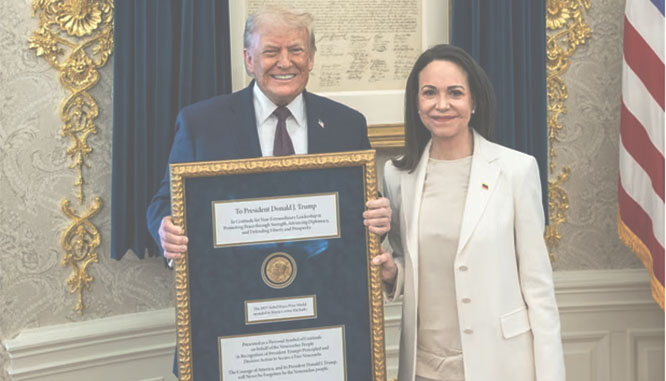
The Nobel Peace Prize is awarded by the independent Norwegian Nobel Committee, not the government. Trump had campaigned for last year’s prize, which went to Venezuelan opposition leader María Corina Machado, who dedicated her award to him.

Støre reiterated that the Nobel Prize decision rests solely with the committee.

Comments

Add new comment

  • Coastaldigest.com reserves the right to delete or block any comments.
  • Coastaldigset.com is not responsible for its readers’ comments.
  • Comments that are abusive, incendiary or irrelevant are strictly prohibited.
  • Please use a genuine email ID and provide your name to avoid reject.
News Network
January 20,2026

Mangaluru: In a major step towards strengthening rural innovation, the Office of the Principal Scientific Adviser (PSA) to the Government of India is supporting the establishment of RuTAGe Smart Village Centres (RSVCs) across the country through collaborations with academic institutions, civil society organisations and philanthropic partners.

As part of this national initiative, Nitte (Deemed to be University) will set up the first RSVCs in the region at Nitte GP in Udupi district and at the Nitte Health Centre, Sevanjali Trust, Farangipete, in Dakshina Kannada district. The centres will be inaugurated on January 21. In South India, the programme is being implemented by the Section Infin-8 Foundation (SI-8).

Speaking to reporters on Monday, SI-8 founder-director Vishwas US said experts from Nitte University and SI-8 would work closely with farmers, students, youth and local entrepreneurs to adapt and deploy technologies tailored to local needs.

Project head Prof Iddya Karunasagar, representing Nitte DU, said the RSVCs at Nitte and Farangipete would serve as demonstration hubs for a wide range of agriculture, energy, skill-development and assistive technologies. These include solar dryers for fruits, vegetables and crops; soil-testing solutions; power weeders and women-friendly farm tools; wind-powered devices for rural artisans; grain storage systems; grass-cutting and tree-climbing equipment; and liquid fertiliser production using cowshed waste.

SI-8 CEO Aravind C Kumar said the centres would also provide access to digital and knowledge-based platforms such as ISRO applications, government scheme portals, market linkage tools and gamified learning resources, along with assistive technologies for persons with visual impairments.

Highlighting the broader impact of the initiative, Principal Scientific Adviser Prof Ajay Kumar Sood said it demonstrated how applied research could bridge the rural–urban divide and help create self-reliant, technology-enabled villages.

The initiative has been made possible through philanthropic support from Dr NC Murthy of ACM Business Solutions, LLC, USA. Dr Sapna Poti, Director (Strategic Alliances) at the Office of the Principal Scientific Adviser, said the long-term objective is to build self-sufficient, technology-driven communities capable of generating sustainable livelihoods on their own.

Comments

Add new comment

  • Coastaldigest.com reserves the right to delete or block any comments.
  • Coastaldigset.com is not responsible for its readers’ comments.
  • Comments that are abusive, incendiary or irrelevant are strictly prohibited.
  • Please use a genuine email ID and provide your name to avoid reject.