



Jammu and Kashmir: A year after floods, victims still wait for rehabilitation

September 7, 2015

Srinagar, Sep 7: A year after floods devastated parts of Kashmir, the victims of the natural calamity feel that governments at the Centre and in the state have done "precious little" for rehabilitating them.
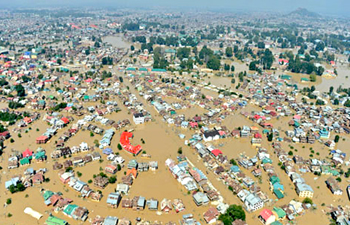
floods
"We are talking one year down the line and all we have got peanuts in the name of relief and rehabilitation," 75-year-old Ghulam Mohammad Bhat said.

Bhat's three-storey house in Jawahar Nagar area of the city collapsed in the flood that struck Kashmir and some parts of Jammu in the first week of September last year. He and his family were lucky to leave their home minutes before the tragedy struck.

"We saw our house collapse in front of our eyes as we took refuge in the third storey of neighbour's house.

Everything was gone and we managed to just escape with our lives only," Bhat's wife, Nabla Begum, said.

The elderly couple are still putting up with their relatives in uptown Rawalpora locality as the Rs 78,800 given to them by the government as compensation was not even enough to get the debris of their collapsed house cleared.

"We were expecting large hearted approach from the Centre for rehabilitating the flood victims but even after one year, they have not taken a decision on the relief package for the state," Bhat said.

Some of the victims have also alleged malpractices by the lower ranking staff of the Revenue Department, who prepared the loss assessment report following the floods last year.

They alleged that bribes and close connections with politicians ensure that some people got the first instalment of relief more than once.

"There is one case in our locality where a man had got Rs 50,000 compensation four times in four different bank accounts using different variations of his name," Ali Mohammad, a resident of Natipora, said.

Showing the documents of Revenue Department, Ali Mohammad pointed out that one Mohammad Amin Bhat's name also figured as 'Mohd Amin', 'M A Bhat' and 'Mohammad Amin' in the list of beneficiaries in Natipora.

"We don't have so many Mohammad Amins in our locality. Someone needs to look into it," he said.

In Old Barzulla locality, which was unaffected by the floods, the Revenue authorities on the basis of recommendations made by political workers have allegedly dished out relief cheques to hundreds of house owners.

"Many people have returned the cheques but most have encashed the instruments. How does that happen when genuine victims are running from pillar to post for some help to reconstruct their homes," Mohammad Irfan a local resident said.

There are some victims who are running from pillar to post for lack of proper documentation.

"My house was destroyed in the deluge but I was denied even the Rs 75,000 compensation as the property was still in the name of my father. Being the only son, I thought it not necessary to transfer the property in my name and now I am paying for it," A M Bhat, a resident of Wazir Bagh said.

Bhat said he made several representations to authorities including Deputy Commissioner Srinagar for considering his case for compensation.

"First I was told to get an affidavit from the court in support of my claim for compensation. After that I was told to get a recommendation letter from Masjid Committee or Mohalla Welfare Committee ... I got it from both. After that Patwari concerned came for on-ground verification but no decision has been taken yet," he added.

The traders' bodies of the Valley maintain that they were not able to comprehend the policy pursued by the governments with regard to rehabilitation of flood victims, which includes the business community.

"We left no stone unturned to represent the case of victims but now we are disheartened. (Union) Finance Minister Arun Jaitley during a meeting in Delhi assured us that a package will be announced in a short span of time. Is one year not enough time?" president of Kashmir Chamber of Commerce and Industry (KCCI) Sheikh Ashiq said.

Ashiq said there is a need to infuse a new life in the economy of Jammu and Kashmir by giving a comprehensive reconstruction and development package.

"We are apprehensive that the state economy might collapse in the couple of years to come. Business community may not be able to repay loans and general public, most of whom are flood victims, do not have the spending capacity now," he said.

Ashiq said while development package as promised by the Centre was welcome, a Bihar-like package will not work in Jammu and Kashmir.

"When people do not have roof over heads and businesses have no capital to resume their activities, what are railway lines, roads and other infrastructure going to do for the economy?" he asked.

Ashiq said relief and rehabilitation should be a major component of any development package that the Centre might be planning for the state. "We hope there is one".

Deputy Chief Minister Nirmal Singh had said yesterday that a big financial package will soon be sanctioned to the state for the rehabilitation of the affected people.

"Centre had given some money which we distributed. A big package will be announced soon. You know the government has to go into the details as to where the money will be spent (but) it will come soon," Singh said.

He said the financial package would be bigger than the Rs 44,000 crore package proposed by the previous government.

As the state government is planning to mark September 7 as the revival day, traders, separatists and opposition National Conference have called for a strike tomorrow to protest against the alleged failure of the government to rehabilitate victims.


Comments

Add new comment

  • Coastaldigest.com reserves the right to delete or block any comments.
  • Coastaldigset.com is not responsible for its readers’ comments.
  • Comments that are abusive, incendiary or irrelevant are strictly prohibited.
  • Please use a genuine email ID and provide your name to avoid reject.
News Network
December 16,2025

bengal.jpg

The deletion of over 58 lakh names from West Bengal’s draft electoral rolls following a Special Intensive Revision (SIR) has sparked widespread concern and is likely to deepen political tensions in the poll-bound state.

According to the Election Commission, the revision exercise has identified 24 lakh voters as deceased, 19 lakh as relocated, 12 lakh as missing, and 1.3 lakh as duplicate entries. The draft list, published after the completion of the first phase of SIR, aims to remove errors and duplication from the electoral rolls.

However, the scale of deletions has raised fears that a large number of eligible voters may have been wrongly excluded. The Election Commission has said that individuals whose names are missing can file objections and seek corrections. The final voter list is scheduled to be published in February next year, after which the Assembly election announcement is expected. Notably, the last Special Intensive Revision in Bengal was conducted in 2002.

The development has intensified the political row over the SIR process. Chief Minister Mamata Banerjee and her Trinamool Congress have strongly opposed the exercise, accusing the Centre and the Election Commission of attempting to disenfranchise lakhs of voters ahead of the elections.

Addressing a rally in Krishnanagar earlier this month, Banerjee urged people to protest if their names were removed from the voter list, alleging intimidation during elections and warning of serious consequences if voting rights were taken away.

The BJP, meanwhile, has defended the revision and accused the Trinamool Congress of politicising the issue to protect what it claims is an illegal voter base. Leader of the Opposition Suvendu Adhikari alleged that the ruling party fears losing power due to the removal of deceased, fake, and illegal voters.

The controversy comes amid earlier allegations by the Trinamool Congress that excessive work pressure during the SIR led to the deaths by suicide of some Booth Level Officers (BLOs), for which the party blamed the Election Commission. With the draft list now out, another round of political confrontation appears imminent.

As objections begin to be filed, the focus will be on whether the correction mechanism is accessible, transparent, and timely—critical factors in ensuring that no eligible voter is denied their democratic right ahead of a crucial election.

Comments

Add new comment

  • Coastaldigest.com reserves the right to delete or block any comments.
  • Coastaldigset.com is not responsible for its readers’ comments.
  • Comments that are abusive, incendiary or irrelevant are strictly prohibited.
  • Please use a genuine email ID and provide your name to avoid reject.
News Network
December 16,2025

jordan.jpg

Prime Minister Narendra Modi on Monday held talks with Jordan’s King Abdullah II in Amman, during which the two leaders discussed ways to further strengthen bilateral relations, with the Prime Minister outlining an eight-point vision covering key areas of cooperation.

Describing the meeting as “productive”, PM Modi said he shared a roadmap focused on trade and economy, fertilisers and agriculture, information technology, healthcare, infrastructure, critical and strategic minerals, civil nuclear cooperation, and people-to-people ties.

In a post on social media platform X, the Prime Minister praised King Abdullah II’s personal commitment to advancing India–Jordan relations, particularly as both countries mark the 75th anniversary of the establishment of diplomatic ties this year.

“Held productive discussions with His Majesty King Abdullah II in Amman. His personal commitment towards vibrant India-Jordan relations is noteworthy. This year, we are celebrating the 75th anniversary of our bilateral diplomatic relations,” PM Modi said.

The meeting took place at the Al Husseiniya Palace, where the two leaders also exchanged views on regional and global issues of mutual interest. According to the Ministry of External Affairs (MEA), both sides agreed to further deepen cooperation in areas including trade and investment, defence and security, counter-terrorism and de-radicalisation, fertilisers and agriculture, infrastructure, renewable energy, tourism, and heritage.

The MEA said both leaders reaffirmed their united stand against terrorism.

PM Modi arrived in Amman earlier on Monday and was received by Jordanian Prime Minister Jafar Hassan, who accorded him a formal welcome. Following the talks, King Abdullah II hosted a banquet dinner in honour of the Prime Minister, reflecting the warmth of bilateral ties.

Jordan is the first leg of PM Modi’s three-nation tour. From Amman, the Prime Minister will travel to Ethiopia at the invitation of Prime Minister Abiy Ahmed Ali, marking his first official visit to the African nation. The tour will conclude with a visit to Oman.

Comments

Add new comment

  • Coastaldigest.com reserves the right to delete or block any comments.
  • Coastaldigset.com is not responsible for its readers’ comments.
  • Comments that are abusive, incendiary or irrelevant are strictly prohibited.
  • Please use a genuine email ID and provide your name to avoid reject.
News Network
December 13,2025

New Delhi: School-going children are picking up drug and smoking habits and engaging in consumption of alcohol, with the average age of introduction to such harmful substances found to be around 13 years, suggesting a need for earlier interventions as early as primary school, a multi-city survey by AIIMS-Delhi said.

The findings also showed substance use increased in higher grades, with grade XI/XII students two times more likely to report use of substances when compared with grade VIII students. This emphasised the importance of continued prevention and intervention through middle and high school.

The study led by Dr Anju Dhawan of AIIMS's National Drug Dependence Treatment Centre, published in the National Medical Journal of India this month, looks at adolescent substance use across diverse regions.

The survey included 5,920 students from classes 8, 9, 11 and 12 in urban government, private and rural schools across 10 cities -- Bengaluru, Chandigarh, Delhi, Dibrugarh, Hyderabad, Imphal, Jammu, Lucknow, Mumbai, and Ranchi. The data were collected between May 2018 and June 2019.

The average age of initiation for any substance was 12.9 (2.8) years. It was lowest for inhalants (11.3 years) followed by heroin (12.3 years) and opioid pharmaceuticals (without prescription; 12.5 years).

Overall, 15.1 per cent of participants reported lifetime use, 10.3 per cent reported past year use, and 7.2 per cent reported use in the past month of any substance, the study found.

The most common substances used in the past year, after tobacco (4 per cent) and alcohol (3.8 per cent), were opioids (2.8 per cent), followed by cannabis (2 per cent) and inhalants (1.9 per cent). Use of non-prescribed pharmaceutical opioids was most common among opioid users (90.2 per cent).

On being asked, 'Do you think this substance is easily available for a person of your age' separately for each substance category, nearly half the students (46.3 per cent) endorsed that tobacco products and more than one-third of the students (36.5 per cent) agreed that a person of their age can easily procure alcohol products.

Similarly, for Bhang (21.9 per cent), ganja/charas (16.1 per cent), inhalants (15.2 per cent), sedatives (13.7 per cent), opium and heroin (10 per cent each), the students endorsed that these can be easily procured.

About 95 per cent of the children, irrespective of their grade, agreed with the statement that 'drug use is harmful'.

The rates of substance use (any) among boys were significantly higher than those of girls for substance use (ever), use in the past year and use in the past 30 days. Compared to grade VIII students, grade IX students were more likely, and grade XI/XII students were twice as likely to have used any substance (ever).

The likelihood of past-year use of any substance was also higher for grade IX students and for grade XI/XII students as compared to grade VIII students.

About 40 per cent of students mentioned that they had a family member who used tobacco or alcohol each. The use of cannabis (any product) and opioid (any product) by a family member was reported by 8.2 per cent and 3.9 per cent of students, respectively, while the use of other substances, such as inhalants/sedatives by family was 2-3 per cent, the study found.

A relatively smaller percentage of students reported use of tobacco or alcohol among peers as compared to among family members, while a higher percentage reported inhalants, sedatives, cannabis or opioid use among peers.

Children using substances (past year) compared to non-users reported significantly higher any substance use by their family members and peers.

There were 25.7 per cent students who replied 'yes' to the question 'conflicts/fights often occur in your family'. Most students also replied affirmatively to 'family members are aware of how their time is being spent' and 'damily members are aware of with whom they spend their time'.

Comments

Add new comment

  • Coastaldigest.com reserves the right to delete or block any comments.
  • Coastaldigset.com is not responsible for its readers’ comments.
  • Comments that are abusive, incendiary or irrelevant are strictly prohibited.
  • Please use a genuine email ID and provide your name to avoid reject.
