



Johnson & Johnson Knew For Decades That Its Baby Powder Had Cancer-causing Asbestos: Report

Agencies
December 15, 2018

Dec 15: Shares of Johnson & Johnson fell 10 percent on Friday and were on track to post their biggest percentage drop in more than 16 years, after Reuters reported that the pharma major knew for decades that cancer-causing asbestos lurked in its Baby Powder.

The decline in shares erased about $40 billion from the company's market capitalisation, with investors worrying about the impact of the report as it faces thousands of talc-related lawsuits.

The stock was the biggest drag on the broader Dow Jones Industrial Average DJI and S&P 500 SPX indexes and was among the most traded on U.S. exchanges. About 28 million shares exchanged hands by 1830 GMT, more than three times its 25-day moving average.

J&J was found to have known about the presence of small amounts of asbestos in its products from as early as 1971, a Reuters examination of company memos, internal reports and other confidential documents showed.

The report also said the company had commissioned and paid for studies conducted on its Baby Powder franchise and hired a ghostwriter to redraft the article that presented the findings in a journal.

In response to the report, the company said "any suggestion that Johnson & Johnson knew or hid information about the safety of talc is false."

"This is all a calculated attempt to distract from the fact that thousands of independent tests prove our talc does not contain asbestos or cause cancer," Ernie Knewitz, J&J's vice president of global media relations, wrote in an emailed response to the report.

The company also said Baby Powder was asbestos-free and added it would continue to defend the safety of its product.

At least two Wall Street analysts said the stock appeared to be oversold on the news.

"In our opinion litigation overhangs are real, and we do not minimize the situation, but the stock pull back does seem over done to us," BMO Capital Markets analyst Joanne Wuensch said.

J&J, in 1976, had assured the U.S. Food and Drug Administration that no asbestos was "detected in any sample" of talc produced between December 1972 and October 1973 when at least three tests by three different labs from 1972 to 1975 had found asbestos in its talc.

The company has been battling more than 10,000 cases claiming its Baby Powder and Shower to Shower products cause ovarian cancer. The products have also been linked with mesothelioma, a rare and deadly form of cancer that affects the delicate tissue that lines body cavities.

"We believe it is highly unlikely the company's exposure to this talc issue will even come close to the $40 billion in lost market cap today," J.P. Morgan analysts said.

They added that talc was not an issue that would resolve quickly for J&J and expect shares to trade at a lower multiple pending further clarity on the company’s exposure to the issue.

While J&J has dominated the talc powder market for more than 100 years, the products contributed to a mere 0.5 percent of its revenue of $76.5 billion last year. Talc cases make up fewer than 10 percent of all personal injury lawsuits pending against the company.

However, Baby Powder is considered essential to J&J's image as a caring company – a "sacred cow," as one 2003 internal email put it.

CFRA Research analyst Colin Sarcola said, "We see today's news potentially impacting sales of everything from baby shampoo to prosthetic hips."

"Given these elevated risks, we no longer feel JNJ shares are attractive at recent prices," Sarcola added.

Shares were last down 8 percent at $135.85, also pulling down the broader S&P 500 healthcare index.

Comments

Add new comment

  • Coastaldigest.com reserves the right to delete or block any comments.
  • Coastaldigset.com is not responsible for its readers’ comments.
  • Comments that are abusive, incendiary or irrelevant are strictly prohibited.
  • Please use a genuine email ID and provide your name to avoid reject.
News Network
November 27,2025

siddDKS.jpg

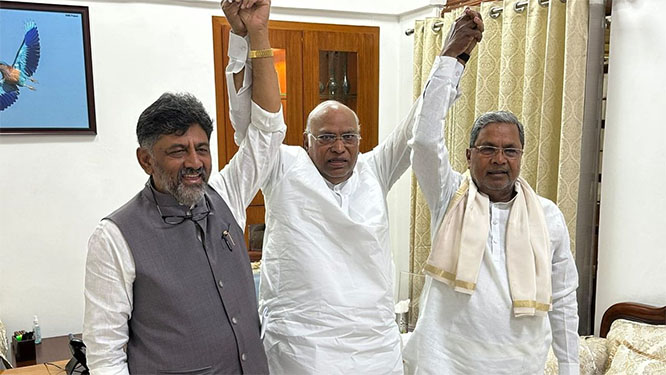
Congress president Mallikarjun Kharge on Thursday announced that he will convene a high-level meeting in New Delhi with senior leaders — including Rahul Gandhi, Karnataka Chief Minister Siddaramaiah and Deputy Chief Minister D.K. Shivakumar — to resolve the escalating leadership turmoil in Karnataka and “put an end to the confusion.”

Kharge said the discussions would focus on the way forward for the ruling party, as rumours of a possible leadership change continue to swirl. The speculation has intensified after the Congress government crossed the halfway mark of its five-year term on November 20, reviving talk of an alleged 2023 “power-sharing agreement” between Siddaramaiah and Shivakumar.

“After reaching Delhi, I will call three or four important leaders and hold discussions. Once we talk, we will decide how to move ahead and end this confusion,” Kharge told reporters in Bengaluru, according to PTI.

When asked specifically about calling Siddaramaiah and Shivakumar to Delhi, he responded: “Certainly, we should call them. We will discuss with them and settle the issue.”

He confirmed that Rahul Gandhi, the Chief Minister, the Deputy Chief Minister and other senior members would be part of the deliberations. “After discussing with everyone, a decision will be made,” he said.

Meanwhile, Siddaramaiah held a separate strategy meeting at his Bengaluru residence with ministers and leaders seen as his close confidants, including G. Parameshwara, Satish Jarkiholi, H.C. Mahadevappa, K. Venkatesh and K.N. Rajanna.
Signalling calm, the Chief Minister told reporters, “Will go to Delhi if the high command calls.”

Shivakumar echoed a similar stance, saying he too would head to the national capital if summoned by the party leadership.

Comments

Add new comment

  • Coastaldigest.com reserves the right to delete or block any comments.
  • Coastaldigset.com is not responsible for its readers’ comments.
  • Comments that are abusive, incendiary or irrelevant are strictly prohibited.
  • Please use a genuine email ID and provide your name to avoid reject.
News Network
December 4,2025

Udupi: A 40-year-old NRI from Udupi has reportedly lost more than Rs 12.25 lakh in an online investment scam operated through Telegram.

According to a complaint filed at the CEN police station, Leo Jerome Mendonsa, who has been working in Dubai for the past 15 years in computer accessories sales, maintains NRI accounts in Karkala and Nitte.

On November 12, 2025, Mendonsa was added to a Telegram group called Instaflow Earnings by unknown individuals. Users identified as Priya and Dipannita persuaded him to invest in “Revenue Tasks.” Initially, Mendonsa transferred Rs 1,100 multiple times and received the promised returns, encouraging him to continue.

On November 14, another user, Nishmitha Shetty, directed him to register on a website, digitvisionuoce.cc, and invest Rs 4 lakh in various shares. Over the next few days, he made multiple transfers totaling Rs 12,25,000, including Rs 50,000 via Google Pay, believing the scheme was legitimate.

After receiving the money, the alleged handlers stopped responding, and neither the invested amount nor the promised profits were returned.

The CEN police have registered a case under Sections 66(C) and 66(D) of the IT Act and Section 318(4) of the Bharatiya Nyaya Sanhita (BNS), and investigations are ongoing.

Comments

Add new comment

  • Coastaldigest.com reserves the right to delete or block any comments.
  • Coastaldigset.com is not responsible for its readers’ comments.
  • Comments that are abusive, incendiary or irrelevant are strictly prohibited.
  • Please use a genuine email ID and provide your name to avoid reject.
News Network
December 6,2025

pilot.jpg

New Delhi: IndiGo, India’s largest airline, faced major operational turbulence this week after failing to prepare for new pilot-fatigue regulations issued by the Directorate General of Civil Aviation (DGCA). The stricter rules—designed to improve flight safety—took effect in phases through 2024, with the latest implementation on November 1. IndiGo has acknowledged that inadequate roster planning led to widespread cancellations and delays.

Below are the key DGCA rules that affected IndiGo’s operations:

1. Longer Mandatory Weekly Rest

Weekly rest for pilots has been increased from 36 hours to 48 hours.

The government says the extended break is essential to curb cumulative fatigue. This rule remains in force despite the current crisis.

2. Cap on Night Landings

Pilots can now perform only two night landings per week—a steep reduction from the earlier limit of six.

Night hours, defined as midnight to early morning, are considered the least alert period for pilots.

Given the disruptions, this rule has been temporarily relaxed for IndiGo until February 10.

3. Reduced Maximum Night Flight Duty

Flight duty that stretches into the night is now capped at 10 hours.

This measure has also been kept on hold for IndiGo until February 10 to stabilize operations.

4. Weekly Rest Cannot Be Replaced With Personal Leave

Airlines can no longer count a pilot’s personal leave as part of the mandatory 48-hour rest.

Pilots say this closes a loophole that previously reduced actual rest time.

Currently, all airlines are exempt from this rule to normalise travel.

5. Mandatory Fatigue Monitoring

Airlines must submit quarterly fatigue reports along with corrective actions to DGCA.

This system aims to create a transparent fatigue-tracking framework across the industry.

The DGCA has stressed that these rules were crafted to strengthen flight safety and align India with global fatigue-management standards. The temporary relaxations are expected to remain until February 2025, giving IndiGo time to stabilise its schedules and restore normal air travel.

Comments

Add new comment

  • Coastaldigest.com reserves the right to delete or block any comments.
  • Coastaldigset.com is not responsible for its readers’ comments.
  • Comments that are abusive, incendiary or irrelevant are strictly prohibited.
  • Please use a genuine email ID and provide your name to avoid reject.
