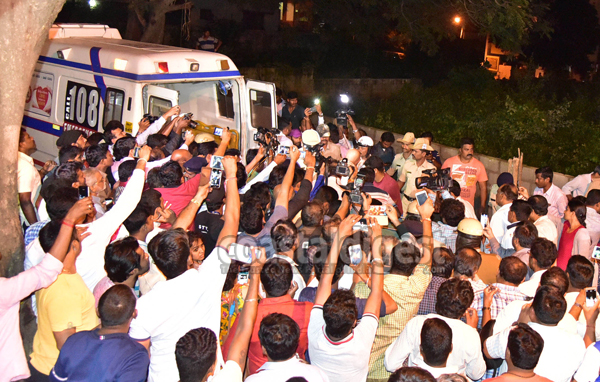
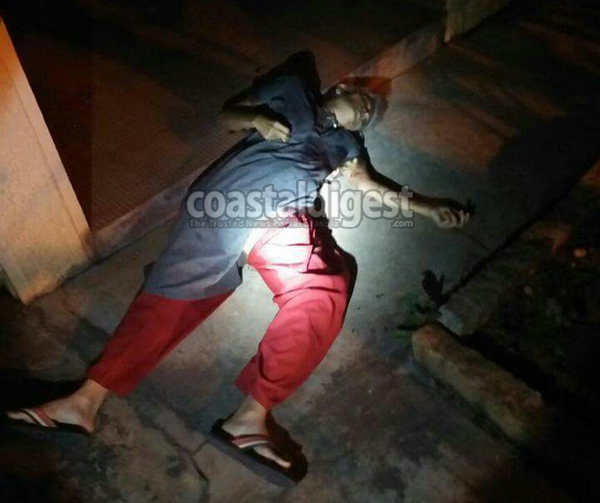
Journalist Gauri Lankesh, who led crusade against communalism, shot dead

coastaldigest.com news network
September 5, 2017

Bengaluru, Sept 5: Veteran journalist and peace activist Gauri Lankesh (55) who led a crusade against saffron extremists and communalism in Karnataka for decades was on Tuesday shot dead by unidentified gunmen near her residence in Bengaluru.
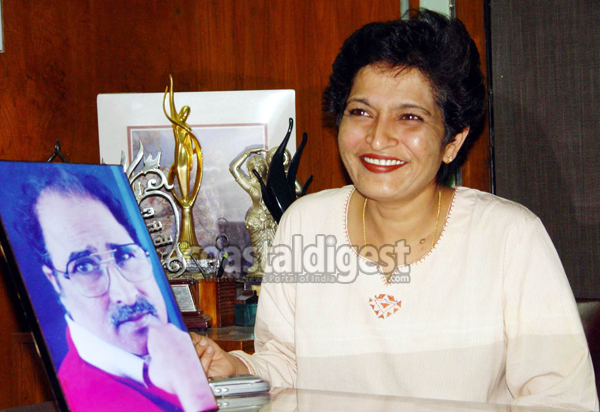
The incident took place within a few days after the second anniversary of the assassination of M M Kalburgi, a rationalist and former vice-chancellor of Kannada University in Hampi, who also had earned the wrath of Hindutva extremists through his writings. The manner in which Gauri was killed was eerily similar to the way in which Kalburgi was killed.

According to reports, at around 7: 00 pm, the gunmen shot at Gauri and wounded her fatally before escaping from the scene.  Police said that Gauri was getting out of her car to open the gate of her house, when assailants shot her. The shots penetrated her chest and she was killed on the spot, reports said.

Gauri was the daughter of revolutionary journalist P Lankesh. She was a veteran editor and columnist in both Kannada and English, and was a vocal critic of the right wing.

Last year, she was convicted of criminal defamation in two cases by the Judicial Magistrate First Class (JMFC) Court in Hubballi on Monday. Dharwad BJP MP Prahallad Joshi and BJP leader Umesh Dhushi had filed individual defamation cases against Lankesh in objection to a report on BJP leaders she had published in her periodical on January 23, 2008.

According to the police, Gauri left her office - Gauri Lankesh Patrike - at Gandhi Bazar around 7 pm. She reached her home around 7.45 pm.

As she was about to open the main door, three assailants called her. As she stepped out, they pumped four bullets from point-blank range. The bullets pierced her abdomen and chest.

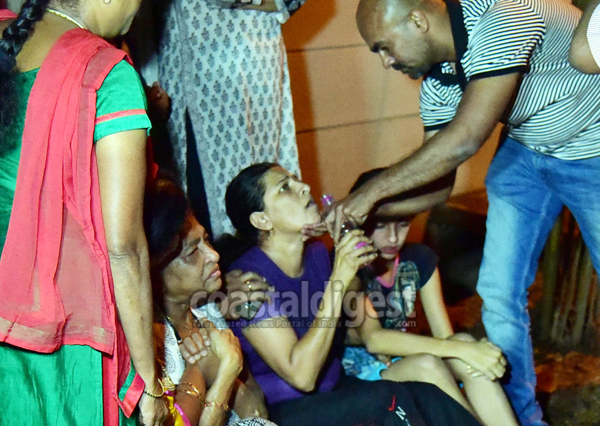
Neighbours rushed out on hearing gunshots and Gauri's screams and called an ambulance.

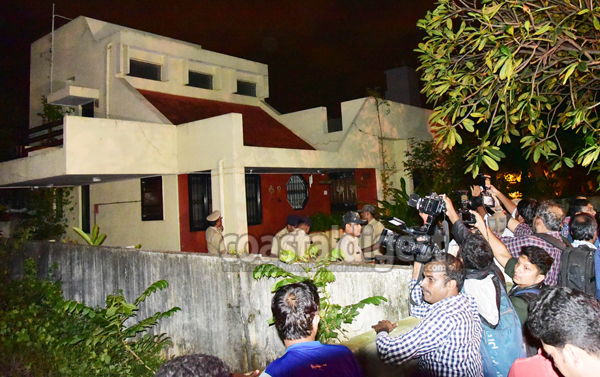
"The house is located in a secluded area near Ideal Homes in Rajarajeshwarinagar. There was no immediate help after the attack," said Shivasundar, Gauri's close aide.

Police Commissioner T Suneel Kumar said it is yet to be ascertained whether the assailants were following Gauri or waiting near her residence.

"Four cartridges have been found at the spot. There are two CCTV cameras at the house and the footage will be examined after forensic officials inspect the spot. Three teams have been formed to nab the assailants, including one headed by joint commissioner (crime). We are also checking other CCTV cameras in the area," Kumar said.

The police said that the modus operandi in Gauri's murder is similar to that of Kalburgi case.

Gauri is the eldest daughter of revolutionary Kannada journalist and thinker P Lankesh. Gauri was known for her writings against the RSS and the BJP.

She had spearheaded several movements in the state and was instrumental in facilitating the surrender of Maoists who wanted to return to the mainstream.

Chief Minister Siddaramaiah said, "Soon after the police submit a preliminary report, we will determine the nature of the probe.”

The chief minister clarified that Gauri had not sought police protection and that there were no intelligence reports indicating a threat to her life.

After visiting the spot, Home Minister Ramalinga Reddy said, "She (Gauri) was staying alone and her mother was with her sister Kavitha in Uttarahalli. The officials told me that she met DGP R K Dutta three times. However, she never shared any information about a threat to her life. In fact, she called me on Saturday and said that she would meet on Monday. But she did not turn up,'' Reddy said.

The body was shifted to the Victoria Hospital for postmortem. A family member said the funeral would be held on Wednesday.
Comments

ayman kudroli
 - 
Tuesday, 5 Sep 2017

wipe out namardonki fouj club of bachelors what  akbaruddin owaisi said once its true ban rss terrorist org

Habeeb Puttur
 - 
Tuesday, 5 Sep 2017

Definately behind this murder KP Bhat and Raghu Swamy... arrest them soon...just check last week's gauri lankesh pathrike main page, what she wrote....and about whom...

Add new comment

  • Coastaldigest.com reserves the right to delete or block any comments.
  • Coastaldigset.com is not responsible for its readers’ comments.
  • Comments that are abusive, incendiary or irrelevant are strictly prohibited.
  • Please use a genuine email ID and provide your name to avoid reject.
News Network
January 23,2026

Karnataka Governor Thaawarchand Gehlot read only three lines from the 122-paragraph address prepared by the Congress-led state government while addressing the joint session of the Legislature on Thursday, effectively bypassing large sections critical of the BJP-led Union government.

The omitted portions of the customary Governor’s address outlined what the state government described as a “suppressive situation in economic and policy matters” under India’s federal framework. The speech also sharply criticised the Centre’s move to replace the Mahatma Gandhi National Rural Employment Guarantee Act (MGNREGA) with the Viksit Bharat–Guarantee for Rozgar and Ajeevika Mission (Gramin) Act, commonly referred to as the VB-GRAM (G) Act.

Governor Gehlot had earlier conveyed his objection to several paragraphs that were explicitly critical of the Union government. On Thursday, he confined himself to the opening lines — “I extend a warm welcome to all of you to the joint session of the State legislature. I am extremely pleased to address this august House” — before jumping directly to the concluding sentence of the final paragraph.

He ended the address by reading the last line of paragraph 122: “Overall, my government is firmly committed to doubling the pace of the State’s economic, social and physical development. Jai Hind — Jai Karnataka.”

According to the prepared speech, the Karnataka government demanded the scrapping of the VB-GRAM (G) Act, describing it as “contractor-centric” and detrimental to rural livelihoods, and called for the full restoration of MGNREGA. The state government argued that the new law undermines decentralisation, weakens labour protections, and centralises decision-making in violation of constitutional norms.

Key points from the unread sections of the speech:

•    Karnataka facing a “suppressive” economic and policy environment within the federal system

•    Repeal of MGNREGA described as a blow to rural livelihoods

•    VB-GRAM (G) Act accused of protecting corporate and contractor interests

•    New law alleged to weaken decentralised governance

•    Decision-making said to be imposed by the Centre without consulting states

•    Rights of Adivasis, women, backward classes and agrarian communities curtailed

•    Labourers allegedly placed under contractor control

•    States facing mounting fiscal stress due to central policies

•    VB-GRAM (G) Act accused of enabling large-scale corruption

Comments

Add new comment

  • Coastaldigest.com reserves the right to delete or block any comments.
  • Coastaldigset.com is not responsible for its readers’ comments.
  • Comments that are abusive, incendiary or irrelevant are strictly prohibited.
  • Please use a genuine email ID and provide your name to avoid reject.
News Network
January 23,2026

Mangaluru: The Karnataka Government Polytechnic (KPT), Mangaluru, has achieved autonomous status from the All India Council for Technical Education (AICTE), becoming the first government polytechnic in the country to receive such recognition in its 78-year history. The status was granted by AICTE, New Delhi, and subsequently approved by the Karnataka Board of Technical Education in October last year.

Officials said the autonomy was conferred a few months ago. Until recently, AICTE extended autonomous status only to engineering colleges, excluding diploma institutions. However, with a renewed national focus on skill development, several government polytechnics across India have now been granted autonomy.

KPT, the second-largest polytechnic in Karnataka, was established in 1946 with four branches and has since expanded to offer eight diploma programmes, including computer science and polymer technology. The institution is spread across a 19-acre campus.

Ravindra M Keni, the first dean of the institution, told The Times of India that AICTE had proposed autonomous status for polytechnic institutions that are over 25 years old. “Many colleges applied. In the first round, 100 institutions were shortlisted, which was further narrowed down to 15 in the second round. We have already completed one semester after becoming an autonomous institution,” he said. He added that nearly 500 students are admitted annually across eight three-year diploma courses.

Explaining the factors that helped KPT secure autonomy, Keni said the institution has consistently recorded 100 per cent admissions and placements for its graduates. He also noted its strong performance in sports, with the college emerging champions for 12 consecutive years, along with active student participation in NCC and NSS activities.

Autonomous status allows KPT to design industry-oriented curricula, conduct examinations, prepare question papers, and manage academic documentation independently. The institution can also directly collaborate with industries and receive priority funding from AICTE or the Ministry of Education. While academic autonomy has been granted, financial control will continue to rest with the state government.

“There will be separate committees for examinations, question paper setting, boards of studies, and boards of examiners. The institution will now have the freedom to conduct admissions without government notifications and issue its own marks cards,” Keni said, adding that new academic initiatives would be planned after a year of functioning under the autonomous framework.

Comments

Add new comment

  • Coastaldigest.com reserves the right to delete or block any comments.
  • Coastaldigset.com is not responsible for its readers’ comments.
  • Comments that are abusive, incendiary or irrelevant are strictly prohibited.
  • Please use a genuine email ID and provide your name to avoid reject.
News Network
February 1,2026

Bengaluru: Karnataka Deputy Chief Minister D K Shivakumar on Sunday criticised the Union Budget presented by Finance Minister Nirmala Sitharaman, claiming it offered no tangible benefit to the state.

Though he said he was yet to study the budget in detail, Shivakumar asserted that Karnataka had gained little from it. “There is no benefit for our state from the central budget. I was observing it. They have now named a programme after Mahatma Gandhi, after repealing the MGNREGA Act that was named after him,” he said.

Speaking to reporters here, the Deputy Chief Minister demanded the restoration of MGNREGA, and made it clear that the newly enacted rural employment scheme — VB-G RAM G — which proposes a 60:40 fund-sharing formula between the Centre and the states, would not be implemented in Karnataka.

“I don’t see any major share for our state in this budget,” he added.

Shivakumar, who also holds charge of Bengaluru development, said there were high expectations for the city from the Union Budget. “The Prime Minister calls Bengaluru a ‘global city’, but what has the Centre done for it?” he asked.

He also drew attention to the problems faced by sugar factories, particularly those in the cooperative sector, alleging a lack of timely decisions and support from the central government.

Noting that the Centre has the authority to fix the minimum support price (MSP) for agricultural produce, Shivakumar said the Union government must take concrete steps to protect farmers’ interests.

Comments

Add new comment

  • Coastaldigest.com reserves the right to delete or block any comments.
  • Coastaldigset.com is not responsible for its readers’ comments.
  • Comments that are abusive, incendiary or irrelevant are strictly prohibited.
  • Please use a genuine email ID and provide your name to avoid reject.