In latest twist to air force procurement, India now eying Boeing's F/A-18 Super Hornet

Agencies
March 17, 2018

New Delhi/Singapore, Mar 17: Boeing Co, considered the frontrunner in the race to supply the Indian navy with new fighter jets, is now in contention for a much bigger $15 billion order after the government abruptly asked the air force to consider the twin-engine planes.

Until recently, Lockheed Martin Corp’s F-16 and Saab AB’s Gripen were in a two-horse race supply at least 100 single-engine jets to build up the Indian Air Force’s fast-depleting combat fleet.

Both had offered to build the planes in India in collaboration with local companies as part of Prime Minister Narendra Modi’s drive to build a domestic industrial base and cut back on arms imports.

But last month the government asked the air force to open up the competition to twin-engine aircraft and to evaluate Boeing’s F/A-18 Super Hornet, a defense ministry source said. That jet is a finalist for the Indian navy’s $8 billion to $9 billion contract for 57 fighters.

The defense ministry plans to within weeks issue a request for information (RFI), the first stage of a procurement process, for a fighter to be built in India. The competition will be open to both single and twin-engine jets, the official said, but both Lockheed and Saab said they had not been informed about the new requirements.

The latest change of heart is a major opportunity for Boeing, whose only foreign Super Hornet customer so far is the Royal Australian Air Force.

It also illustrates how dysfunctional the weapons procurement process and arms industry are in the world’s second-most-populous country. The need for new fighters has been known for nearly 15 years, but after many announcements, twists and turns, the country’s air force has only three-quarters of the aircraft it needs.

An indigenous light combat aircraft, the Tejas, is still not operational, 35 years after it was first proposed. 

An Indian Air Force source said fighter procurement was urgent: the branch’s operational strength has fallen to just 33 squadrons, its weakest level in four decades, as it decommissions Soviet-era MiG-21s.

“The IAF wants the RFI issued within weeks and get the process started,” said the source, who declined to be identified because he was not authorized to speak to the media. “The problem is that government keeps shifting what it wants.”

A PRESSING NEED

Over the next decade, 13 more squadrons will be retired as their aircraft age out of service, parliament’s standing committee on defense said in a December report.

The defense ministry declined to comment on the air force’s aircraft modernization program, saying it was not in a position to do so.

Lockheed, which had offered to shift its F-16 production line in Fort Worth, Texas, to India, said it had not been told of any change to the Indian plan for single-engine fighters.

“Our proposed F-16 partnership with India stands firm,” the company said in an email. Last year it picked Tata Advanced Systems as its local partner and said it was in talks with dozens of firms to build up the supplier network.

“The Government of India has not yet issued formal requirements but we are continuing to support government-to-government discussions and engage with Indian companies about F-16 industrial opportunities,” Lockheed said.

Sweden’s Saab was also caught off guard.

“We have seen the reports in the Indian media, but no new formal communication has been made to us regarding the fighter program,” said Rob Hewson, Saab Asia Pacific’s head of communications.

France’s Dassault Systemes SE’s Rafale, the Eurofighter Typhoon and Russian aircraft are also potential contenders under the new requirements, the air force source and industry analysts said.

Admiral Harry Harris, the head of U.S. Pacific Command, told the U.S. House Armed Services Committee last month that India was considering the stealthy F-35, among other options. But the Indian air force said no request had been made to Lockheed for even a briefing on the aircraft.

An order the size of India’s is rare. The only comparable opportunity for the Super Hornet is Canada’s request for 88 fighters, which could be worth as much as $14.6 billion.

The Indian air force competition has echoes of a 2007 tender for 126 medium multi-role combat aircraft, for which Dassault was selected for exclusive negotiations. But the talks quickly bogged down over local production and prices, and in the end, the government ordered just 36 Rafales in 2016 for $8.7 billion.

LOCAL FIGHTER

The air force ideally would like a combination of lighter single-engine and twin-engine jets, as well as stealthy aircraft, but cannot afford such a range of foreign systems, analysts said.

A twin-engine foreign fighter would perhaps offer the best value while the Tejas finishes development, they said.

India’s annual defense capital procurement budget of $14 billion to $15 billion has to be spread over the army, navy, air force and the indigenous defense research organization. 

“The operational costs are going up with increased manpower, higher wages and general inflation. Ministry of Defence doesn’t have the luxury to go for too many platforms despite the rapidly falling squadron strength of the air force,” said Amber Dubey, partner and India head of aerospace and defense at global consultancy KPMG.

Boeing India President Pratyush Kumar said the company was ready to respond to any request from the air force.

“We will follow the MoD’s lead on their process and will be responsive to their needs if we are asked to provide any information,” he said.

Kumar said Boeing was committed to building the planes in India and had offered to help with India’s plans to develop its own advanced medium combat aircraft.

But the experience with the Rafale contract has made experts skeptical that the latest tender will proceed as planned.

Richard A. Bitzinger, visiting senior fellow at Singapore’s S.Rajaratnam School of International Studies, said he did not expect a resolution in even the next two to three years.

“I am never surprised by what the Indians do when it comes to their procurement tenders. They are constantly changing the rules, changing their minds, and often even cancelling orders mid-way through,” he said.

“The Indians have a remarkable knack for snatching defeat from the jaws of victory.”

Comments

Add new comment

  • Coastaldigest.com reserves the right to delete or block any comments.
  • Coastaldigset.com is not responsible for its readers’ comments.
  • Comments that are abusive, incendiary or irrelevant are strictly prohibited.
  • Please use a genuine email ID and provide your name to avoid reject.
News Network
November 28,2025

ministerPM.jpg

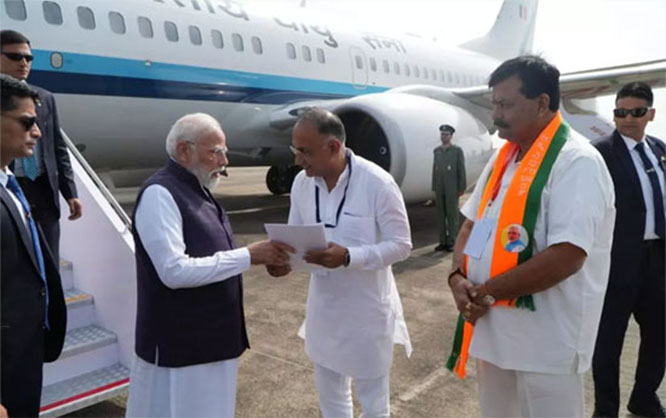
Mangaluru, Nov 28: Karnataka Health Minister and Dakshina Kannada district in-charge minister Dinesh Gundu Rao on Friday handed over Chief Minister Siddaramaiah’s letter to Prime Minister Narendra Modi, highlighting the severe distress faced by farmers due to crashing crop prices.

PM Modi arrived at the Mangaluru International Airport en route to Udupi, where Gundu Rao welcomed him and submitted the letter. The chief minister’s message stressed that farmers are suffering heavy losses because maize and green gram are being bought far below the Minimum Support Price (MSP). The state urged the Centre to immediately begin procurement at MSP.

According to the letter, Karnataka has a bumper harvest this year—over 54.74 lakh metric tons of maize and 1.98 lakh metric tons of green gram—yet farmers are unable to secure fair prices. Against the MSP of ₹2,400/MT for maize and ₹8,768/MT for green gram, market rates have plunged to ₹1,600–₹1,800 and ₹5,400 respectively.

The chief minister has requested the Centre to:

• Direct NAFED, FCI and NCCF to start MSP procurement immediately.
• Ensure ethanol units purchase maize directly from farmers or FPOs.
• Increase Karnataka’s ethanol allocation, citing high production capacity.
• Stop maize imports, which have depressed domestic prices.
• Relax quality norms for green gram, allowing up to 10% discoloration due to rains.

The letter stresses that MSP is crucial for farmer dignity and income stability and calls for swift central intervention to prevent a deepening crisis.

Comments

Add new comment

  • Coastaldigest.com reserves the right to delete or block any comments.
  • Coastaldigset.com is not responsible for its readers’ comments.
  • Comments that are abusive, incendiary or irrelevant are strictly prohibited.
  • Please use a genuine email ID and provide your name to avoid reject.
News Network
December 2,2025

A major upgrade in safety and monitoring is planned for Haj 2026, with every Indian pilgrim set to receive a Haj Suvidha smart wristband linked to the official Haj Suvidha mobile app. The initiative aims to support pilgrims—especially senior citizens—who may struggle with smartphones during the 45-day journey.

What the Smart Wristband Will Do

Officials said the device will come with:
•    Location tracking
•    Pedometer
•    SOS emergency button
•    Qibla compass
•    Prayer timings
•    Basic health monitoring

SP Tiwari, secretary of the UP State Haj Committee, said the goal is to make the pilgrimage safer and more comfortable.

“Most Hajis are elderly and not comfortable with mobile apps,” he said. “The smartwatch will help locate pilgrims who forget their way or cannot communicate their location.”

The wristbands will be monitored by the Consulate General of India in Saudi Arabia, similar to mobile tracking via the Haj Suvidha App.

Free Distribution and Training

•    Smart wristbands will be given free of cost.
•    Training for pilgrims will be conducted between January and February 2026.
•    Sample units will reach state Haj committees soon.
•    Final devices will be distributed as pilgrims begin their journey.

New Rules for Accommodation

Two major decisions have also been finalised for Haj 2026:
1.    Separate rooms for men and women – including married couples. They may stay on the same floor but must occupy different rooms, following stricter Saudi guidelines.
2.    Cooking banned – gas cylinders will not be allowed; all meals will be provided through official catering services arranged by the Haj Committee of India.

These decisions were finalised during a meeting of the Haj Committee of India and state representatives in Mumbai.

Haj Suvidha App Launched Earlier

The government launched the Haj Suvidha App in 2024, offering:

•    Training modules
•    Accommodation and flight details
•    Baggage information
•    SOS and translation tools
•    Grievance redressal

Haj 2026 Quota and Key States

•    India’s total Haj quota for 2026: 1,75,025 pilgrims
•    70% (1,25,000) allotted to the Haj Committee of India
•    30% (around 50,000) reserved for Haj Group Organisers

Uttar Pradesh has the largest allocation (around 30,000 seats), though approximately 18,000 pilgrims are expected to go this year. States with high pilgrim numbers include Kerala, Maharashtra and Gujarat.

Dates of Haj 2026

The pilgrimage is scheduled to take place from 24 May to 29 May, 2026 (tentative).
Haj is one of the five pillars of Islam and is mandatory for Muslims who meet the required conditions.

Comments

Add new comment

  • Coastaldigest.com reserves the right to delete or block any comments.
  • Coastaldigset.com is not responsible for its readers’ comments.
  • Comments that are abusive, incendiary or irrelevant are strictly prohibited.
  • Please use a genuine email ID and provide your name to avoid reject.
News Network
December 2,2025

DKSsiddu.jpg

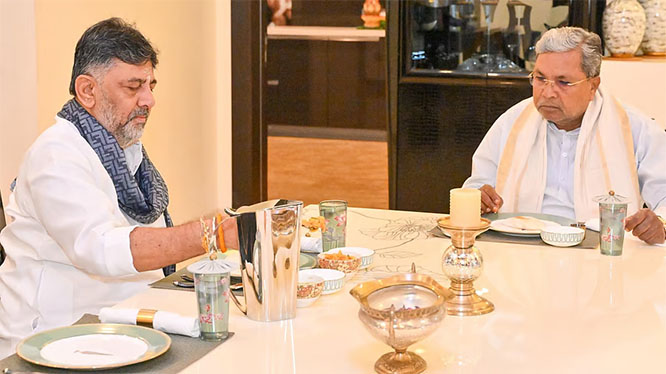
Bengaluru: 'Nati koli saaru' (country chicken curry) considered one of Chief Minister Siddaramaiah’s favourites along with steaming hot idlis was on the breakfast menu at Deputy CM D K Shivakumar’s residence on Tuesday, according to official sources.

The spread also included 'nati koli' fry, vada and pongal, among other items, they said.

In an apparent show of unity, Siddaramaiah visited Shivakumar’s residence for breakfast, just days after the two leaders shared a meal amid a simmering power tussle in the state Congress.

Siddaramaiah drove to the Deputy CM’s residence in Sadashivanagar, where he was received by Shivakumar and his brother D K Suresh, who is a former Congress MP.

Suresh and Kunigal MLA H D Ranganath, a relative of Shivakumar, joined them for breakfast, which featured a mix of vegetarian and non-vegetarian dishes.

Speaking to reporters later, Siddaramaiah said Shivakumar had invited him during his visit to the CM’s residence for breakfast on Saturday.

Asked about the difference between the two meals, the chief minister said, "At his (Shivakumar’s) house it was non-veg, while at my house it was veg. He is a vegetarian, I am a non-vegetarian. I had not prepared non-veg. I told DK to get chicken from the village as you won’t get the original in Bengaluru."

Shivakumar said he had initially invited Siddaramaiah to his residence, but the CM had suggested visiting his place first and reciprocating later. "It was a vegetarian breakfast at the CM’s house on Saturday," he noted.

"Today, I invited him (the CM) to my house. He enjoyed the breakfast, which had his Mysuru taste," Shivakumar added. At this point, Siddaramaiah remarked that Shivakumar’s wife is also from Mysuru.

Saturday’s breakfast at Siddaramaiah’s official residence, held as part of efforts by the Congress high command to ease tensions in the leadership dispute between the two, reportedly included idlis and sambar, according to official sources.

Comments

Add new comment

  • Coastaldigest.com reserves the right to delete or block any comments.
  • Coastaldigset.com is not responsible for its readers’ comments.
  • Comments that are abusive, incendiary or irrelevant are strictly prohibited.
  • Please use a genuine email ID and provide your name to avoid reject.