Mallya loses over Rs 10,000 crore UK lawsuit

Agencies
May 9, 2018

London, May 9: Embattled liquor tycoon Vijay Mallya, undergoing an extradition trial in a UK court over fraud and money laundering charges by Indian authorities, today lost a lawsuit filed by 13 Indian banks in the UK High Court seeking to collect from him more than Rs 10,000 crore (USD 1.55 billion).

Judge Andrew Henshaw refused to overturn a worldwide order freezing 62-year-old Mallya's assets and upheld an Indian court's ruling that a consortium of 13 Indian banks was entitled to recover funds amounting to nearly USD 1.55 billion  (1.145 billion pounds).

The victory for the banks, which claimed the businessman had wilfully defaulted on the loans accessed from them, will enable them to enforce the Indian judgment against Mallya's assets in England and Wales. The worldwide freezing order prevents Mallya from removing any assets from England and Wales up to that value or to in any way dispose of, deal with or diminish the value of his assets in or outside of this jurisdiction, up to the same value.

"Today's judgment is a very important decision not just for our clients, who want to proceed in this jurisdiction with enforcing the judgment they secured against Dr Mallya in India, but also for Indian and international banks more generally," said Paul Gair, from UK law firm TLT which represented the Indian banks in the London court.

"In dismissing Dr Mallya's application, the High Court has demonstrated its willingness to recognise judgments granted by courts in other jurisdictions, giving parties opportunities to enforce their judgments against any assets held here. This case also sets a strong precedent for parties to secure a worldwide freezing order when enforcing judgments against wilful defaulters," he said.

Gair, a partner in TLT's banking and financial services litigation team, added that in a weakened global economy, "non-performing loans" present a real challenge for lenders, particularly where customers have assets located around the world.

"The English courts can play a vital role in these cases given that London is the world's leading financial centre," he noted.

TLT acted for the Indian banks in successfully defeating two applications – first, an application to set aside the first recorded case of a judgment of the Debt Recovery Tribunal (DRT) in India being registered by the English High Court, and the second, to discharge an associated worldwide freezing order. The firm had also acted for the banks in November 2017 to secure the registration and freezing order, which was successfully upheld today.

The case is the latest stage in long-running litigation in which the banks are seeking to recover sums lent to the now-defunct Kingfisher Airlines Limited, guaranteed by Mallya.

The businessman was represented by Nicholas Peacock and George Heyman of Maitland Chambers, who was instructed by the law firm Macfarlanes LLP.

The High Court judge has also refused permission to appeal today's ruling, which leaves Mallya's lawyers with the only option of directly petitioning the UK's Court of Appeal.

The claim brought by 13 Indian banks against Mallya had come up for a hearing in the High Court last month. The litigation in the Queen's Bench Division of the commercial court in England's High Court of Justice lists the State Bank of India, Bank of Baroda, Corporation Bank, Federal Bank Ltd, IDBI Bank, Indian Overseas Bank, Jammu &a Kashmir Bank, Punjab & Sind Bank, Punjab National Bank, State Bank of Mysore, UCO Bank, United Bank of India and JM Financial Asset Reconstruction Co. Pvt Ltd as the applicants.

Mallya and related concerns – Ladywalk LLP, Rose Capital Ventures Ltd and Orange India Holdings – are listed as respondents. The assets freeze order had forced Mallya on to a weekly allowance of 5,000 pounds, which his lawyers had managed to boost to 18,325.31 pounds a week at a hearing earlier this year.

According to court documents, the claim relates to a judgment of the Debt Recovery Tribunal (DRT) in Karnataka, which concluded that Mallya was "liable" to the banks in the sum of INR 62,033,503,879.42 plus interest.

The "freezing order" involves Mallya and related concerns being "restrained… until further order, from removing from the jurisdiction any of their assets in the jurisdiction up to a limit of 1,145,000,000 pounds and in any way disposing of, dealing with or diminishing the value of any of their assets whether they are inside or outside the jurisdiction up to the same value".

The UK court had earlier upheld the Indian court's injunction and given Mallya's lawyers more time to respond due to the ongoing extradition trial at Westminster Magistrates’ Court in London, which is now set for a hearing on July 11.

Meanwhile, Mallya remains on a 650,000-pound bail bond since his arrest on an extradition warrant by Scotland Yard in April last year.

The Crown Prosecution Service (CPS), representing the Indian government, has claimed that the evidence they have presented confirms "dishonesty" on the part of the businessman, who acquired the loans through misrepresentation and had no intentions of repaying them.

Mallya's defence team has been deposing a series of expert witnesses to try and establish that the default by Kingfisher Airlines was the result of a business failure within a wider context of a global financial crisis and that its owner had no "fraudulent" intentions.


Comments

Add new comment

  • Coastaldigest.com reserves the right to delete or block any comments.
  • Coastaldigset.com is not responsible for its readers’ comments.
  • Comments that are abusive, incendiary or irrelevant are strictly prohibited.
  • Please use a genuine email ID and provide your name to avoid reject.
News Network
December 16,2025

jordan.jpg

Prime Minister Narendra Modi on Monday held talks with Jordan’s King Abdullah II in Amman, during which the two leaders discussed ways to further strengthen bilateral relations, with the Prime Minister outlining an eight-point vision covering key areas of cooperation.

Describing the meeting as “productive”, PM Modi said he shared a roadmap focused on trade and economy, fertilisers and agriculture, information technology, healthcare, infrastructure, critical and strategic minerals, civil nuclear cooperation, and people-to-people ties.

In a post on social media platform X, the Prime Minister praised King Abdullah II’s personal commitment to advancing India–Jordan relations, particularly as both countries mark the 75th anniversary of the establishment of diplomatic ties this year.

“Held productive discussions with His Majesty King Abdullah II in Amman. His personal commitment towards vibrant India-Jordan relations is noteworthy. This year, we are celebrating the 75th anniversary of our bilateral diplomatic relations,” PM Modi said.

The meeting took place at the Al Husseiniya Palace, where the two leaders also exchanged views on regional and global issues of mutual interest. According to the Ministry of External Affairs (MEA), both sides agreed to further deepen cooperation in areas including trade and investment, defence and security, counter-terrorism and de-radicalisation, fertilisers and agriculture, infrastructure, renewable energy, tourism, and heritage.

The MEA said both leaders reaffirmed their united stand against terrorism.

PM Modi arrived in Amman earlier on Monday and was received by Jordanian Prime Minister Jafar Hassan, who accorded him a formal welcome. Following the talks, King Abdullah II hosted a banquet dinner in honour of the Prime Minister, reflecting the warmth of bilateral ties.

Jordan is the first leg of PM Modi’s three-nation tour. From Amman, the Prime Minister will travel to Ethiopia at the invitation of Prime Minister Abiy Ahmed Ali, marking his first official visit to the African nation. The tour will conclude with a visit to Oman.

Comments

Add new comment

  • Coastaldigest.com reserves the right to delete or block any comments.
  • Coastaldigset.com is not responsible for its readers’ comments.
  • Comments that are abusive, incendiary or irrelevant are strictly prohibited.
  • Please use a genuine email ID and provide your name to avoid reject.
News Network
December 7,2025

envoy.jpg

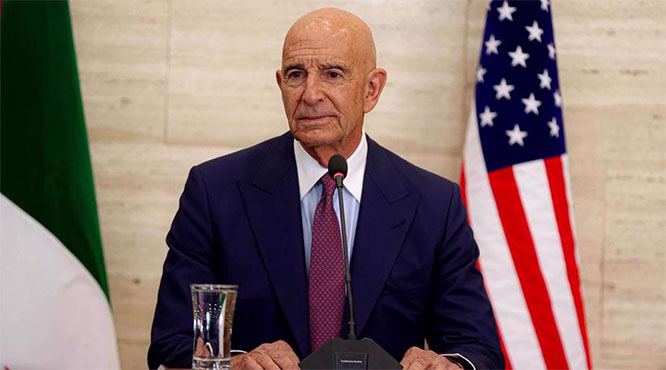
Since 1946, the United States has attempted 93 coups or “regime change” operations across the world — including two in Iran, US Special Envoy for Syria Tom Barrack has admitted.

Speaking to the UAE-based IMI Media Group, in remarks published by The National, Barrack said Washington tried twice to overthrow the Iranian government but failed both times. 

“For (Trump) then to be imputed with regime change — we had two regime changes in Iran already. Neither one worked. So I think wisely leave it to the region to solve,” said Barrack, who also serves as the US ambassador to Turkey.

His comments come six months after the US joined Israel in airstrikes against Iran during ongoing indirect nuclear negotiations between Tehran and Washington.

On June 13, Israel launched an attack on Iran that killed at least 1,064 people and hit civilian infrastructure. Days later, the United States targeted three nuclear facilities — Fordow, Natanz and Isfahan — in what Iran called a clear violation of international law. Iranian retaliation eventually forced a halt to the assault on June 24.

Barrack further claimed that US President Donald Trump and Foreign Secretary Marco Rubio are “not into regime change” and prefer a regional approach driven by Middle Eastern countries themselves. According to him, regional dialogue and non-interference by outside powers offer a more durable path forward.

He added that Washington is still open to an agreement with Tehran if Iranian authorities show “seriousness” and willingness to engage constructively.

However, Iran maintains the US has not shown readiness for meaningful talks. In an interview with Japan’s Kyodo News, Iranian Foreign Minister Abbas Araghchi said negotiations could advance only if Washington acknowledges Iran’s right to peaceful nuclear energy and lifts unilateral sanctions.

Comments

Add new comment

  • Coastaldigest.com reserves the right to delete or block any comments.
  • Coastaldigset.com is not responsible for its readers’ comments.
  • Comments that are abusive, incendiary or irrelevant are strictly prohibited.
  • Please use a genuine email ID and provide your name to avoid reject.
News Network
December 6,2025

pilot.jpg

New Delhi: IndiGo, India’s largest airline, faced major operational turbulence this week after failing to prepare for new pilot-fatigue regulations issued by the Directorate General of Civil Aviation (DGCA). The stricter rules—designed to improve flight safety—took effect in phases through 2024, with the latest implementation on November 1. IndiGo has acknowledged that inadequate roster planning led to widespread cancellations and delays.

Below are the key DGCA rules that affected IndiGo’s operations:

1. Longer Mandatory Weekly Rest

Weekly rest for pilots has been increased from 36 hours to 48 hours.

The government says the extended break is essential to curb cumulative fatigue. This rule remains in force despite the current crisis.

2. Cap on Night Landings

Pilots can now perform only two night landings per week—a steep reduction from the earlier limit of six.

Night hours, defined as midnight to early morning, are considered the least alert period for pilots.

Given the disruptions, this rule has been temporarily relaxed for IndiGo until February 10.

3. Reduced Maximum Night Flight Duty

Flight duty that stretches into the night is now capped at 10 hours.

This measure has also been kept on hold for IndiGo until February 10 to stabilize operations.

4. Weekly Rest Cannot Be Replaced With Personal Leave

Airlines can no longer count a pilot’s personal leave as part of the mandatory 48-hour rest.

Pilots say this closes a loophole that previously reduced actual rest time.

Currently, all airlines are exempt from this rule to normalise travel.

5. Mandatory Fatigue Monitoring

Airlines must submit quarterly fatigue reports along with corrective actions to DGCA.

This system aims to create a transparent fatigue-tracking framework across the industry.

The DGCA has stressed that these rules were crafted to strengthen flight safety and align India with global fatigue-management standards. The temporary relaxations are expected to remain until February 2025, giving IndiGo time to stabilise its schedules and restore normal air travel.

Comments

Add new comment

  • Coastaldigest.com reserves the right to delete or block any comments.
  • Coastaldigset.com is not responsible for its readers’ comments.
  • Comments that are abusive, incendiary or irrelevant are strictly prohibited.
  • Please use a genuine email ID and provide your name to avoid reject.