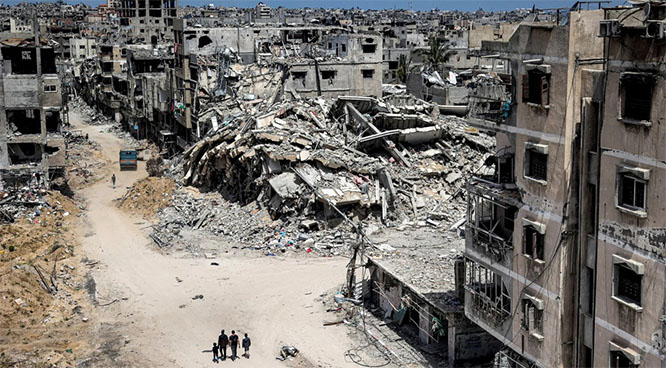
10,000 bodies decomposing under destroyed buildings in Gaza spreading diseases

News Network
April 30, 2024

Gazarubble.jpg

Gaza civil defense agency has warned of a looming health disaster in the besieged Strip as the decomposition of dead bodies under the rubble of buildings destroyed by the relentless Israeli bombings accelerates.

The agency pointed on Tuesday to the risk of diseases and epidemics associated with the public decomposition of thousands of bodies due to rising temperature.

“The continued accumulation of thousands of bodies under the rubble has begun to cause the spread of disease and epidemics, especially with the onset of summer and the rise in temperatures, which accelerates the process of decomposition,” it said in a statement.

Seven months into the war, the Geneva-based Euro-Mediterranean Human Rights Monitor warned earlier that the decomposition of dead bodies for long periods leads to the transmission of serious diseases, including blood-borne viruses and tuberculosis.

"Gastrointestinal infections like cholera can also be easily spread through direct contact with dead bodies leaking excrement, soiled clothing, or contaminated tools or vehicles," it added.

In another report last week, Euro-Med Monitor also warned that thousands of corpses left in the streets or beneath house debris are rotting and being consumed by cats and dogs, which is an additional factor contributing to the spread of infectious diseases.

"The spread threatens the environment and public health in the Strip, and health authorities in the Strip have detected about one million cases of infectious diseases," the report added.

The Global Nutrition Group also estimates that at least 90 percent of the Gaza Strip’s children under the age of five are affected by one or more infectious diseases and that 70 percent have had diarrhea in the past two weeks—a 23-fold increase compared with the 2022 baseline.

Unexpected blistering temperatures across Gaza have also added to the daily misery faced by the enclave’s people and sparked new fears of disease outbreaks amid a lack of sufficient clean water and waste disposal, the UN Relief and Works Agency for Palestine Refugees in the Near East, also known as UNRWA said on Thursday.

This comes as the death toll from Israel's genocidal campaign against Gaza rose to 34,535. Among the dead are more than 14,500 children and 9,500 women.

Since the war began on October 7, nearly 85 percent of Gaza's 2.3 million people have been displaced.

Vast swathes of the besieged territory are in ruins as Israel continues its onslaught, dropping at least 75,000 tons of explosives on Gaza, according to the Gaza Media Office.

Earlier this month, UNRWA, said 62 percent of all houses in the besieged territory have been damaged or destroyed.

Gaza Media Office recently reported that nearly 90,000 housing units have been destroyed while nearly 300,000 units have been damaged by the Israeli air and ground offensive.

The United Nations Office for the Coordination of Humanitarian Affairs (OCHA) reported on Monday that nearly 37.5 million tons of conflict-generated debris are estimated to be present throughout Gaza, based on assessments by UN bodies.

The world’s hunger watchdog, known as the Integrated Food-Security Phase Classification (IPC), said in a report published on March 18 that about 1.1 million Palestinians in Gaza are living through catastrophic food insecurity, warning that famine is likely to strike by May in northern Gaza and can spread across the territory by July.

Francesca Albanese, the UN special rapporteur on the occupied Palestinian territory, said in a report published in late March that there were clear indications that Israel has violated three of the five acts listed under the UN Genocide Convention.

These acts Albanese said were “killing members of the group; causing serious bodily or mental harm to the group’s members; and deliberately inflicting on the group conditions of life calculated to bring about its physical destruction in whole or in part.”


Comments

Add new comment

  • Coastaldigest.com reserves the right to delete or block any comments.
  • Coastaldigset.com is not responsible for its readers’ comments.
  • Comments that are abusive, incendiary or irrelevant are strictly prohibited.
  • Please use a genuine email ID and provide your name to avoid reject.
News Network
December 4,2025

indigoflight.jpg

Domestic carrier IndiGo has cancelled over 180 flights from three major airports — Mumbai, Delhi and Bengaluru — on Thursday, December 4, as the airline struggles to secure the required crew to operate its flights in the wake of new flight-duty and rest-period norms for pilots.

While the number of cancellations at Mumbai airport stands at 86 (41 arrivals and 45 departures) for the day, at Bengaluru, 73 flights have been cancelled, including 41 arrivals, according to a PTI report that quoted sources.

"IndiGo cancelled over 180 flights on Thursday at three airports-Mumbai, Delhi and Bengaluru," the source told the news agency.

Besides, it had cancelled as many as 33 flights at Delhi airport for Thursday, the source said, adding, "The number of cancellations is expected to be higher by the end of the day."

The Gurugram-based airline's On-Time Performance (OTP) nosedived to 19.7 per cent at six key airports — Delhi, Mumbai, Chennai, Kolkata, Bengaluru and Hyderabad — on December 3, as it struggled to get the required crew to operate its services, down from almost half of December 2, when it was 35 per cent.

"IndiGo has been facing acute crew shortage since the implementation of the second phase of the FDTL (Flight Duty Time Limitations) norms, leading to cancellations and huge delays in its operations across the airports," a source had told PTI on Wednesday.

Chaos continued at several major airports for the third day on Thursday because of the cancellations.

A spokesperson for the Kempegowda International Airport (KIA) in Bengaluru said that 73 IndiGo flights had been cancelled on Thursday.

At least 150 flights were cancelled and dozens of others delayed on Wednesday, airport sources said, leaving thousands of travellers stranded, according to news agency Reuters.

The Directorate General of Civil Aviation (DGCA) has said it is investigating IndiGo flight disruptions and has asked the airline to submit the reasons for the current situation, as well as its plans to reduce flight cancellations and delays.

It may be mentioned here that the pilots' body, Federation of Indian Pilots (FIP), has alleged that IndiGo, despite getting a two-year preparatory window before the full implementation of new flight duty and rest period norms for cockpit crew, "inexplicably" adopted a "hiring freeze".

The FIP said it has urged the safety regulator, the DGCA, not to approve airlines' seasonal flight schedules unless they have adequate staff to operate their services "safely and reliably" in accordance with the New Flight Duty Time Limitations (FDTL) norms.

In a letter to the DGCA late on Wednesday, the FIP urged the DGCA to consider re-evaluating and reallocating slots to other airlines, which have the capacity to operate them without disruption during the peak holiday and fog season if IndiGo continues to "fail in delivering on its commitments to passengers due to its own avoidable staffing shortages."

Comments

Add new comment

  • Coastaldigest.com reserves the right to delete or block any comments.
  • Coastaldigset.com is not responsible for its readers’ comments.
  • Comments that are abusive, incendiary or irrelevant are strictly prohibited.
  • Please use a genuine email ID and provide your name to avoid reject.
News Network
December 7,2025

SHRIMP.jpg

Mangaluru, Dec 7: A rare bamboo shrimp has been rediscovered on mainland India more than 70 years after it was last reported, confirming for the first time the presence of Atyopsis spinipes in the country. The find was made by researchers from the Centre for Climate Change Studies at Sathyabama Institute of Science and Technology, Chennai, during surveys in Karnataka and Odisha.

The team — shrimp expert Dr S Prakash, PhD scholar K Kunjulakshmi, and Mangaluru-based researcher Maclean Antony Santos — combined field surveys, ecological assessments and DNA analysis to identify the elusive species. Their findings, published in Zootaxa, resolve decades of taxonomic confusion stemming from a 1951 report that misidentified the species as Atyopsis moluccensis without strong evidence.

The shrimp has now been confirmed at two locations: the Mulki–Pavanje estuary near Mangaluru and the Kuakhai River in Bhubaneswar. Historical specimens from the Andaman Islands, previously labelled as A. moluccensis, were also found to be misidentified and actually belong to A. spinipes.

The rediscovery began after an aquarium hobbyist in Odisha spotted a shrimp in 2022, prompting systematic surveys across Udupi, Karwar and Mangaluru. Four female specimens were collected in Mulki and one in Odisha, all genetically matching.

Researchers warn the species may exist in very small, vulnerable populations as freshwater habitats face increasing pressure from pollution, sand mining and infrastructure development. All verified specimens have been deposited with the Zoological Survey of India for future reference.

Comments

Add new comment

  • Coastaldigest.com reserves the right to delete or block any comments.
  • Coastaldigset.com is not responsible for its readers’ comments.
  • Comments that are abusive, incendiary or irrelevant are strictly prohibited.
  • Please use a genuine email ID and provide your name to avoid reject.
News Network
December 7,2025

Mangaluru, Dec 7: A 34-year-old fruit and vegetable trader in Mangaluru has reportedly lost ₹33.1 lakh after falling victim to an online investment scam run through a fake mobile app.

Police said the scam began in September, when the victim received a link on Facebook. Clicking it connected him to a WhatsApp number, where an unidentified person introduced a high-return investment scheme and instructed him to download an app.

To build trust, the fraudster asked him to invest ₹30,000 on September 24. The trader soon received ₹34,000 as “profit,” convincing him the scheme was genuine. Over the next two months, he transferred money in multiple instalments via Google Pay and IMPS to different scanner codes and bank accounts shared by the scammers. Between September 24 and December 3, he ended up sending a total of ₹33.1 lakh.

When he later requested a refund of his investment and promised returns, the scammers demanded additional payments, claiming he needed to pay a “service tax” first. Even after he paid a small amount, no money was returned, and the scammers continued pressuring him for more.

A case has been registered at the CEN Crime Police Station.

Comments

Add new comment

  • Coastaldigest.com reserves the right to delete or block any comments.
  • Coastaldigset.com is not responsible for its readers’ comments.
  • Comments that are abusive, incendiary or irrelevant are strictly prohibited.
  • Please use a genuine email ID and provide your name to avoid reject.