



10,000 bodies decomposing under destroyed buildings in Gaza spreading diseases

News Network
April 30, 2024

Gazarubble.jpg

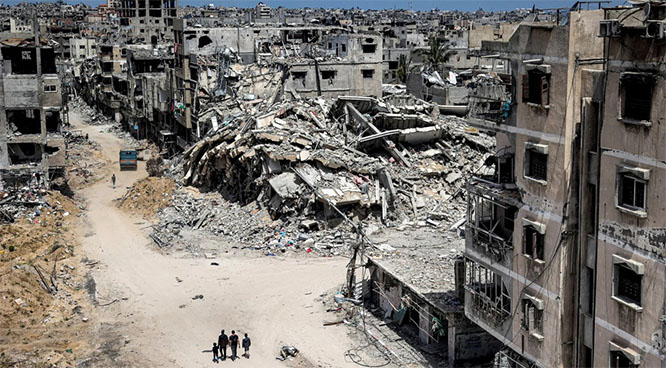
Gaza civil defense agency has warned of a looming health disaster in the besieged Strip as the decomposition of dead bodies under the rubble of buildings destroyed by the relentless Israeli bombings accelerates.

The agency pointed on Tuesday to the risk of diseases and epidemics associated with the public decomposition of thousands of bodies due to rising temperature.

“The continued accumulation of thousands of bodies under the rubble has begun to cause the spread of disease and epidemics, especially with the onset of summer and the rise in temperatures, which accelerates the process of decomposition,” it said in a statement.

Seven months into the war, the Geneva-based Euro-Mediterranean Human Rights Monitor warned earlier that the decomposition of dead bodies for long periods leads to the transmission of serious diseases, including blood-borne viruses and tuberculosis.

"Gastrointestinal infections like cholera can also be easily spread through direct contact with dead bodies leaking excrement, soiled clothing, or contaminated tools or vehicles," it added.

In another report last week, Euro-Med Monitor also warned that thousands of corpses left in the streets or beneath house debris are rotting and being consumed by cats and dogs, which is an additional factor contributing to the spread of infectious diseases.

"The spread threatens the environment and public health in the Strip, and health authorities in the Strip have detected about one million cases of infectious diseases," the report added.

The Global Nutrition Group also estimates that at least 90 percent of the Gaza Strip’s children under the age of five are affected by one or more infectious diseases and that 70 percent have had diarrhea in the past two weeks—a 23-fold increase compared with the 2022 baseline.

Unexpected blistering temperatures across Gaza have also added to the daily misery faced by the enclave’s people and sparked new fears of disease outbreaks amid a lack of sufficient clean water and waste disposal, the UN Relief and Works Agency for Palestine Refugees in the Near East, also known as UNRWA said on Thursday.

This comes as the death toll from Israel's genocidal campaign against Gaza rose to 34,535. Among the dead are more than 14,500 children and 9,500 women.

Since the war began on October 7, nearly 85 percent of Gaza's 2.3 million people have been displaced.

Vast swathes of the besieged territory are in ruins as Israel continues its onslaught, dropping at least 75,000 tons of explosives on Gaza, according to the Gaza Media Office.

Earlier this month, UNRWA, said 62 percent of all houses in the besieged territory have been damaged or destroyed.

Gaza Media Office recently reported that nearly 90,000 housing units have been destroyed while nearly 300,000 units have been damaged by the Israeli air and ground offensive.

The United Nations Office for the Coordination of Humanitarian Affairs (OCHA) reported on Monday that nearly 37.5 million tons of conflict-generated debris are estimated to be present throughout Gaza, based on assessments by UN bodies.

The world’s hunger watchdog, known as the Integrated Food-Security Phase Classification (IPC), said in a report published on March 18 that about 1.1 million Palestinians in Gaza are living through catastrophic food insecurity, warning that famine is likely to strike by May in northern Gaza and can spread across the territory by July.

Francesca Albanese, the UN special rapporteur on the occupied Palestinian territory, said in a report published in late March that there were clear indications that Israel has violated three of the five acts listed under the UN Genocide Convention.

These acts Albanese said were “killing members of the group; causing serious bodily or mental harm to the group’s members; and deliberately inflicting on the group conditions of life calculated to bring about its physical destruction in whole or in part.”

Comments

Add new comment

  • Coastaldigest.com reserves the right to delete or block any comments.
  • Coastaldigset.com is not responsible for its readers’ comments.
  • Comments that are abusive, incendiary or irrelevant are strictly prohibited.
  • Please use a genuine email ID and provide your name to avoid reject.
News Network
November 24,2025

israelsyra.jpg

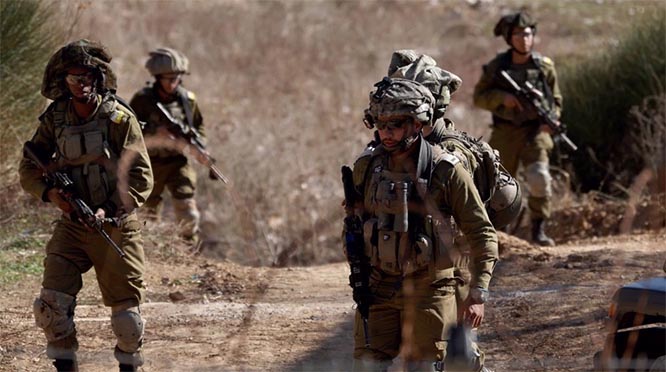
Israeli forces have pushed over the Syrian frontier, erecting a checkpoint and stopping vehicles in the southwestern city of Quneitra, in yet another breach of the Arab country’s sovereignty.

The violation took place on Sunday, when the troops made their way across the border, setting up the outpost near the Ain al-Bayda junction in northern Quneitra, Syrian outlets reported.

According to the al-Ikhbariya paper, an Israeli detachment positioned itself at the junction, halting cars and conducting searches.

The Syrian Arab News Agency (SANA) reported that three Israeli military vehicles then moved further into the northern countryside, deploying between the town of Jubata al-Khashab and the villages of Ofaniya and Ain al-Bayda. The agency added that a separate Israeli unit mounted a new incursion in the central region, approaching the villages of Umm Batina and al-Ajraf.

Residents said such activities have surged in recent months, pointing to Israeli advances onto farmland, leveling of extensive forested areas, arrests, and spread of mobile checkpoints.

The Israeli regime began markedly increasing its military aggression against Syria last year.

The escalation coincided with increasingly ferocious onslaughts throughout the country by the so-called Hay'at Tahrir al-Sham (HTS) Takfiri terrorist group, which the government of President Bashar al-Assad had confined to northwestern Syria. The HTS, however, managed to overthrow the government as the Israeli attacks would pummel the country’s civilian and defensive infrastructure.

Various reports have shown that, during the escalation, the regime conducted more than 1,000 airstrikes on the Syrian territory and over 400 ground raids into the south.

Following the collapse of the Assad government, Tel Aviv also widened its grip over the occupied Golan Heights by taking control of a demilitarized buffer zone, in defiance of a 1974 Disengagement Agreement. Earlier this month, senior Israeli officials, including Prime Minister Benjamin Netanyahu, visited the buffer zone, prompting expressions of alarm on the part of the United Nations.

The United States, the regime’s biggest ally, has, meanwhile, been fraternizing the HTS head Abu Mohammed al-Jolani amid the widely reported prospect of rapprochement with Tel Aviv.

Comments

Add new comment

  • Coastaldigest.com reserves the right to delete or block any comments.
  • Coastaldigset.com is not responsible for its readers’ comments.
  • Comments that are abusive, incendiary or irrelevant are strictly prohibited.
  • Please use a genuine email ID and provide your name to avoid reject.
News Network
December 4,2025

Mangaluru: Chaos erupted at Mangaluru International Airport (MIA) after IndiGo flight 6E 5150, bound for Mumbai, was repeatedly delayed and ultimately cancelled, leaving around 100 passengers stranded overnight. The incident highlights the ongoing country-wide operational disruptions affecting the airline, largely due to the implementation of new Flight Duty Time Limitations (FDTL) norms for crew.

The flight was initially scheduled for 9:25 PM on Tuesday but was first postponed to 11:40 PM, then midnight, before being cancelled around 3:00 AM. Passengers expressed frustration over last-minute communication and the lack of clarity, with elderly and ailing travellers particularly affected. “Though the airline arranged food, there was no proper communication, leaving us confused,” said one family member.

An IndiGo executive at MIA cited the FDTL rules, designed to prevent pilot fatigue by limiting crew working hours, as the cause of the cancellation. While alternative arrangements, including hotel stays, were offered, about 100 passengers chose to remain at the airport, creating tension. A replacement flight was arranged but also faced delays due to the same constraints, finally departing for Mumbai around 1:45 PM on Wednesday. Passengers either flew, requested refunds, or postponed their travel.

The Mangaluru delay is part of a broader crisis for IndiGo. The airline has been forced to make “calibrated schedule adjustments”—a euphemism for widespread cancellations and delays—after stricter FDTL norms came into effect on November 1.

While an IndiGo spokesperson acknowledged unavoidable flight disruptions due to technology issues, operational requirements, and the updated crew rostering rules, the DGCA has intervened, summoning senior airline officials to explain the chaos and outline corrective measures.

The ripple effect has been felt across the country, with major hubs like Bengaluru and Mumbai reporting numerous cancellations. The Mangaluru incident underscores the systemic operational strain currently confronting India’s largest carrier, leaving passengers nationwide grappling with uncertainty and delays.

Comments

Add new comment

  • Coastaldigest.com reserves the right to delete or block any comments.
  • Coastaldigset.com is not responsible for its readers’ comments.
  • Comments that are abusive, incendiary or irrelevant are strictly prohibited.
  • Please use a genuine email ID and provide your name to avoid reject.
News Network
November 26,2025

students.jpg

Bengaluru, Nov 26: Karnataka is taking its first concrete steps towards lifting a three-decade-old ban on student elections in colleges and universities. Deputy Chief Minister D.K. Shivakumar announced Wednesday that the state government will form a small committee to study the reintroduction of campus polls, a practice halted in 1989 following incidents of violence.

Speaking at a 'Constitution Day' event organised by the Karnataka Congress, Mr. Shivakumar underscored the move's aim: nurturing new political leadership from the grassroots.

"Recently, (Leader of the Opposition in Lok Sabha) Rahul Gandhi wrote a letter to me and Chief Minister (Siddaramaiah) asking us to think about restarting student elections," Shivakumar stated. "I'm announcing today that we'll form a small committee and seek a report on this."

Student elections were banned in Karnataka in 1989, largely due to concerns over violence and the infiltration of political party affiliates into campus life. The ban effectively extinguished vibrant student bodies and the pipeline of young leaders they often produced.

Mr. Shivakumar, who also serves as the Karnataka Congress president, said that former student leaders will be consulted to "study the pros and cons" of the re-introduction.

Acknowledging the history of the ban, he added, "There were many criminal activities taking place back then. We’ll see how we can conduct (student) elections by regulating such criminal activities."

The Deputy CM reminisced about his own journey, which began on campus. He recalled his political activism at Sri Jagadguru Renukacharya College leading to his first Assembly ticket in 1985 at the age of 23. "That's how student leadership was at the time. Such leadership has gone today. College elections have stopped," he lamented, adding that for many, college elections were "like a big movement" where leaders were forged.

The move, driven by the Congress high command's push to cultivate young talent, will face scrutiny from academics and university authorities who have, in the past, expressed concern that the return of polls could disrupt the peaceful academic environment and turn campuses into political battlegrounds.

Comments

Add new comment

  • Coastaldigest.com reserves the right to delete or block any comments.
  • Coastaldigset.com is not responsible for its readers’ comments.
  • Comments that are abusive, incendiary or irrelevant are strictly prohibited.
  • Please use a genuine email ID and provide your name to avoid reject.