



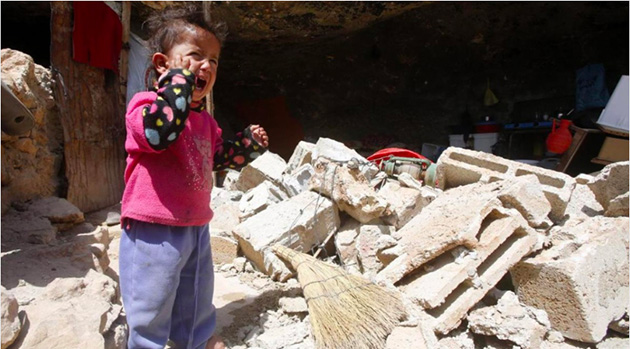
130,000 Palestinians facing home demolition threat in territories occupied by Israel

News Network
November 13, 2022

building.jpg

As many as 130,000 Palestinians, who live in the areas occupied by the Israeli regime following a war in 1948, face the threat of demolition of their homes and other structures, a new report says.

The survey was published by the Arab Center for Alternative Planning (ACAP) and the Sikkuy-Aufoq Organization, both of whom are NGOs based in the Israeli-occupied Palestinian territories, the Palestinian Information Center news agency reported on Saturday (November 12, 2022).

The two organizations produced the statistics by counting the number of the Palestinian-owned buildings that lacked what the occupying regime calls "construction permits."

The 130,000 Palestinians reside in about 29,000 buildings that have fallen short of obtaining the permits due to restrictions or dilatory tactics that are intentionally employed by the occupying regime. About 15,000 of those Palestinian structures are small buildings, agricultural sheds, car repair shops, and other structures.

Close to 90 percent of the structures are located "within the approved structural plans and within areas designated for housing," the news agency reported, citing the research. The Tel Aviv regime, however, has stopped short of completing the "necessary planning procedures" in those areas that allow the issuance of the permits.

The Israeli regime claimed existence after occupying huge swathes of Palestinian territories during a Western-backed war that lasted between May 1948 and March 1949.

Following the warfare, roughly 800,000 Jews immigrated to the occupied territories in line with plans led by the Israeli regime, which sought to create a racial supremacy regime. In the year running up to the war, Tel Aviv also embarked on a large-scale ethnic cleansing campaign that forced between 750,000 to 850,000 Palestinians out of their homeland.

The research, meanwhile, showed that, within the occupied territories, it takes Palestinians an average of eight years to obtain a building permit, compared to just 2.5 years for the Israeli population.

Palestinians demonstrate in occupied territories against Israel's demolitions

Separately on Saturday, scores of Palestinians took to the streets in the city of Tayibe, located in the central part of the occupied territories, in protest at the Israeli regime's demolition policy.

The protests broke out after a local Palestinian resident, Diaa Jaber, was notified that his home would be demolished soon by the Israeli authorities, the official Palestinian Wafa news agency reported.

The protesters blocked the main road in the city to express their rejection of the policy, under which dozens of their homes and structures are at risk of demolition.

They chanted slogans and raised banners reading ‘demolition of Arabs’ homes won’t go on’, and ‘no to the demolition policy’.

Witnesses said Israeli police forces confronted the participants in an attempt to disperse them.

In early September, the UN Office for the Coordination of Humanitarian Affairs (OCHA) offered a grim report, saying the Israeli regime has demolished close to 9,000 Palestinian-owned structures since 2009, rendering thousands of Palestinians homeless.

According to the report, the regime has laid waste to as many as 8,746 such buildings throughout the period. The demolitions have displaced some 13,000 Palestinians and inflicted losses on around 152,000 others, the UN report added.

In order to try to rationalize flattening of the Palestinian structures, the regime has been accusing their owners of lacking construction permit, obtaining which is next to impossible.

The Tel Aviv regime also regularly destroys the homes of Palestinians it blames for attacks on Israeli settlers, in an act of collective punishment condemned by human rights activists.

Thousands of Palestinians, in spite of the fact that they had done nothing wrong and were not suspected of any wrongdoing, have been displaced due to the regime’s cruel policy.


Comments

Add new comment

  • Coastaldigest.com reserves the right to delete or block any comments.
  • Coastaldigset.com is not responsible for its readers’ comments.
  • Comments that are abusive, incendiary or irrelevant are strictly prohibited.
  • Please use a genuine email ID and provide your name to avoid reject.
News Network
February 1,2026

Bengaluru: The Karnataka High Court has refused to quash an investigation against a WhatsApp group administrator accused of allowing the circulation of obscene and offensive images depicting Hindutva politicians and idols in 2021.

Justice M Nagaprasanna observed that, prima facie, the ingredients of the offence under Section 295A of the Indian Penal Code were made out. “The offence under Section 295A of the IPC is met to every word of its ingredient, albeit prima facie,” the judge said.

The petitioner, Sirajuddin, a resident of Belthangady taluk in Dakshina Kannada district, had challenged the FIR registered against him at the CEN (Cyber, Economics and Narcotics) police station, Mangaluru, for offences under Section 295A of the IPC and Section 67 of the Information Technology Act. Section 295A relates to punishment for deliberate and malicious acts intended to outrage the religious feelings of any class of citizens.

According to the complaint filed by K Jayaraj Salian, also a resident of Belthangady taluk, he received a WhatsApp group link from an unknown source and was added to the group after accessing it. The group reportedly had six administrators and around 250 participants, where obscene and offensive images depicting Hindu deities and certain political figures were allegedly circulated repeatedly.

Sirajuddin was arrested in connection with the case and later released on bail on February 16, 2021. He argued before the court that he was being selectively targeted, while other administrators—including the creator of the group—were neither arrested nor investigated. He also contended that the Magistrate could not have taken cognisance of the offence under Section 295A without prior sanction under Section 196(1) of the CrPC.

Rejecting the argument, Justice Nagaprasanna held that prior sanction is required only at the stage of taking cognisance, and not at the stage of registration of the crime or during investigation.

The judge noted that the State had produced the entire investigation material before the court. “A perusal of the material reveals depictions of Hindu deities in an extraordinarily obscene, demeaning and profane manner. The content is such that its reproduction in a judicial order would itself be inappropriate,” the court said, adding that the material, on its face, had the tendency to outrage religious feelings and disturb communal harmony.

Observing that the case was still at the investigation stage, the court said it could not interdict the probe at this juncture. However, it expressed concern that the investigating officer appeared to have not proceeded uniformly against all administrators. The court clarified that if the investigation revealed the active involvement of any member in permitting the circulation of such content, they must also be proceeded against.

“At this investigative stage, any further observation by this Court would be unnecessary,” the order concluded.

Comments

Add new comment

  • Coastaldigest.com reserves the right to delete or block any comments.
  • Coastaldigset.com is not responsible for its readers’ comments.
  • Comments that are abusive, incendiary or irrelevant are strictly prohibited.
  • Please use a genuine email ID and provide your name to avoid reject.
News Network
January 19,2026

trump.jpg

Donald Trump has linked his repeated threats to seize Greenland to his failure to win the Nobel Peace Prize, in a letter to Norwegian Prime Minister Jonas Gahr Støre.

The authenticity of the letter, in which Trump says he no longer feels obligated to “think purely of peace,” was confirmed by Støre to the Norwegian newspaper VG.

“Considering your country decided not to give me the Nobel Peace Prize for having stopped eight wars plus, I no longer feel an obligation to think purely of peace,” Trump wrote, adding he can now “think about what is good and proper for the United States.”

Støre said Trump’s letter was in response to a short message he had sent earlier, on behalf of himself and Finland’s President Alexander Stubb.

Trump has escalated rhetoric toward Greenland, a self-governing Danish territory, insisting the US will take control “one way or the other.” Over the weekend, he tweeted: “Now it is time, and it will be done!!!”

On Saturday, Trump threatened a 10% tariff on imports from Denmark, Norway, Sweden, France, Germany, the UK, the Netherlands, and Finland from 1 February until the US is allowed to purchase the island. EU diplomats met for emergency talks on possible retaliatory tariffs and sanctions.

In his letter, Trump argued Denmark “cannot protect” Greenland from Russia or China, questioning Danish ownership: “There are no written documents; it’s only that a boat landed there hundreds of years ago.” He added that NATO should support the US, claiming the world is “not secure unless we have complete and total control of Greenland.”

Trump’s stance has unsettled the EU and NATO, as he refused to rule out military action to take control of the mineral-rich island.

The Nobel Peace Prize is awarded by the independent Norwegian Nobel Committee, not the government. Trump had campaigned for last year’s prize, which went to Venezuelan opposition leader María Corina Machado, who dedicated her award to him.

Støre reiterated that the Nobel Prize decision rests solely with the committee.

Comments

Add new comment

  • Coastaldigest.com reserves the right to delete or block any comments.
  • Coastaldigset.com is not responsible for its readers’ comments.
  • Comments that are abusive, incendiary or irrelevant are strictly prohibited.
  • Please use a genuine email ID and provide your name to avoid reject.
News Network
February 1,2026

Bengaluru: Karnataka Deputy Chief Minister D K Shivakumar on Sunday criticised the Union Budget presented by Finance Minister Nirmala Sitharaman, claiming it offered no tangible benefit to the state.

Though he said he was yet to study the budget in detail, Shivakumar asserted that Karnataka had gained little from it. “There is no benefit for our state from the central budget. I was observing it. They have now named a programme after Mahatma Gandhi, after repealing the MGNREGA Act that was named after him,” he said.

Speaking to reporters here, the Deputy Chief Minister demanded the restoration of MGNREGA, and made it clear that the newly enacted rural employment scheme — VB-G RAM G — which proposes a 60:40 fund-sharing formula between the Centre and the states, would not be implemented in Karnataka.

“I don’t see any major share for our state in this budget,” he added.

Shivakumar, who also holds charge of Bengaluru development, said there were high expectations for the city from the Union Budget. “The Prime Minister calls Bengaluru a ‘global city’, but what has the Centre done for it?” he asked.

He also drew attention to the problems faced by sugar factories, particularly those in the cooperative sector, alleging a lack of timely decisions and support from the central government.

Noting that the Centre has the authority to fix the minimum support price (MSP) for agricultural produce, Shivakumar said the Union government must take concrete steps to protect farmers’ interests.

Comments

Add new comment

  • Coastaldigest.com reserves the right to delete or block any comments.
  • Coastaldigset.com is not responsible for its readers’ comments.
  • Comments that are abusive, incendiary or irrelevant are strictly prohibited.
  • Please use a genuine email ID and provide your name to avoid reject.