



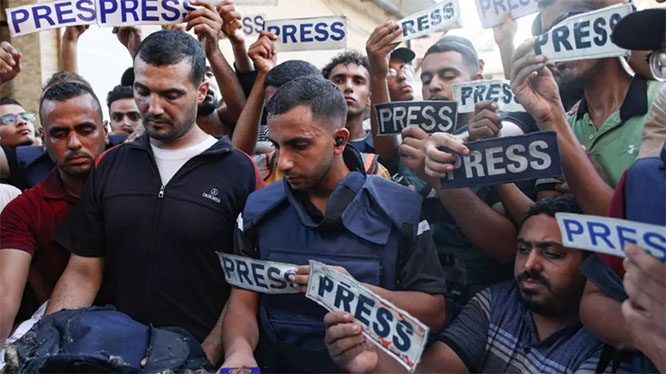
188 Palestinian journalists killed by Israeli army in Gaza

News Network
November 10, 2024

gazajournalists.jpg

The media office in the Gaza Strip, where the Israeli regime has been waging a genocidal war since last October, says as many as 188 Palestinian journalists have been killed since the onset of the brutal military onslaught.

The office provided the figure on Saturday, naming four journalists as the most recent victims of the onslaught.

It identified the foursome as Zahraa Mohammad Abu Sukheil, Ahmad Mohammad Abu Sukheil, Mustafa Khadr Bahar, and Abdel Rahman Khadr Bahar.

The office said it “strongly condemns the targeting, killing, and assassination of Palestinian journalists by the Israeli occupation and holds it fully responsible for committing this heinous crime.”

“We call on the international community, international organizations, and those involved in journalistic work worldwide to take action against the occupation, pursue it in international courts for its ongoing crimes, and pressure it to halt the genocide and the targeted killings of Palestinian journalists,” it said.

Earlier in the day, the office said the Israeli regime had bombed the tents sheltering journalists and displaced persons at the al-Aqsa Martyrs' Hospital in the city of Deir al-Balah in central Gaza for the ninth consecutive time.

The atrocity that claimed the lives of two people and injured 26 others came as part of “the genocidal crimes committed by the Israeli occupation army against hospitals, civilians, and displaced persons,” it said.

The media office held the regime and the United States, its biggest ally, as well as other countries aiding the genocide fully responsible for such systematic crimes.

At least 43,552 Palestinians, mostly women and children, have been killed and 102,765 others wounded since the launch of the war that followed a retaliatory operation by Gaza’s resistance groups.

The fatalities include 44 people, who were killed across the coastal sliver, in the most recent phase of the military onslaught.

As many as 24 of the victims were killed in the northern part of the territory, where the regime has markedly intensified its deadly attacks for weeks.

They included an eight-year-old child and a five-year-old one, who lost their lives after Israeli warplanes targeted a group of minors filling up jerry cans with water alongside their mother at the Jabalia Refugee camp.

Gaza’s heath ministry, meanwhile, said a number of victims remained under the rubble and in the streets following Israeli airstrikes, saying ambulances and civil defense teams could not reach them due to the sheer extent of the destruction caused by the raids and obstruction caused by the regime.

Also on Saturday, the Integrated Food Security Phase Classification (IPC) report, a United Nations-backed assessment, warned that famine was looming in northern Gaza amid escalated Israeli aggression and the regime’s near-total siege of the targeted areas.

The alert from the Famine Review Committee warned of "an imminent and substantial likelihood of famine occurring, due to the rapidly deteriorating situation in the Gaza Strip."

On October 17, the body projected that the number of people in Gaza facing "catastrophic" food insecurity between November and April 2025 would reach 345,000, or 16 percent of the population.

The IPC report classified that figure as Phase 5 -- a situation when "starvation, death, destitution, and extremely critical acute malnutrition levels are evident."

The Israeli military, however, questioned the report's credibility.

"To date, all assessments by the IPC have proven incorrect and inconsistent with the situation on the ground," the army said in a statement, denouncing "partial, biased data and superficial sources with vested interests."


Comments

Add new comment

  • Coastaldigest.com reserves the right to delete or block any comments.
  • Coastaldigset.com is not responsible for its readers’ comments.
  • Comments that are abusive, incendiary or irrelevant are strictly prohibited.
  • Please use a genuine email ID and provide your name to avoid reject.
News Network
January 23,2026

modIKERALA.jpg

Prime Minister Narendra Modi, during his visit to Thiruvananthapuram on Friday, January 23, indicated that the Bharatiya Janata Party (BJP) is aiming to expand its political footprint in Kerala ahead of the Assembly elections scheduled in the coming months.

Speaking at a BJP-organised public meeting, Modi drew parallels between the party’s early electoral gains in Gujarat and its recent victory in the Thiruvananthapuram Municipal Corporation. The civic body win, which ended decades of Left control, was cited by the Prime Minister as a possible starting point for the party’s broader ambitions in the state.

Recalling BJP’s political trajectory in Gujarat, Modi said the party was largely insignificant before 1987 and received little media attention. He pointed out that the BJP’s first major breakthrough came with its victory in the Ahmedabad Municipal Corporation that year.

“Just as our journey in Gujarat began with one city, Kerala’s journey has also started with a single city,” Modi said, suggesting that the party’s municipal-level success could translate into wider electoral acceptance.

The Prime Minister alleged that successive governments led by the Left Democratic Front (LDF) and the United Democratic Front (UDF) had failed to adequately develop Thiruvananthapuram. He accused both fronts of corruption and neglect, claiming that basic infrastructure and facilities were denied to the capital city for decades.

According to Modi, the BJP’s control of the civic body represents a shift driven by public dissatisfaction with the existing political alternatives. He asserted that the BJP administration in Thiruvananthapuram had begun working towards development, though no specific details or timelines were outlined.

Addressing the gathering at Putharikandam Maidan, Modi said the BJP intended to project Thiruvananthapuram as a “model city,” reiterating his party’s commitment to governance-led change.

The Prime Minister’s visit to Kerala also included the inauguration of several development projects and the flagging off of new train services, as the BJP intensifies its political outreach in the poll-bound state.

Comments

Add new comment

  • Coastaldigest.com reserves the right to delete or block any comments.
  • Coastaldigset.com is not responsible for its readers’ comments.
  • Comments that are abusive, incendiary or irrelevant are strictly prohibited.
  • Please use a genuine email ID and provide your name to avoid reject.
News Network
January 20,2026

Mangaluru: In a major step towards strengthening rural innovation, the Office of the Principal Scientific Adviser (PSA) to the Government of India is supporting the establishment of RuTAGe Smart Village Centres (RSVCs) across the country through collaborations with academic institutions, civil society organisations and philanthropic partners.

As part of this national initiative, Nitte (Deemed to be University) will set up the first RSVCs in the region at Nitte GP in Udupi district and at the Nitte Health Centre, Sevanjali Trust, Farangipete, in Dakshina Kannada district. The centres will be inaugurated on January 21. In South India, the programme is being implemented by the Section Infin-8 Foundation (SI-8).

Speaking to reporters on Monday, SI-8 founder-director Vishwas US said experts from Nitte University and SI-8 would work closely with farmers, students, youth and local entrepreneurs to adapt and deploy technologies tailored to local needs.

Project head Prof Iddya Karunasagar, representing Nitte DU, said the RSVCs at Nitte and Farangipete would serve as demonstration hubs for a wide range of agriculture, energy, skill-development and assistive technologies. These include solar dryers for fruits, vegetables and crops; soil-testing solutions; power weeders and women-friendly farm tools; wind-powered devices for rural artisans; grain storage systems; grass-cutting and tree-climbing equipment; and liquid fertiliser production using cowshed waste.

SI-8 CEO Aravind C Kumar said the centres would also provide access to digital and knowledge-based platforms such as ISRO applications, government scheme portals, market linkage tools and gamified learning resources, along with assistive technologies for persons with visual impairments.

Highlighting the broader impact of the initiative, Principal Scientific Adviser Prof Ajay Kumar Sood said it demonstrated how applied research could bridge the rural–urban divide and help create self-reliant, technology-enabled villages.

The initiative has been made possible through philanthropic support from Dr NC Murthy of ACM Business Solutions, LLC, USA. Dr Sapna Poti, Director (Strategic Alliances) at the Office of the Principal Scientific Adviser, said the long-term objective is to build self-sufficient, technology-driven communities capable of generating sustainable livelihoods on their own.

Comments

Add new comment

  • Coastaldigest.com reserves the right to delete or block any comments.
  • Coastaldigset.com is not responsible for its readers’ comments.
  • Comments that are abusive, incendiary or irrelevant are strictly prohibited.
  • Please use a genuine email ID and provide your name to avoid reject.