



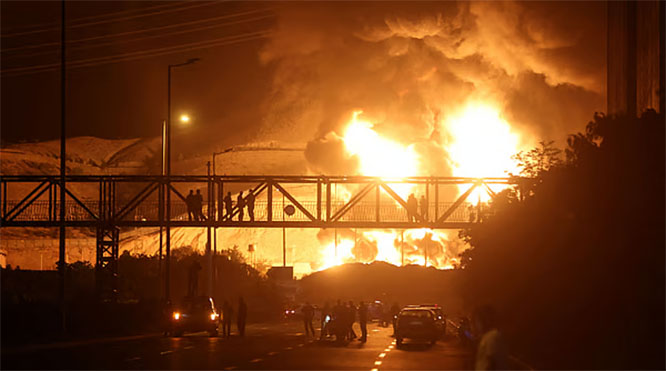
Israel and Iran launched fresh attacks on each other overnight into Sunday, June 15, stoking fears of a wider conflict after Israel expanded its bestial aggression against its main rival with a strike on the world’s biggest gas field.
Tehran called off nuclear talks that Washington had said were the only way to halt Israel’s bombing, while Israeli Prime Minister Benjamin Netanyahu said the attacks were nothing compared with what Iran would see in the coming days.
Iranian Foreign Minister Abbas Araqchi said the discussions in Oman could not take place while Iran was being subjected to Israel’s “barbarous” attacks.
The latest wave of Iranian attacks began shortly after 11:00 p.m. on Saturday (2000 GMT), when air raid sirens blared in Jerusalem and Haifa, sending around a million people into bomb shelters.
Around 2:30 a.m. local time (2330 GMT Saturday), the Israeli military warned of another incoming missile barrage and urged residents to seek shelter.
Explosions echoed through Tel Aviv and Jerusalem as missiles streaked across the skies as interceptor rockets were launched in response. The military lifted its shelter-in-place advisory nearly an hour after issuing the warning.
The ambulance service said at least seven people were killed overnight, including a 10-year-old boy and a woman in her 20s, and more than 140 injured in multiple attacks.
Search and rescue worked combed through the rubble of residential buildings destroyed in multiple strikes, using flashlights and dogs to look for survivors.
Israeli media said at least 35 people were missing after a strike hit Bat Yam, a city south of Tel Aviv. A spokesperson for the emergency services said a missile hit an 8-story building there and while many people were rescued, there were fatalities.
It was unclear how many buildings were hit overnight.
So far, at least nine people in Israel have been killed and over 300 others injured since Iran launched its retaliatory attacks on Friday.
Iran has said 78 people were killed there on the first day of Israel’s campaign, and scores more on the second, including 60 when a missile brought down a 14-story apartment block in Tehran, where 29 of the dead were children.
The Shahran oil depot in Tehran was targeted in an Israeli attack, Iran said, but added the situation was under control. A fire had erupted after an Israeli attack on an oil refinery near the capital while Israeli strikes also targeted Iran’s defense ministry building, causing minor damage, the semi-official Tasnim news agency said on Sunday.
US President Donald Trump had warned Iran of worse to come, but said it was not too late to halt the Israeli campaign if Tehran accepted a sharp downgrading of its nuclear program.
Israeli military issues evacuation warning to Iranians
Israel on Sunday issued an evacuation warning to Iranians residing near weapons facilities in Iran, an Israeli military spokesperson said in a post on X in Arabic and Farsi.
The spokesperson said the evacuation warning includes all weapons factories and supporting facilities.
US forces supported Israel in attacks
Araghchi said Sunday Tehran had evidence to show US forces supported the intense bombardment campaign Israel launched against the Islamic republic this week.
“We have solid proof of the support of the American forces and American bases in the region for the attacks of the Zionist regime military forces,” Araghchi told foreign diplomats in a meeting broadcast on state TV.
Araghchi also slammed the United Nations Security Council, accusing it of “indifference” over Israel’s deadly attacks on the Islamic republic.
Gas field attack
In the first apparent attack to hit Iran’s energy infrastructure, Tasnim news agency said Iran partially suspended production at South Pars, the world’s biggest gas field, after an Israeli strike caused a fire there on Saturday.
The South Pars field, offshore in Iran’s southern Bushehr province, is the source of most of the gas produced in Iran.
Fears about potential disruption to the region’s oil exports had already driven up oil prices 9 percent on Friday even though Israel spared Iran’s oil and gas on the first day of its attacks.
An Iranian general, Esmail Kosari, said on Saturday that Tehran was reviewing whether to close the Strait of Hormuz controlling access to the Gulf for tankers.
With Israel saying its operation could last weeks, and Netanyahu urging Iran’s people to rise up against their Islamic clerical rulers, fears have grown of a regional conflagration dragging in outside powers.
B’Tselem, a leading Israeli human rights organization, said on Saturday that instead of exhausting all possibilities for a diplomatic resolution, Israel’s government had chosen to start a war that puts the entire region in danger.
Tehran has warned Israel’s allies that their military bases in the region would come under fire too if they helped shoot down Iranian missiles.
However, 20 months of war in Gaza and a conflict in Lebanon last year have decimated Tehran’s strongest regional proxies, Hamas in Gaza and Hezbollah in Lebanon, reducing its options for retaliation.
Israel sees Iran’s nuclear program as a threat to its existence, and said the bombardment was designed to avert the last steps to production of a nuclear weapon.
Tehran insists the program is entirely civilian and that it does not seek an atomic bomb. The UN nuclear watchdog, however, reported Iran this week as violating obligations under the global non-proliferation treaty.
Iran says scores killed
Iran said 78 people were killed on the first day of Israel’s campaign, and scores more on the second, including 60 when a missile brought down a 14-story apartment block in Tehran, where 29 of the dead were children.
Iran had launched its own retaliatory missile volley on Friday night, killing at least three people in Israel.
With Israel saying its operation could last weeks, and Netanyahu urging Iran’s people to rise up against their Islamic clerical rulers, fears have grown of a regional conflagration dragging in outside powers.
B’Tselem, a leading Israeli human rights organization, said on Saturday that instead of exhausting all possibilities for a diplomatic resolution, Israel’s government had chosen to start a war that puts the entire region in danger.
Tehran has warned Israel’s allies that their military bases in the region would come under fire too if they helped shoot down Iranian missiles.
However, 20 months of war in Gaza and a conflict in Lebanon last year have decimated Tehran’s strongest regional proxies, Hamas in Gaza and Hezbollah in Lebanon, reducing its options for retaliation.
Israel sees Iran’s nuclear program as a threat to its existence, and said the bombardment was designed to avert the last steps to production of a nuclear weapon.
Tehran insists the program is entirely civilian and that it does not seek an atomic bomb. However the UN nuclear watchdog reported it this week as violating obligations under the global non-proliferation treaty.
‘We will hit every site’
Israel said three people were killed and 76 wounded by Iran’s retaliatory drone and missile barrage overnight, which lit up the skies over Jerusalem and Tel Aviv.
Netanyahu vowed to keep up Israel’s campaign.
“We will hit every site, every target of the ayatollah regime,” he said in a video statement, threatening greater action “in the coming days.”
He added that the Israeli campaign had dealt a “real blow” to Iran’s nuclear program and maintained it had the “clear support” of US President Donald Trump.
Netanyahu’s defense minister, Israel Katz, warned “Tehran will burn” if it kept targeting Israeli civilians.
Israel’s fire service reported residential buildings were hit following the latest launches.
Iranian President Masoud Pezeshkian fired back that “the continuation of the Zionist aggression will be met with a more severe and powerful response from the Iranian armed forces.”
According to a statement from his office, Pezeshkian also condemned Washington’s “dishonesty” for supporting Israel while engaged in nuclear talks with Iran — which mediator Oman said would no longer take place on Sunday.
Western governments have repeatedly accused Iran of seeking a nuclear weapon, which it denies.
Amid the continued conflict, planned negotiations between Iran and the United States over Tehran’s nuclear program were canceled, throwing into question when and how an end to the fighting could come.




Comments
Add new comment