



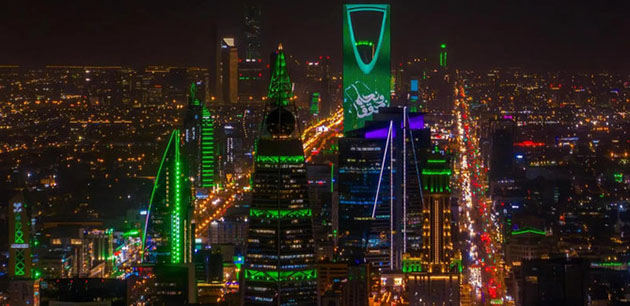
Celebration of ‘progress and unity’ marks Saudi Arabia’s 93rd National Day

Agencies
September 23, 2023

saudi.jpg

Riyadh, Sept 23: This day marks the 93rd National Day of Saudi Arabia, a day of pride and celebration for both its citizens and residents. Under the visionary leadership that prioritizes the well-being and prosperity of the people, this joyous occasion reflects upon the nation's remarkable journey toward a promising future.

As we commemorate this historic day, the Saudi Press Agency (SPA) takes us on a reflective journey through the life of a true statesman, King Abdulaziz bin Abdulrahman Al-Faisal Al Saud. On September 23, 1932, he achieved the monumental task of unifying the disparate tribes and scattered regions of the Arabian Peninsula, establishing the Kingdom of Saudi Arabia. This Islamic state, with Riyadh as its capital, adopted the Holy Qur'an and the Prophet's Sunnah as its constitution.

King Abdulaziz's remarkable journey began in Riyadh in 1293 Hijri. At the tender age of seven, he began learning to read and write, and at ten, his father, Imam Abdulrahman Al-Faisal, gathered scholars and tutors to instill in him the fundamentals of Islam and equestrian skills. His upbringing was greatly influenced by his courageous father and wise mother, Princess Sarah Al-Sudairi. King Abdulaziz shared a close bond with his siblings, including his sister, Princess Noura.

Throughout his life, King Abdulaziz encountered numerous challenges that shaped his character and instilled in him qualities of patience, strength, and statesmanship. One of the most trying moments was his forced departure from Riyadh in 1308 Hijri when he and his family settled in various locations, including the Yabrin oasis, Bahrain, and Kuwait. Despite these hardships, his determination to reclaim Riyadh, a city with deep historical significance for his family, remained unwavering.

In his twenties, King Abdulaziz embarked on a journey back to Riyadh, leading an army. His arrival in Al-Shaqib district marked the beginning of a pivotal chapter. Following a brief but intense battle, he restored order, ushering in a period of political stability that laid the foundation for Riyadh's growth and prosperity.

In 1320 Hijri, the people and notables of Riyadh pledged allegiance to him as Emir of Najd and Imam of its people. This victory brought much-needed stability after years of turmoil, setting the stage for Riyadh's transformation.

King Abdulaziz's tireless efforts to unite the nation, restore security, and combat the chaos of the Arabian Peninsula culminated in him becoming the revered leader of a newly constructed nation, securing a respected place for it on the world stage.

On September 23, 1932, King Abdulaziz issued a royal decree, renaming the state from the Kingdom of Hejaz and Najd and its annexes as the Kingdom of Saudi Arabia.

With the nation-building process well underway, King Abdulaziz turned his attention to expanding the Two Holy Mosques to serve pilgrims and establishing schools, hospitals, villages, and irrigation systems to support agriculture. These ambitious endeavors required substantial funding.

In the fall of 1933, oil exploration efforts began, initially yielding no results. However, persistence paid off when oil was discovered 5,000 feet underground in the "Ain Jet" area in 1939. This discovery marked a turning point, opening the doors to major state projects.

King Abdulaziz's interest extended beyond domestic affairs; he maintained diplomatic relations with countries worldwide, prioritizing the Kingdom's independence while fostering relations irrespective of religious, cultural, or civilizational differences. His approach garnered admiration from world leaders and media alike.

In Muharram 1373 Hijri, King Abdulaziz fell seriously ill in Taif, and he passed away on November 9, 1953. He was laid to rest in Al-Oud Cemetery, Riyadh.

As he built his nation, King Abdulaziz's commitment to education was unwavering. He avidly read Arabic books on various sciences, printing and distributing them freely. He sought the counsel of his citizens, guided by Islamic principles, fostering cooperation between the ruler and the governed.

King Abdulaziz's righteous approach, continued by his sons, laid the groundwork for the Kingdom's remarkable development, characterized by collaboration between the leadership and the people.

In a historic gathering on Muharram 25, 1355 Hijri, King Abdulaziz emphasized his desire for close ties with the people, stating, "My door is always open to anyone who wants to talk."

Under his leadership, Saudi Arabia forged strong relationships with Arab and Muslim nations and engaged the international community with transparency and pragmatism.

King Abdulaziz's legacy was the culmination of a rich history. The First Saudi State, founded by Imam Mohammed bin Saud in 1139 Hijri, laid the foundation for the nation's development. The Second Saudi State, initiated by Turki bin Abdullah bin Mohammed bin Saud, continued this legacy for approximately 68 years.

However, the true turning point came on the fifth day of Shawwal, 1319 Hijri, when King Abdulaziz reclaimed Riyadh with valor, establishing a state grounded in the principles of the Holy Qur'an and Prophet Mohammad's Sunnah.

Subsequent leaders, including King Saud, King Faisal, King Khalid, King Fahd, and King Abdullah, each contributed to the nation's progress and development, with a focus on education, healthcare, industry, and economic growth.

Today, under the wise leadership of Custodian of the Two Holy Mosques King Salman, Saudi Arabia continues its journey of growth, development, and global influence. The Kingdom boasts a strong economy that ranks among the world's top 20.

As we celebrate Saudi Arabia's National Day, we reflect on the nation's remarkable accomplishments, secure in the knowledge that its legacy of progress and unity will continue to thrive under the leadership of King Salman. Saudi Arabia stands as a testament to what can be achieved with vision, determination, and the unwavering commitment to the welfare of its people.


Comments

Add new comment

  • Coastaldigest.com reserves the right to delete or block any comments.
  • Coastaldigset.com is not responsible for its readers’ comments.
  • Comments that are abusive, incendiary or irrelevant are strictly prohibited.
  • Please use a genuine email ID and provide your name to avoid reject.
News Network
November 27,2025

imrankhan.jpg

Authorities at Pakistan’s high-security Adiala Jail in Rawalpindi on Wednesday dismissed speculation about the condition of imprisoned former Pakistan Prime Minister Imran Khan, rejecting rumours that he had been moved out of the facility or was in danger. Officials said Khan was in “good health” and described the viral death claims as “baseless.”

“There is no truth to reports about his transfer from Adiala Jail,” the Rawalpindi prison administration said in a statement, according to Geo News. “He is fully healthy and receiving complete medical attention.”

Amid swirling rumours on social media, Imran Khan’s party, Pakistan Tehreek-e-Insaf (PTI), urged the federal government to issue an official clarification and demanded that authorities allow his family to meet him immediately, Dawn reported.

The frenzy began after Khan’s three sisters called for an impartial probe into what they described as a “brutal” police assault on them and other PTI supporters outside Adiala Jail last week. Soon after, several social media handles circulated unverified claims alleging that Khan had been “killed” inside the prison.

The rumours intensified when a handle named “Afghanistan Times” claimed that “credible sources” had confirmed Khan’s “murder” and that his body had been moved out of the jail — allegations that have not been verified by any credible agency.

Imran Khan, PTI’s patron-in-chief, has been lodged in the Rawalpindi prison since August 2023 in multiple cases. For over a month, an undeclared restriction has prevented family members and senior PTI leaders from meeting him. Khyber-Pakhtunkhwa Chief Minister Sohail Afridi has reportedly been denied access despite making seven attempts.

In a letter to Punjab Police Chief Usman Anwar, Khan’s sisters — Noreen Niazi, Aleema Khan, and Dr. Uzma Khan — said they were “peacefully protesting” outside the jail when police allegedly launched an unprovoked assault after streetlights were switched off.

“At 71, I was seized by my hair, thrown to the ground and dragged across the road,” Noreen Niazi said, alleging that other women present were also slapped and manhandled.

Adiala Jail officials reiterated that speculation over Imran Khan’s health was unfounded and insisted that his well-being was being ensured, Geo News reported.

Comments

Add new comment

  • Coastaldigest.com reserves the right to delete or block any comments.
  • Coastaldigset.com is not responsible for its readers’ comments.
  • Comments that are abusive, incendiary or irrelevant are strictly prohibited.
  • Please use a genuine email ID and provide your name to avoid reject.
News Network
November 28,2025

fire.jpg

Several Syrians were killed and more than two dozen others injured in Israeli strikes on the outskirts of Damascus, amid intensified incursions by the occupying regime since the fall of former president Bashar al-Assad and the rise of Hayat Tahrir al-Sham (HTS) rule.

Syrian state TV reported that the casualties occurred during an overnight Israeli assault involving helicopters and drones on the town of Beit Jinn in the Damascus countryside. The attack followed an Israeli military unit’s entry into the town, where they were surrounded by local residents, leading to gunfire and direct confrontations.

According to the report, “The occupation army’s helicopters and artillery shelled Beit Jinn, located at the foothills of Mount Hermon, resulting in 13 martyrs and 25 injured civilians.” The broadcaster did not specify the full extent of damage.

Al-Ikhbariyah Syria confirmed that the shelling coincided with Israeli soldiers entering Beit Jinn, while artillery pounded surrounding areas. The broadcaster stated that the escalation began after local residents clashed with an Israeli patrol that had infiltrated the southern town and “kidnapped” three young men.

Following a two-hour exchange of heavy fire, Israeli forces withdrew and repositioned on the hill of Butt al-Warda at the town’s outskirts.

Israeli media acknowledged that six soldiers were wounded in the clashes—three of them seriously—describing the confrontation as a “sudden ambush” that forced the deployment of reserve units and air support to secure an exit route. No further details were provided.

The aggression has fueled renewed displacement from Beit Jinn, with residents fleeing to nearby villages amid increasingly frequent Israeli attacks.

The raid came just a day after Israeli troops carried out another ground incursion into Umm al-Luqas village in Quneitra province. According to SANA, an Israeli unit in four vehicles entered the village, raided several homes, and later withdrew.

Syria condemned the repeated incursions as violations of the 1974 Disengagement Agreement and UN resolutions, urging the international community to enforce compliance and pressure Israel to halt its operations and withdraw fully.

Israel has expanded its attacks across Syrian territory following the collapse of the Assad government last year. Prime Minister Benjamin Netanyahu has reportedly instructed his forces to push deeper into Syrian territory and seize strategic positions.

Meanwhile, critics say the HTS-led interim government’s inaction and growing normalization gestures toward Israel have emboldened Tel Aviv to intensify its military operations. HTS, formerly linked to al-Qaeda, seized control of Damascus last December, formally ending Assad’s rule.

Comments

Add new comment

  • Coastaldigest.com reserves the right to delete or block any comments.
  • Coastaldigset.com is not responsible for its readers’ comments.
  • Comments that are abusive, incendiary or irrelevant are strictly prohibited.
  • Please use a genuine email ID and provide your name to avoid reject.
News Network
November 28,2025

ministerPM.jpg

Mangaluru, Nov 28: Karnataka Health Minister and Dakshina Kannada district in-charge minister Dinesh Gundu Rao on Friday handed over Chief Minister Siddaramaiah’s letter to Prime Minister Narendra Modi, highlighting the severe distress faced by farmers due to crashing crop prices.

PM Modi arrived at the Mangaluru International Airport en route to Udupi, where Gundu Rao welcomed him and submitted the letter. The chief minister’s message stressed that farmers are suffering heavy losses because maize and green gram are being bought far below the Minimum Support Price (MSP). The state urged the Centre to immediately begin procurement at MSP.

According to the letter, Karnataka has a bumper harvest this year—over 54.74 lakh metric tons of maize and 1.98 lakh metric tons of green gram—yet farmers are unable to secure fair prices. Against the MSP of ₹2,400/MT for maize and ₹8,768/MT for green gram, market rates have plunged to ₹1,600–₹1,800 and ₹5,400 respectively.

The chief minister has requested the Centre to:

• Direct NAFED, FCI and NCCF to start MSP procurement immediately.
• Ensure ethanol units purchase maize directly from farmers or FPOs.
• Increase Karnataka’s ethanol allocation, citing high production capacity.
• Stop maize imports, which have depressed domestic prices.
• Relax quality norms for green gram, allowing up to 10% discoloration due to rains.

The letter stresses that MSP is crucial for farmer dignity and income stability and calls for swift central intervention to prevent a deepening crisis.

Comments

Add new comment

  • Coastaldigest.com reserves the right to delete or block any comments.
  • Coastaldigset.com is not responsible for its readers’ comments.
  • Comments that are abusive, incendiary or irrelevant are strictly prohibited.
  • Please use a genuine email ID and provide your name to avoid reject.
