



Children not allowed at Two Holy Mosques during Ramadan 2021

News Network
April 12, 2021

Riyadh: The Ministry of Hajj and Umrah has revealed the updated mechanism and regulations for the issuance of permit to perform Umrah as well as to perform prayer at Grand Mosque in Makkah and visit the Rawdah Sharif at the Prophet’s Mosque in Madinah during the holy month of Ramadan.

According to the regulations, only vaccinated pilgrims and worshipers will be allowed to perform the rituals. Children will not be allowed to accompany the pilgrims and worshipers at the Two Holy Mosques. The Isha prayer permit will include performance of taraweeh (special prayers during Ramadan) prayers as well.

The ministry said that the permits will be issued for immunized persons as shown in the Tawakkalna application, and these include three categories: those immunized by taking two doses of the vaccine; those who have spent 14 days after getting their first dose of the vaccine; and those who have recovered from coronavirus.

The Ministry has set seven time periods for the performance of Umrah, and it will update the capacity around the clock according to the available and canceled reservations.

The ministry emphasized that unauthorized vehicles are not allowed to enter the Central Haram Area in Makkah. Vehicles will have to enter Makkah through various checkpoints only in the appropriate time as mentioned in the permit.

The ministry also highlighted the importance of pre-purchase of transport tickets electronically through the Eatmarna application in order to avoid the delay in transport centers.

During the holy month of Ramadan, the capacity of the Grand Mosque will be raised in order to accommodate 50,000 vaccinated Umrah pilgrims and 100,000 worshipers.

The pilgrims and worshipers will be allowed to enter the Grand Mosques strictly in compliance with the precautionary measures and preventive protocols to stem the spread of coronavirus.

Showing the permits and verifying their validity will be through the Tawakkalna application directly from the account of the permit holder in the application.

The ministry urged all the faithful to get permits issued only through the approved Eatmarna and Tawakkalna applications and warned against relying on fake websites and campaigns.

Recently, the Ministry of Interior warned that hefty fines would be slapped on those who enter Makkah to perform Umrah or prayer at the Grand Mosque without a valid permit during the month of Ramadan.

“Anyone who is caught while entering Makkah to perform Umrah without a permit will face a fine of SR10,000 while anyone who enters Makkah to perform prayer at the Grand Mosque without a permit will have to pay a fine of SR1,000,” an official source at the ministry said.

According to the source, the new regulation will be in force until the end of the pandemic and till the return to normal public life. The ministry source called upon citizens and expatriates to abide by the directives to obtain a permit for the performance of Umrah and prayer at the Grand Mosque through the Eatmarna application.

“The security personnel will carry out their duties along all roads, security check posts, as well as at the sites and corridors leading to the central area around the Grand Mosque to prevent any attempt to violate the regulations issued in this regard,” the source added.

Comments

Add new comment

  • Coastaldigest.com reserves the right to delete or block any comments.
  • Coastaldigset.com is not responsible for its readers’ comments.
  • Comments that are abusive, incendiary or irrelevant are strictly prohibited.
  • Please use a genuine email ID and provide your name to avoid reject.
News Network
January 23,2026

modIKERALA.jpg

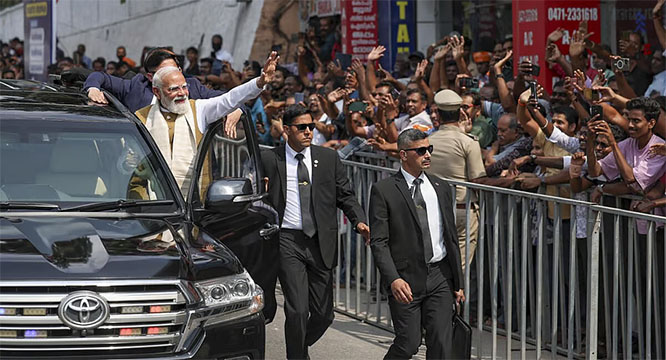
Prime Minister Narendra Modi, during his visit to Thiruvananthapuram on Friday, January 23, indicated that the Bharatiya Janata Party (BJP) is aiming to expand its political footprint in Kerala ahead of the Assembly elections scheduled in the coming months.

Speaking at a BJP-organised public meeting, Modi drew parallels between the party’s early electoral gains in Gujarat and its recent victory in the Thiruvananthapuram Municipal Corporation. The civic body win, which ended decades of Left control, was cited by the Prime Minister as a possible starting point for the party’s broader ambitions in the state.

Recalling BJP’s political trajectory in Gujarat, Modi said the party was largely insignificant before 1987 and received little media attention. He pointed out that the BJP’s first major breakthrough came with its victory in the Ahmedabad Municipal Corporation that year.

“Just as our journey in Gujarat began with one city, Kerala’s journey has also started with a single city,” Modi said, suggesting that the party’s municipal-level success could translate into wider electoral acceptance.

The Prime Minister alleged that successive governments led by the Left Democratic Front (LDF) and the United Democratic Front (UDF) had failed to adequately develop Thiruvananthapuram. He accused both fronts of corruption and neglect, claiming that basic infrastructure and facilities were denied to the capital city for decades.

According to Modi, the BJP’s control of the civic body represents a shift driven by public dissatisfaction with the existing political alternatives. He asserted that the BJP administration in Thiruvananthapuram had begun working towards development, though no specific details or timelines were outlined.

Addressing the gathering at Putharikandam Maidan, Modi said the BJP intended to project Thiruvananthapuram as a “model city,” reiterating his party’s commitment to governance-led change.

The Prime Minister’s visit to Kerala also included the inauguration of several development projects and the flagging off of new train services, as the BJP intensifies its political outreach in the poll-bound state.

Comments

Add new comment

  • Coastaldigest.com reserves the right to delete or block any comments.
  • Coastaldigset.com is not responsible for its readers’ comments.
  • Comments that are abusive, incendiary or irrelevant are strictly prohibited.
  • Please use a genuine email ID and provide your name to avoid reject.
News Network
January 23,2026

Mangaluru: The Karnataka Government Polytechnic (KPT), Mangaluru, has achieved autonomous status from the All India Council for Technical Education (AICTE), becoming the first government polytechnic in the country to receive such recognition in its 78-year history. The status was granted by AICTE, New Delhi, and subsequently approved by the Karnataka Board of Technical Education in October last year.

Officials said the autonomy was conferred a few months ago. Until recently, AICTE extended autonomous status only to engineering colleges, excluding diploma institutions. However, with a renewed national focus on skill development, several government polytechnics across India have now been granted autonomy.

KPT, the second-largest polytechnic in Karnataka, was established in 1946 with four branches and has since expanded to offer eight diploma programmes, including computer science and polymer technology. The institution is spread across a 19-acre campus.

Ravindra M Keni, the first dean of the institution, told The Times of India that AICTE had proposed autonomous status for polytechnic institutions that are over 25 years old. “Many colleges applied. In the first round, 100 institutions were shortlisted, which was further narrowed down to 15 in the second round. We have already completed one semester after becoming an autonomous institution,” he said. He added that nearly 500 students are admitted annually across eight three-year diploma courses.

Explaining the factors that helped KPT secure autonomy, Keni said the institution has consistently recorded 100 per cent admissions and placements for its graduates. He also noted its strong performance in sports, with the college emerging champions for 12 consecutive years, along with active student participation in NCC and NSS activities.

Autonomous status allows KPT to design industry-oriented curricula, conduct examinations, prepare question papers, and manage academic documentation independently. The institution can also directly collaborate with industries and receive priority funding from AICTE or the Ministry of Education. While academic autonomy has been granted, financial control will continue to rest with the state government.

“There will be separate committees for examinations, question paper setting, boards of studies, and boards of examiners. The institution will now have the freedom to conduct admissions without government notifications and issue its own marks cards,” Keni said, adding that new academic initiatives would be planned after a year of functioning under the autonomous framework.

Comments

Add new comment

  • Coastaldigest.com reserves the right to delete or block any comments.
  • Coastaldigset.com is not responsible for its readers’ comments.
  • Comments that are abusive, incendiary or irrelevant are strictly prohibited.
  • Please use a genuine email ID and provide your name to avoid reject.