



Christmas cancelled in birthplace of Jesus Christ amid Israel’s genocidal war

News Network
December 25, 2023

Bethlehem.jpg

In the city of Bethlehem in the Israeli-occupied West Bank, Christmas has always been synonymous with festivities, colorful decorations, sumptuous food, and bustling markets.

Christian communities in the city, which is a major pilgrimage destination for Christians for being the birthplace of Jesus Christ, adorn their homes and alleys and flock markets for shopping.

This year, however, a pall of gloom has descended on Bethlehem amid the Israeli regime’s genocidal war against Palestinians in the besieged Gaza Strip as well as the occupied West Bank.

Christian communities in Bethlehem as well as in the Gaza Strip have decided to cancel the annual Christmas festivities in solidarity with the victims of the occupying entity’s unbridled aggression.

Streets in Bethlehem wear a deserted look and markets are also mostly closed these days. The usual hustle and bustle associated with Christmas celebrations is missing in the birthplace of Jesus.

As the death toll in the besieged coastal territory tops 20,000, most of them children and women, both Palestinian Muslims and Christians are in grief and no mood for traditional festivities.

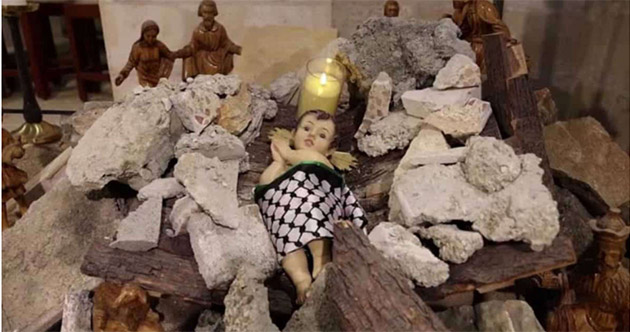
Reverend Isaac Munther, a Palestinian pastor of a Lutheran church in Bethlehem, addressing his congregation earlier this month with the figure of Jesus Christ in a keffiyeh, said Christmas is the “radiance of life from the heart of destruction and death.” 
“If Christ were to be born today, he would be born under the rubble. I invite you to see the image of Jesus in every child killed and pulled from under the rubble, in every child struggling for life in destroyed hospitals, in every child in incubators,” Pastor Munther said, surrounded by rubble.

“Christmas celebrations are canceled this year, but Christmas itself is not and will not be canceled, for our hope cannot be canceled,” he hastened to add.

Last week, Pope Francis slammed the Tel Aviv regime for committing terrorism against Palestinians in Gaza, after an Israeli sniper killed two women at a Catholic church in Gaza where they had taken refuge. 

“Some say, ‘This is terrorism. This is war.’ Yes, it is war. It is terrorism,” the head of the Catholic Church said, urging people not to forget people suffering from the Israeli war.

His statement came after an Israeli attack on the Holy Family Parish in Gaza.

An estimated 1,100 Christians live among 2.3 million people in the Gaza Strip, and an additional 50,000 live in the occupied West Bank, notably in Bethlehem and East Jerusalem.

Both Muslims and Christians have come under ferocious attacks in Gaza since October 7, and many mosques and churches have been vandalized or destroyed by the regime's warplanes.

In late October, an Israeli airstrike targeted the complex of the Church of Saint Porphyrius, the oldest church in Gaza and the third oldest in the world, killing at least 16 people, including 10 from one family.

In a statement at the time, the Greek Orthodox Patriarchate condemned the bombing, stressing that "targeting churches and its affiliated institutions, in addition to the shelters they provide to protect innocent citizens, constitutes a war crime that cannot be ignored."

It came weeks after an attack on an Anglican Al-Ahli Arab Hospital in northern Gaza, founded in 1882 and managed by the Episcopal Church in occupied Jerusalem al-Quds.

Reverend Mitri Raheb, the president of Dar al-Kalima University, speaking to Democracy Now on Friday said he has not experienced “so much sadness” in his entire life.

“You don’t have a Christmas tree in Bethlehem. There are no tourists coming, because of the war. And the people are not up for celebrations, because our people in Gaza, but not only our people in Gaza, also our people in the West Bank, we’re experiencing apartheid, colonization by Jewish settlers,” he said.

“These are the Christmas gifts of Israel for the Christian community in Gaza. And I fear that this is the end of the Christian presence in Gaza.”

In November, the Patriarchs and Heads of Churches in Jerusalem had urged Christians to avoid “unnecessarily festive activities” and donate Christmas funds for humanitarian aid for Gaza.

The churches and municipality of Ramallah in the occupied West Bank also announced the cancellation of Christmas festivities, restricting the annual events to church services, devoid of celebrations.

“At this time every year, we prepare to decorate the city in celebration of Christmas, to welcome the holiday with joy and love. However, today, instead of bringing smiles to the faces of our children, we mourn for them,” it said in a statement.

“Instead of giving them holiday gifts, we can't even send humanitarian aid to them (in Gaza) while they are under bombardment, war, and destruction.”

In solidarity with the Palestinian Muslims and Christians and in protest against the Israeli genocide in Gaza, Christian communities in many countries have announced they will cancel this year’s festival.

“Jesus was a Palestinian revolutionary! This #Christmas, ask yourself ‘What would Jesus do?’ Would he be in the #Resistance,” wrote David Miller, London-based Press TV show host, on his X handle.

Mangingisada, a Philippines-based activist, in a social media post, urged his friends and followers not to wish him Christmas this year.

“As a Christian, I will not accept any fake greetings from terrorist Israelis. I want an end to bombings and killings in Gaza and the West Bank. I want an end to the apartheid and illegal occupation,” he wrote.

Aditya Chakrabortyy, a writer for Guardian, in a post on X, said the world cannot ignore what is unfolding in the besieged Gaza Strip amid the Israeli regime’s bombings.

“When we celebrate the birth of a child in Bethlehem on what is today the West Bank and are supposed to ignore the killing of 10,000 children in Gaza,” he wrote.

Comments

Add new comment

  • Coastaldigest.com reserves the right to delete or block any comments.
  • Coastaldigset.com is not responsible for its readers’ comments.
  • Comments that are abusive, incendiary or irrelevant are strictly prohibited.
  • Please use a genuine email ID and provide your name to avoid reject.
News Network
February 1,2026

US President Donald Trump on Saturday claimed that the government of India led by Prime Minister Narendra Modi has made a deal to buy Venezuelan oil, as opposed to purchasing it from Iran.

"We've already made that deal, the concept of the deal," he told reporters on Air Force One.

Trump had imposed 25% tariffs on countries buying Venezuelan oil, including India, in March 2025. He had also hit India with tariffs for buying Russian oil, saying it was "funding" President Vladimir Putin's war against Ukraine.

Trump has said that the US has taken control of the oil-rich Venezuela after capturing former President Nicolas Maduro in January.

A fleet of 18 ships loaded with crude oil bound for refineries in Texas, Louisiana, and Mississippi in January, the most since December 2024, according to a report by the news agency Bloomberg.

Combined crude deliveries to the US will reach about 2,75,000 barrels a day, more than doubling volumes seen in December last year. Shipments to China, which averaged 4,00,000 barrels a day last year, fell to zero in January.

PM Modi, Venezuelan President Agree To Expand Ties

Prime Minister Narendra Modi and Venezuela's acting President Delcy Rodriguez spoke on Friday and agreed to take the bilateral relations to "new heights" in the years ahead.

It was the first phone call between the two leaders since the capture of Maduro and his wife by the US on January 3.

"Spoke with Acting President of Venezuela, Ms. Delcy Rodriguez. We agreed to further deepen and expand our bilateral partnership in all areas, with a shared vision of taking India-Venezuela relations to new heights in the years ahead," PM Modi said in a post on X.

A statement from Prime Minister Modi's office said the two leaders agreed to further expand and deepen the India-Venezuela partnership in all areas, including trade and investment, energy, digital technology, health, agriculture, and people-to-people ties.

They exchanged views on various regional and global issues of mutual interest and underscored the importance of their close cooperation for the Global South, the statement said.

Rodriguez also said that they discussed partnerships in the fields of agriculture, science and technology, mining, and tourism, as well as the pharmaceutical and automotive industries.

Comments

Add new comment

  • Coastaldigest.com reserves the right to delete or block any comments.
  • Coastaldigset.com is not responsible for its readers’ comments.
  • Comments that are abusive, incendiary or irrelevant are strictly prohibited.
  • Please use a genuine email ID and provide your name to avoid reject.
News Network
January 23,2026

Mangaluru: The Karnataka Government Polytechnic (KPT), Mangaluru, has achieved autonomous status from the All India Council for Technical Education (AICTE), becoming the first government polytechnic in the country to receive such recognition in its 78-year history. The status was granted by AICTE, New Delhi, and subsequently approved by the Karnataka Board of Technical Education in October last year.

Officials said the autonomy was conferred a few months ago. Until recently, AICTE extended autonomous status only to engineering colleges, excluding diploma institutions. However, with a renewed national focus on skill development, several government polytechnics across India have now been granted autonomy.

KPT, the second-largest polytechnic in Karnataka, was established in 1946 with four branches and has since expanded to offer eight diploma programmes, including computer science and polymer technology. The institution is spread across a 19-acre campus.

Ravindra M Keni, the first dean of the institution, told The Times of India that AICTE had proposed autonomous status for polytechnic institutions that are over 25 years old. “Many colleges applied. In the first round, 100 institutions were shortlisted, which was further narrowed down to 15 in the second round. We have already completed one semester after becoming an autonomous institution,” he said. He added that nearly 500 students are admitted annually across eight three-year diploma courses.

Explaining the factors that helped KPT secure autonomy, Keni said the institution has consistently recorded 100 per cent admissions and placements for its graduates. He also noted its strong performance in sports, with the college emerging champions for 12 consecutive years, along with active student participation in NCC and NSS activities.

Autonomous status allows KPT to design industry-oriented curricula, conduct examinations, prepare question papers, and manage academic documentation independently. The institution can also directly collaborate with industries and receive priority funding from AICTE or the Ministry of Education. While academic autonomy has been granted, financial control will continue to rest with the state government.

“There will be separate committees for examinations, question paper setting, boards of studies, and boards of examiners. The institution will now have the freedom to conduct admissions without government notifications and issue its own marks cards,” Keni said, adding that new academic initiatives would be planned after a year of functioning under the autonomous framework.

Comments

Add new comment

  • Coastaldigest.com reserves the right to delete or block any comments.
  • Coastaldigset.com is not responsible for its readers’ comments.
  • Comments that are abusive, incendiary or irrelevant are strictly prohibited.
  • Please use a genuine email ID and provide your name to avoid reject.
News Network
February 1,2026

Bengaluru: Karnataka Deputy Chief Minister D K Shivakumar on Sunday criticised the Union Budget presented by Finance Minister Nirmala Sitharaman, claiming it offered no tangible benefit to the state.

Though he said he was yet to study the budget in detail, Shivakumar asserted that Karnataka had gained little from it. “There is no benefit for our state from the central budget. I was observing it. They have now named a programme after Mahatma Gandhi, after repealing the MGNREGA Act that was named after him,” he said.

Speaking to reporters here, the Deputy Chief Minister demanded the restoration of MGNREGA, and made it clear that the newly enacted rural employment scheme — VB-G RAM G — which proposes a 60:40 fund-sharing formula between the Centre and the states, would not be implemented in Karnataka.

“I don’t see any major share for our state in this budget,” he added.

Shivakumar, who also holds charge of Bengaluru development, said there were high expectations for the city from the Union Budget. “The Prime Minister calls Bengaluru a ‘global city’, but what has the Centre done for it?” he asked.

He also drew attention to the problems faced by sugar factories, particularly those in the cooperative sector, alleging a lack of timely decisions and support from the central government.

Noting that the Centre has the authority to fix the minimum support price (MSP) for agricultural produce, Shivakumar said the Union government must take concrete steps to protect farmers’ interests.

Comments

Add new comment

  • Coastaldigest.com reserves the right to delete or block any comments.
  • Coastaldigset.com is not responsible for its readers’ comments.
  • Comments that are abusive, incendiary or irrelevant are strictly prohibited.
  • Please use a genuine email ID and provide your name to avoid reject.