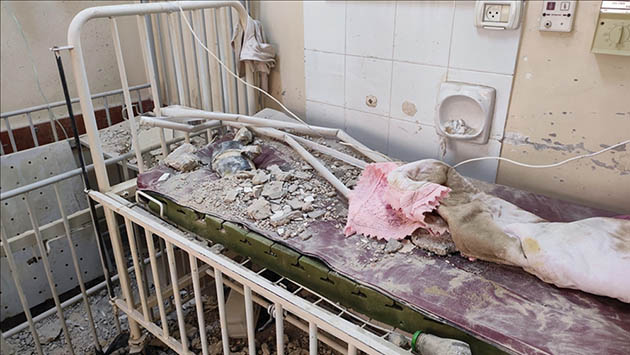
Gaza hospitals stretched to breaking point by Israeli bombing; infections exploding: UN

News Network
December 13, 2023

Gazahospital.jpg

The United Nations says only 13 out of 36 hospitals in the Gaza Strip are partially functional as Israeli occupation forces are targeting medical centers and staff amid heavily bombardment of the besieged territory.

The United Nations Office for the Coordination of Humanitarian Affairs (OCHA) said in a report on Tuesday that the services provided to patients in operational hospitals are “limited” as they have run out of bed capacity.

“The two major hospitals in southern Gaza are operating at three times above their bed capacity while facing critical shortages of basic supplies and fuel,” the report said. “Only one of these hospitals is in the north.”

“[Bed] occupancy rates are now reaching 206 percent in inpatient departments and 250 percent in intensive care units. Additionally, these hospitals are providing shelter to thousands of displaced people,” it added citing data from the Gaza Ministry of Health.

The report also said that the maternity department at Kamal Adwan Hospital in Beit Lahiya, north of Gaza, was hit on Monday, resulting in the death of several mothers.

The hospital remains surrounded by Israeli troops and tanks, and fighting has been reported in its vicinity for three consecutive days, the OCHA report added.

“The hospital is currently accommodating 65 patients, including 12 children in the intensive care unit (ICU) and six newborns in incubators. About 3,000 internally displaced persons (IDPs) remain trapped in the facility and are awaiting evacuation with extreme shortages of water, food, and power reported.”

Ahmed al-Kahlout, head of the Kamal Adwan Hospital, told Al Jazeera that “no one can leave” the hospital, which has been under siege by Israeli tanks for four days and they face “extremely difficult” conditions.

The OCHA report also said that for the sixth consecutive day, Al-Awda Hospital in Jabalya (northern Gaza) remains surrounded by Israeli forces as fighting has been reported in its vicinity.

“Reportedly, 250 doctors, patients, and their family members are trapped inside the hospital,” it said, adding that two medical staff were reportedly killed by Israeli forces while on duty inside the hospital on Saturday.

“Let us be clear: Al-Awda is a functioning hospital with medical staff and many patients in vulnerable condition. Targeting medical workers as they care for their patients is utterly reprehensible, utterly inhumane,” The Doctors Without Borders (Medecins Sans Frontieres, or MSF) said on X, formerly Twitter.

The vicinities of Al-Aqsa Hospital in Deir Al-Balah and Al-Amal Hospital in Khan Younis were also repeatedly bombarded on Sunday and Monday which impeded the access of dozens of casualties, according to the report.

Gaza hospitals are routinely viewed as mere military targets for the Israeli military. Israel has repeatedly claimed that Hamas locates its operational bases in tunnels under hospitals and other civilian infrastructure, a charge Hamas dismisses.

The Israeli army has so far failed to show convincing evidence of  either Hamas-run tunnels or a military command center under the hospitals.

Elsewhere in its report, OCHA voiced concerns over the rapid spread of infectious diseases in the Gaza Strip due to the “overcrowding and poor sanitary conditions” at shelters provided by the United Nations Relief and Works Agency for Palestine Refugees in the Near East (UNRWA) in the south.

“There have been significant increases in some communicable diseases and conditions such as diarrhea, acute respiratory infections, skin infections, and hygiene-related conditions like lice,” the report said.

The report added that on average, UNRWA shelters located in the middle and southern areas are currently sheltering nine times the number of IDPs as was planned for.

Since the start of the offensive on October 7, Israel has killed at least 18,205 Palestinians, mostly women and children, and injured 49,645 others.

Thousands more are also missing and presumed dead under the rubble in Gaza, which is under “complete siege” by Israel.

Earlier, WHO Director-General Tedros Adhanom Ghebreyesus warned that “Gaza’s health system is on its knees and collapsing, with the risk expected to worsen with the deteriorating situation and approaching winter conditions. 

Comments

Add new comment

  • Coastaldigest.com reserves the right to delete or block any comments.
  • Coastaldigset.com is not responsible for its readers’ comments.
  • Comments that are abusive, incendiary or irrelevant are strictly prohibited.
  • Please use a genuine email ID and provide your name to avoid reject.
News Network
January 20,2026

iran.jpg

Iranian security and intelligence forces have captured more than 470 individuals in three provinces, identified as key figures behind the recent wave of violent unrest and terrorist activities linked to foreign-backed networks.

The Intelligence Ministry's provincial office in Khorasan Razavi announced on Monday the arrest of 192 armed terrorists, identified as the main agents behind recent riots in the region. 

According to an official statement, the detainees were involved in the killing of several security personnel and civilians, setting fire to mosques, public service facilities, and buses, as well as attacks on military and law enforcement centers.

The seized items from the group include several bulletproof vests, Kalashnikov rifles, hunting weapons, Winchester rifles, and various cold weapons such as daggers, swords, brass knuckles, tactical knives, crossbows, and chains.

Evidence indicates that some of the individuals were tied to hostile movements and terrorist organizations, with links overseas. Others were identified as members of violent criminal gangs, actively taking part in the unrest alongside their associates.

Simultaneously, in the western province of Lorestan, the IRGC announced the arrest of 134 individuals as the main leaders and influential field agents of a US-Israeli terrorist network.

The IRGC statement stated that these individuals formed terrorist cells during the recent unrest, committing "Daesh-like" acts.

They wounded security forces with firearms and cold weapons, and burned and destroyed public and private properties, including mosques, shops, banks, and private and public vehicles.

In the northwestern province of Zanjan, the police reported detaining 150 people identified as principal leaders and agents behind recent riots.

Authorities noted that these individuals were responsible for destroying public and private property and intentionally setting fire to vehicles in the province's squares.

Their crimes include shedding the blood of innocent people, destroying public and private property, attempting to enter military sites, disrupting public order, and spreading terror among citizens.

A variety of cold weapons were reportedly seized from the detainees.

What began late last month as peaceful protests over economic hardship across Iran turned violent after public statements by US and Israeli regime figures encouraged vandalism and disorder.

During the unrest, foreign-backed mercenaries rampaged through cities, killing security forces and civilians and damaging public property.

Comments

Add new comment

  • Coastaldigest.com reserves the right to delete or block any comments.
  • Coastaldigset.com is not responsible for its readers’ comments.
  • Comments that are abusive, incendiary or irrelevant are strictly prohibited.
  • Please use a genuine email ID and provide your name to avoid reject.
News Network
January 31,2026

Roy.jpg

Bengaluru: The shooting incident involving CJ Roy, founder of the Confident Group, has once again put the spotlight on a businessman whose life has swung between flamboyant global success and persistent controversy at home.

Though Roy’s business interests extended across continents, his roots lay firmly in Karnataka. An alumnus of Christ School in Bengaluru, he later moved to Tumakuru to pursue an engineering degree. Those familiar with his early years describe him as intensely ambitious, beginning his career as a salesman at a small electronics firm dealing in computers.

Roy’s entry into large-scale real estate came through the Crystal Group, where he worked closely with Latha Namboothiri and rose from manager to director. However, the launch of the Confident Group in 2005 was clouded by industry speculation. Insiders speak of a fallout involving alleged “benami” properties and claims of deception that ultimately led to his independent venture—an episode Roy spent years trying to distance himself from, according to associates.

A tale of two cities

Roy’s professional trajectory diverged sharply across geographies.

In Dubai, he built a reputation as a bold and efficient developer, completing massive luxury residential projects in record time—some reportedly within 11 months. His rapid project delivery and lavish lifestyle in the Emirates earned him admiration and visibility in the real estate sector.

In Bengaluru, however, his image remained far more fractured. Sources say Roy stayed away from the city for several years amid disputes over unpaid dues to vendors and suppliers. Several projects were allegedly stalled, with accusations of unfulfilled commitments to cement and steel suppliers continuing to follow him.

Roy’s return to Bengaluru’s business and social circles began around 2018, marked by a conscious attempt at rebranding. His appointment as Honorary Consul of the Slovak Republic added diplomatic legitimacy, which he complemented with visible CSR initiatives, including ambulance donations and high-profile charity events.

Heavy police presence in Langford Town

Following the incident, police personnel from the Central division were deployed outside the Confident Group building in Langford Town, which also houses the Slovak Honorary Consulate in Bengaluru.

The otherwise busy premises near Hosur Road wore a deserted look on Friday, reflecting the shock and uncertainty that followed the tragedy.

Comments

Add new comment

  • Coastaldigest.com reserves the right to delete or block any comments.
  • Coastaldigset.com is not responsible for its readers’ comments.
  • Comments that are abusive, incendiary or irrelevant are strictly prohibited.
  • Please use a genuine email ID and provide your name to avoid reject.
News Network
February 1,2026

Bengaluru, Feb 1: For travelers landing at Kempegowda International Airport (KIA), the sleek, wood-paneled curves of Terminal 2 promise a world-class welcome. But the famed “Garden City” charm quickly withers at the curb. As India’s aviation sector swells to record numbers—handling over 43 million passengers in Bengaluru alone this past year—the “last mile” has turned into a marathon of frustration.

The Bengaluru Logjam: Rules vs Reality

While the city awaits the 2027 completion of the Namma Metro Blue Line, the interim has been chaotic. Recent “decongestion” rules at Terminal 1 have pushed app-based cab pickups to distant parking zones, forcing weary passengers into a 20-minute walk with luggage.

“I landed after ten months away and felt like a stranger in my own city,” says Ruchitha Jain, a Koramangala resident. “My driver couldn’t find me, staff couldn’t guide me, and the so-called ‘Premium’ lane is just a fancy tax on convenience.”

•    The Cost of Distance: A 40-km cab ride can now easily cross ₹1,500, driven by demand pricing and airport surcharges.

•    The Bus Gap: While Vayu Vajra remains a lifeline, its ₹300–₹400 fare is often cited as the most expensive airport bus service in the country.

A National Pattern of Disconnect

The struggle is not unique to Karnataka. From Chennai’s coast to Hyderabad’s plateau, India’s airports tell a familiar story: brilliant runways, broken exits.

City:    Primary Issue   |    Recent Development

Bengaluru:    Cab pickup restrictions & distance  |    App-based taxis shifted to far parking zones; long walks and fare spikes reported

Chennai:    Multi-Level Parking (MLCP) hike  |    Passengers report 40-minute walks to reach cab pickup points

Hyderabad:    “Taxi mafia” & touting  |    Over 440 touting cases reported; security presence intensified

Mumbai:    Fare scams  |     Tourists charged ₹18,000 for just 400 metres, triggering police action

In Hyderabad, travelers continue to battle entrenched local groups that intimidate Uber and Ola drivers, pushing passengers toward overpriced private taxis. Chennai flyers, meanwhile, complain that reaching the designated pickup zones now takes longer than short-haul flights from cities like Coimbatore.

The ‘Budget Day’ Hope

As Finance Minister Nirmala Sitharaman presents the Union Budget 2026 today, the aviation sector is watching closely. With the government’s renewed emphasis on multimodal integration, there is cautious hope for funding toward seamless airport-metro-bus hubs.

The vision is clear: a future where planes, trains, and metros speak the same language. Until then, passengers at KIA—and airports across India—will continue to discover that the hardest part of flying isn’t the thousands of kilometres in the air, but the last few on the ground.

Comments

Add new comment

  • Coastaldigest.com reserves the right to delete or block any comments.
  • Coastaldigset.com is not responsible for its readers’ comments.
  • Comments that are abusive, incendiary or irrelevant are strictly prohibited.
  • Please use a genuine email ID and provide your name to avoid reject.