



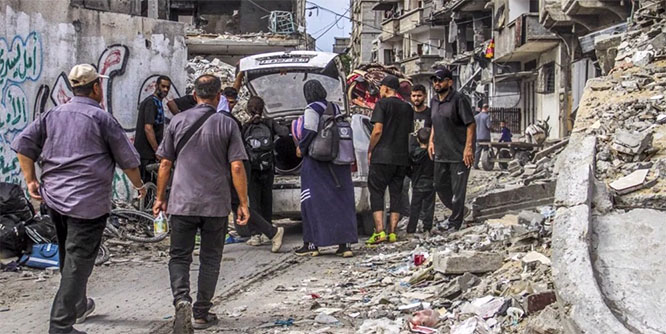
Hamas vows to remain 'steadfast' as Israel continues to massacre children and women in Gaza

News Network
October 12, 2024

building.jpg

The Palestinian Civil Defense in the Gaza Strip says at least 30 people were killed by Israeli strikes in the northern Gaza Strip city of Jabalia and its refugee camp Friday.

The agency’s spokesman Mahmud Bassal said the Israeli regime targeted Jabalia before 9:40 p.m. local time (1840 GMT) and left “12 dead, including women and children” in the city.

Bassal added that 14 people were still missing and likely trapped under the rubble.

Before that incident, Ahmad al-Kahlut, the director of the agency in northern Gaza, said 18 people had been killed by several Israeli strikes, including hits on “eight schools” in the camp that were serving as shelters for displaced Palestinian people.

The day’s aggression left at least 110 injured, according to figures provided by Bassal and Kahlut.

Human rights organizations have repeatedly warned against Israel’s fresh round of aggression on the Gaza Strip’s northern areas, home to hundreds of thousands of Palestinians having sought refuge from the regime’s year-long genocide in the south.

The Israeli regime announced earlier in the week that one of its largest forced displacement orders since October last year, calling for the expulsion of 37 neighborhoods across northern Gaza, which targets over 400,000 Palestinians in the entirety of the blockaded area.

In a statement, the medical humanitarian organization Doctors Without Borders, also known as MSF, said the Israeli regime’s forced expulsion orders in the northern Gaza Strip were turning the war-ravaged besieged area into a “lifeless desert.”

The Geneva-based Euro-Mediterranean Human Rights Monitor also warned earlier that the Israeli regime was subjecting the northern part of the Gaza Strip to “one of the most violent campaigns of genocide.”

The aggression comes as part of the regime’s October 7, 2023-present war on the coastal sliver, which has so far claimed the lives of more than 42,000 people and wounded over 97,500 others, most of them women and children.

Most of Gaza’s 2.3 million people have since been displaced and humanitarian conditions have deteriorated sharply.

Israel’s expulsion plan ‘could last several months’

An Israeli report based on conversations with military officials said the regime is enacting a plan that will effectively ethnically cleanse the Palestinian population in northern Gaza after a siege that could last months.

Conceived by retired Major-General Giora Eiland, the plan aims to empty northern Gaza of its 400,000 residents to make way for a “closed military zone.”

“The general’s plan,” which was launched in an Israeli TV campaign in September, called for the ethnic cleansing of northern Gaza, warning that those that remain will face starvation.

“The right thing to do is to inform the approximately 300,000 residents who remained in the northern Gaza Strip… we are ordering you to leave,” Eiland said last month.

“In a week, the entire territory of the northern Gaza Strip will become military territory.”

According to a report published on Friday in the Israeli daily newspaper Yedioth Ahronoth, the occupation is now implementing a “scaled-down” version of the plan in the Jabalia refugee camp.

Even though the “general’s plan” aims to create conditions to force the population in Jabalia and nearby Beit Hanoun and Beit Lahia to flee south, most people have refused to leave their homes so far, the report added.

Hamas ‘remains steadfast’ in face of Jabalia aggression

Hamas political bureau member Izzat al-Rishq said on Friday that the Gaza-based resistance movement “remains steadfast” in the face of the Israeli aggression on the Jabalia refugee camp, which has continued for the past six days.

“Our people’s choice will always remain … steadfastness on the ground, resilience, and resistance against the occupation’s aggression,” Rishq said in a statement.

He characterized the Israeli actions as akin to “Nazi terrorism,” highlighting that “since Oct. 7 of last year, the Israeli army has engaged in various forms of aggression against Palestinians in Gaza, the occupied West Bank, and [al-Quds] without achieving any of its violent objectives.”

“Those who hold firmly to their land and defend their rights will have the final word, while this fascist enemy will only reap further disappointment, failure, and defeat, despite international silence and complicity,” he added.

Comments

Add new comment

  • Coastaldigest.com reserves the right to delete or block any comments.
  • Coastaldigset.com is not responsible for its readers’ comments.
  • Comments that are abusive, incendiary or irrelevant are strictly prohibited.
  • Please use a genuine email ID and provide your name to avoid reject.
News Network
November 26,2025

Mangaluru, Nov 26: Assembly Speaker and local MLA U.T. Khader has initiated a high-level push to resolve one of Mangaluru’s longest-standing traffic headaches: the narrow, high-density stretch of National Highway-66 between Nanthoor and Talapady.

He announced on Tuesday that a formal proposal has been submitted to the Union Ministry of Road Transport and Highways (MoRTH) seeking approval to prepare a Detailed Project Report (DPR) for the widening of this crucial corridor.

The plan specifically aims to expand the existing 45-meter road width to a full 60 meters, coupled with the construction of dedicated service roads. Khader highlighted that land for a 60-meter highway was originally acquired during the initial four-laning project, but only 45 meters were developed, leading to a perpetual bottleneck.

"With vehicle density rising sharply, the expansion has become unavoidable," Khader stated, stressing that the upgrade is essential for ensuring smoother traffic flow and improving safety at the city's main entry and exit points.

The stretch between Nanthoor and Talapady is a vital link on the busy Kochi-Panvel coastal highway and connects to major city junctions. The move to utilize the previously acquired land for the full 60-meter width is seen as a necessary measure to catch up with the region's rapid vehicular growth and prevent further traffic gridlocks.

Comments

Add new comment

  • Coastaldigest.com reserves the right to delete or block any comments.
  • Coastaldigset.com is not responsible for its readers’ comments.
  • Comments that are abusive, incendiary or irrelevant are strictly prohibited.
  • Please use a genuine email ID and provide your name to avoid reject.
News Network
November 26,2025

students.jpg

Bengaluru, Nov 26: Karnataka is taking its first concrete steps towards lifting a three-decade-old ban on student elections in colleges and universities. Deputy Chief Minister D.K. Shivakumar announced Wednesday that the state government will form a small committee to study the reintroduction of campus polls, a practice halted in 1989 following incidents of violence.

Speaking at a 'Constitution Day' event organised by the Karnataka Congress, Mr. Shivakumar underscored the move's aim: nurturing new political leadership from the grassroots.

"Recently, (Leader of the Opposition in Lok Sabha) Rahul Gandhi wrote a letter to me and Chief Minister (Siddaramaiah) asking us to think about restarting student elections," Shivakumar stated. "I'm announcing today that we'll form a small committee and seek a report on this."

Student elections were banned in Karnataka in 1989, largely due to concerns over violence and the infiltration of political party affiliates into campus life. The ban effectively extinguished vibrant student bodies and the pipeline of young leaders they often produced.

Mr. Shivakumar, who also serves as the Karnataka Congress president, said that former student leaders will be consulted to "study the pros and cons" of the re-introduction.

Acknowledging the history of the ban, he added, "There were many criminal activities taking place back then. We’ll see how we can conduct (student) elections by regulating such criminal activities."

The Deputy CM reminisced about his own journey, which began on campus. He recalled his political activism at Sri Jagadguru Renukacharya College leading to his first Assembly ticket in 1985 at the age of 23. "That's how student leadership was at the time. Such leadership has gone today. College elections have stopped," he lamented, adding that for many, college elections were "like a big movement" where leaders were forged.

The move, driven by the Congress high command's push to cultivate young talent, will face scrutiny from academics and university authorities who have, in the past, expressed concern that the return of polls could disrupt the peaceful academic environment and turn campuses into political battlegrounds.

Comments

Add new comment

  • Coastaldigest.com reserves the right to delete or block any comments.
  • Coastaldigset.com is not responsible for its readers’ comments.
  • Comments that are abusive, incendiary or irrelevant are strictly prohibited.
  • Please use a genuine email ID and provide your name to avoid reject.
News Network
December 2,2025

A major upgrade in safety and monitoring is planned for Haj 2026, with every Indian pilgrim set to receive a Haj Suvidha smart wristband linked to the official Haj Suvidha mobile app. The initiative aims to support pilgrims—especially senior citizens—who may struggle with smartphones during the 45-day journey.

What the Smart Wristband Will Do

Officials said the device will come with:
•    Location tracking
•    Pedometer
•    SOS emergency button
•    Qibla compass
•    Prayer timings
•    Basic health monitoring

SP Tiwari, secretary of the UP State Haj Committee, said the goal is to make the pilgrimage safer and more comfortable.

“Most Hajis are elderly and not comfortable with mobile apps,” he said. “The smartwatch will help locate pilgrims who forget their way or cannot communicate their location.”

The wristbands will be monitored by the Consulate General of India in Saudi Arabia, similar to mobile tracking via the Haj Suvidha App.

Free Distribution and Training

•    Smart wristbands will be given free of cost.
•    Training for pilgrims will be conducted between January and February 2026.
•    Sample units will reach state Haj committees soon.
•    Final devices will be distributed as pilgrims begin their journey.

New Rules for Accommodation

Two major decisions have also been finalised for Haj 2026:
1.    Separate rooms for men and women – including married couples. They may stay on the same floor but must occupy different rooms, following stricter Saudi guidelines.
2.    Cooking banned – gas cylinders will not be allowed; all meals will be provided through official catering services arranged by the Haj Committee of India.

These decisions were finalised during a meeting of the Haj Committee of India and state representatives in Mumbai.

Haj Suvidha App Launched Earlier

The government launched the Haj Suvidha App in 2024, offering:

•    Training modules
•    Accommodation and flight details
•    Baggage information
•    SOS and translation tools
•    Grievance redressal

Haj 2026 Quota and Key States

•    India’s total Haj quota for 2026: 1,75,025 pilgrims
•    70% (1,25,000) allotted to the Haj Committee of India
•    30% (around 50,000) reserved for Haj Group Organisers

Uttar Pradesh has the largest allocation (around 30,000 seats), though approximately 18,000 pilgrims are expected to go this year. States with high pilgrim numbers include Kerala, Maharashtra and Gujarat.

Dates of Haj 2026

The pilgrimage is scheduled to take place from 24 May to 29 May, 2026 (tentative).
Haj is one of the five pillars of Islam and is mandatory for Muslims who meet the required conditions.

Comments

Add new comment

  • Coastaldigest.com reserves the right to delete or block any comments.
  • Coastaldigset.com is not responsible for its readers’ comments.
  • Comments that are abusive, incendiary or irrelevant are strictly prohibited.
  • Please use a genuine email ID and provide your name to avoid reject.