



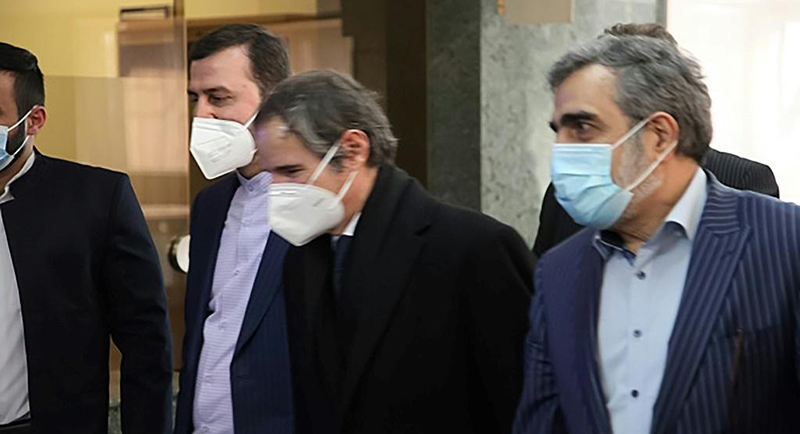
Vienna, Feb 22: The UN nuclear watchdog chief announced on Sunday a “temporary solution” to allow Iranian facility inspections to continue after days of talks with officials, giving some much needed breathing space for diplomatic negotiations.
However, Rafael Grossi admitted that under the new three-month arrangement, the International Atomic Energy Agency (IAEA) would not have the same level of access after a law comes into force on Tuesday limiting some inspections.
Grossi’s visit to Iran came amid stepped-up efforts between US President Joe Biden’s administration, European powers and Tehran to salvage the 2015 nuclear deal that has been on the brink of collapse since Donald Trump withdrew from it and went on to impose sanctions on the nation.
In December, Iran’s conservative-dominated parliament passed the law demanding a suspension of some inspections if the United States failed to lift sanctions by this Sunday.
Tehran had notified the UN body that if the suspensions were lifted it would suspend “voluntary transparency measures” — notably inspections to non-nuclear sites, including military sites suspected of nuclear-related activity.
Grossi said that under the new “temporary technical understanding... there is less access, let’s face it”.
“But still we were able to retain the necessary degree of monitoring and verification work,” he added.
“What we agreed is something that is viable — it is useful to bridge this gap that we are having now, it salvages the situation now,” Grossi told reporters after landing back in Vienna.
Under the temporary agreement Tehran will for “three months record and keep the information of some activities and monitoring equipment”, Iran’s Atomic Energy Organization (IAEO) said.
“During this period, the IAEA will not have access to this information,” the statement said, appearing to confirm comments from Foreign Minister Mohammad Javad Zarif that the law mandates the government to “not provide the tapes” of cameras at sites to the IAEA.
“If the sanctions are completely lifted within three months, Iran will provide this information to the IAEA, otherwise the information will be deleted forever,” the statement added.
Zarif had signalled the Islamic republic wanted to avoid an “impasse” over inspections, but also warned it could further step away from its commitments if Washington does not lift sanctions.
Grossi had said earlier his hope in visiting Tehran was “to stabilise a situation which was very unstable”.
“I think this technical understanding does it so that other political discussions at other levels can take place, and most importantly we can avoid a situation in which we would have been, in practical terms, flying blind,” he added.
Iran’s deputy foreign minister Abbas Araghchi acknowledged on Saturday that his country’s inspection capability would be “reduced by about 20-30 percent” when Tuesday’s law came into effect.
Grossi declined to give his own estimate of how much the IAEA’s inspection capability would be reduced but said the number of inspectors would not be scaled down, and that the agency would still be able to carry out some snap probes.
Biden has committed to rejoining talks on Tehran’s nuclear programme in a shift from Trump’s policy of “maximum pressure” towards the Islamic republic.
Tehran has repeatedly said it is ready to return to its nuclear commitments, on the condition Washington makes the first move by lifting the sanctions that have heaped economic pain on Iran.
But foreign minister Zarif warned that, if sanctions were not lifted, his nation would continue scaling back its commitments under the 2015 deal with the five UN Security Council permanent members and Germany.
The stockpile of “enriched uranium will increase”, he said, stressing that Tehran had the right within the agreement to stop observing commitments “totally or partially” if the other parties fail to honour theirs.
“We are still in the partial phase,” Zarif said. “We can be total.”
The European Union’s political director Enrique Mora has proposed an “informal meeting” involving Iran, with Washington accepting in principle.
Araghchi said Saturday that Tehran was reviewing the proposal, and discussing it with “friends and allies” China and Russia.
Meanwhile Recep Tayyip Erdogan, president of neighbouring Turkey, said on Sunday there was a “window of opportunity” for the lifting of Iran sanctions, calling it “legal and logical”.

Comments
Add new comment