



IAEA, Iran thrash out 'temporary solution' ahead of deadline

Agencies
February 22, 2021

Vienna, Feb 22: The UN nuclear watchdog chief announced on Sunday a “temporary solution” to allow Iranian facility inspections to continue after days of talks with officials, giving some much needed breathing space for diplomatic negotiations.

However, Rafael Grossi admitted that under the new three-month arrangement, the International Atomic Energy Agency (IAEA) would not have the same level of access after a law comes into force on Tuesday limiting some inspections.

Grossi’s visit to Iran came amid stepped-up efforts between US President Joe Biden’s administration, European powers and Tehran to salvage the 2015 nuclear deal that has been on the brink of collapse since Donald Trump withdrew from it and went on to impose sanctions on the nation.

In December, Iran’s conservative-dominated parliament passed the law demanding a suspension of some inspections if the United States failed to lift sanctions by this Sunday.

Tehran had notified the UN body that if the suspensions were lifted it would suspend “voluntary transparency measures” — notably inspections to non-nuclear sites, including military sites suspected of nuclear-related activity.

Grossi said that under the new “temporary technical understanding... there is less access, let’s face it”.

“But still we were able to retain the necessary degree of monitoring and verification work,” he added.

“What we agreed is something that is viable — it is useful to bridge this gap that we are having now, it salvages the situation now,” Grossi told reporters after landing back in Vienna.

Under the temporary agreement Tehran will for “three months record and keep the information of some activities and monitoring equipment”, Iran’s Atomic Energy Organization (IAEO) said.

“During this period, the IAEA will not have access to this information,” the statement said, appearing to confirm comments from Foreign Minister Mohammad Javad Zarif that the law mandates the government to “not provide the tapes” of cameras at sites to the IAEA.

“If the sanctions are completely lifted within three months, Iran will provide this information to the IAEA, otherwise the information will be deleted forever,” the statement added.

Zarif had signalled the Islamic republic wanted to avoid an “impasse” over inspections, but also warned it could further step away from its commitments if Washington does not lift sanctions.

Grossi had said earlier his hope in visiting Tehran was “to stabilise a situation which was very unstable”.

“I think this technical understanding does it so that other political discussions at other levels can take place, and most importantly we can avoid a situation in which we would have been, in practical terms, flying blind,” he added.

Iran’s deputy foreign minister Abbas Araghchi acknowledged on Saturday that his country’s inspection capability would be “reduced by about 20-30 percent” when Tuesday’s law came into effect.

Grossi declined to give his own estimate of how much the IAEA’s inspection capability would be reduced but said the number of inspectors would not be scaled down, and that the agency would still be able to carry out some snap probes.

Biden has committed to rejoining talks on Tehran’s nuclear programme in a shift from Trump’s policy of “maximum pressure” towards the Islamic republic.

Tehran has repeatedly said it is ready to return to its nuclear commitments, on the condition Washington makes the first move by lifting the sanctions that have heaped economic pain on Iran.

But foreign minister Zarif warned that, if sanctions were not lifted, his nation would continue scaling back its commitments under the 2015 deal with the five UN Security Council permanent members and Germany.

The stockpile of “enriched uranium will increase”, he said, stressing that Tehran had the right within the agreement to stop observing commitments “totally or partially” if the other parties fail to honour theirs.

“We are still in the partial phase,” Zarif said. “We can be total.”

The European Union’s political director Enrique Mora has proposed an “informal meeting” involving Iran, with Washington accepting in principle.

Araghchi said Saturday that Tehran was reviewing the proposal, and discussing it with “friends and allies” China and Russia.

Meanwhile Recep Tayyip Erdogan, president of neighbouring Turkey, said on Sunday there was a “window of opportunity” for the lifting of Iran sanctions, calling it “legal and logical”.

Comments

Add new comment

  • Coastaldigest.com reserves the right to delete or block any comments.
  • Coastaldigset.com is not responsible for its readers’ comments.
  • Comments that are abusive, incendiary or irrelevant are strictly prohibited.
  • Please use a genuine email ID and provide your name to avoid reject.
News Network
February 1,2026

US President Donald Trump on Saturday claimed that the government of India led by Prime Minister Narendra Modi has made a deal to buy Venezuelan oil, as opposed to purchasing it from Iran.

"We've already made that deal, the concept of the deal," he told reporters on Air Force One.

Trump had imposed 25% tariffs on countries buying Venezuelan oil, including India, in March 2025. He had also hit India with tariffs for buying Russian oil, saying it was "funding" President Vladimir Putin's war against Ukraine.

Trump has said that the US has taken control of the oil-rich Venezuela after capturing former President Nicolas Maduro in January.

A fleet of 18 ships loaded with crude oil bound for refineries in Texas, Louisiana, and Mississippi in January, the most since December 2024, according to a report by the news agency Bloomberg.

Combined crude deliveries to the US will reach about 2,75,000 barrels a day, more than doubling volumes seen in December last year. Shipments to China, which averaged 4,00,000 barrels a day last year, fell to zero in January.

PM Modi, Venezuelan President Agree To Expand Ties

Prime Minister Narendra Modi and Venezuela's acting President Delcy Rodriguez spoke on Friday and agreed to take the bilateral relations to "new heights" in the years ahead.

It was the first phone call between the two leaders since the capture of Maduro and his wife by the US on January 3.

"Spoke with Acting President of Venezuela, Ms. Delcy Rodriguez. We agreed to further deepen and expand our bilateral partnership in all areas, with a shared vision of taking India-Venezuela relations to new heights in the years ahead," PM Modi said in a post on X.

A statement from Prime Minister Modi's office said the two leaders agreed to further expand and deepen the India-Venezuela partnership in all areas, including trade and investment, energy, digital technology, health, agriculture, and people-to-people ties.

They exchanged views on various regional and global issues of mutual interest and underscored the importance of their close cooperation for the Global South, the statement said.

Rodriguez also said that they discussed partnerships in the fields of agriculture, science and technology, mining, and tourism, as well as the pharmaceutical and automotive industries.

Comments

Add new comment

  • Coastaldigest.com reserves the right to delete or block any comments.
  • Coastaldigset.com is not responsible for its readers’ comments.
  • Comments that are abusive, incendiary or irrelevant are strictly prohibited.
  • Please use a genuine email ID and provide your name to avoid reject.
News Network
January 20,2026

iran.jpg

Iranian security and intelligence forces have captured more than 470 individuals in three provinces, identified as key figures behind the recent wave of violent unrest and terrorist activities linked to foreign-backed networks.

The Intelligence Ministry's provincial office in Khorasan Razavi announced on Monday the arrest of 192 armed terrorists, identified as the main agents behind recent riots in the region. 

According to an official statement, the detainees were involved in the killing of several security personnel and civilians, setting fire to mosques, public service facilities, and buses, as well as attacks on military and law enforcement centers.

The seized items from the group include several bulletproof vests, Kalashnikov rifles, hunting weapons, Winchester rifles, and various cold weapons such as daggers, swords, brass knuckles, tactical knives, crossbows, and chains.

Evidence indicates that some of the individuals were tied to hostile movements and terrorist organizations, with links overseas. Others were identified as members of violent criminal gangs, actively taking part in the unrest alongside their associates.

Simultaneously, in the western province of Lorestan, the IRGC announced the arrest of 134 individuals as the main leaders and influential field agents of a US-Israeli terrorist network.

The IRGC statement stated that these individuals formed terrorist cells during the recent unrest, committing "Daesh-like" acts.

They wounded security forces with firearms and cold weapons, and burned and destroyed public and private properties, including mosques, shops, banks, and private and public vehicles.

In the northwestern province of Zanjan, the police reported detaining 150 people identified as principal leaders and agents behind recent riots.

Authorities noted that these individuals were responsible for destroying public and private property and intentionally setting fire to vehicles in the province's squares.

Their crimes include shedding the blood of innocent people, destroying public and private property, attempting to enter military sites, disrupting public order, and spreading terror among citizens.

A variety of cold weapons were reportedly seized from the detainees.

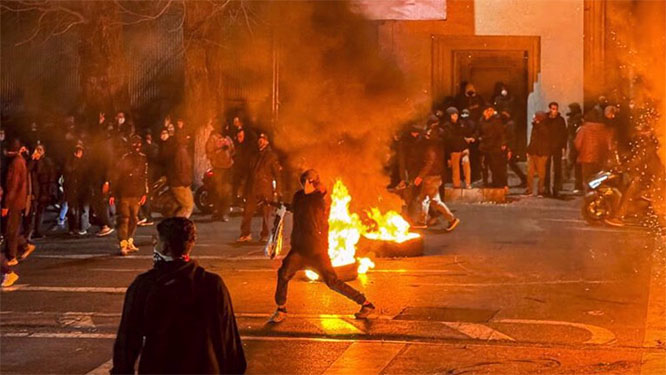
What began late last month as peaceful protests over economic hardship across Iran turned violent after public statements by US and Israeli regime figures encouraged vandalism and disorder.

During the unrest, foreign-backed mercenaries rampaged through cities, killing security forces and civilians and damaging public property.

Comments

Add new comment

  • Coastaldigest.com reserves the right to delete or block any comments.
  • Coastaldigset.com is not responsible for its readers’ comments.
  • Comments that are abusive, incendiary or irrelevant are strictly prohibited.
  • Please use a genuine email ID and provide your name to avoid reject.
News Network
January 23,2026

Karnataka Governor Thaawarchand Gehlot read only three lines from the 122-paragraph address prepared by the Congress-led state government while addressing the joint session of the Legislature on Thursday, effectively bypassing large sections critical of the BJP-led Union government.

The omitted portions of the customary Governor’s address outlined what the state government described as a “suppressive situation in economic and policy matters” under India’s federal framework. The speech also sharply criticised the Centre’s move to replace the Mahatma Gandhi National Rural Employment Guarantee Act (MGNREGA) with the Viksit Bharat–Guarantee for Rozgar and Ajeevika Mission (Gramin) Act, commonly referred to as the VB-GRAM (G) Act.

Governor Gehlot had earlier conveyed his objection to several paragraphs that were explicitly critical of the Union government. On Thursday, he confined himself to the opening lines — “I extend a warm welcome to all of you to the joint session of the State legislature. I am extremely pleased to address this august House” — before jumping directly to the concluding sentence of the final paragraph.

He ended the address by reading the last line of paragraph 122: “Overall, my government is firmly committed to doubling the pace of the State’s economic, social and physical development. Jai Hind — Jai Karnataka.”

According to the prepared speech, the Karnataka government demanded the scrapping of the VB-GRAM (G) Act, describing it as “contractor-centric” and detrimental to rural livelihoods, and called for the full restoration of MGNREGA. The state government argued that the new law undermines decentralisation, weakens labour protections, and centralises decision-making in violation of constitutional norms.

Key points from the unread sections of the speech:

•    Karnataka facing a “suppressive” economic and policy environment within the federal system

•    Repeal of MGNREGA described as a blow to rural livelihoods

•    VB-GRAM (G) Act accused of protecting corporate and contractor interests

•    New law alleged to weaken decentralised governance

•    Decision-making said to be imposed by the Centre without consulting states

•    Rights of Adivasis, women, backward classes and agrarian communities curtailed

•    Labourers allegedly placed under contractor control

•    States facing mounting fiscal stress due to central policies

•    VB-GRAM (G) Act accused of enabling large-scale corruption

Comments

Add new comment

  • Coastaldigest.com reserves the right to delete or block any comments.
  • Coastaldigset.com is not responsible for its readers’ comments.
  • Comments that are abusive, incendiary or irrelevant are strictly prohibited.
  • Please use a genuine email ID and provide your name to avoid reject.