



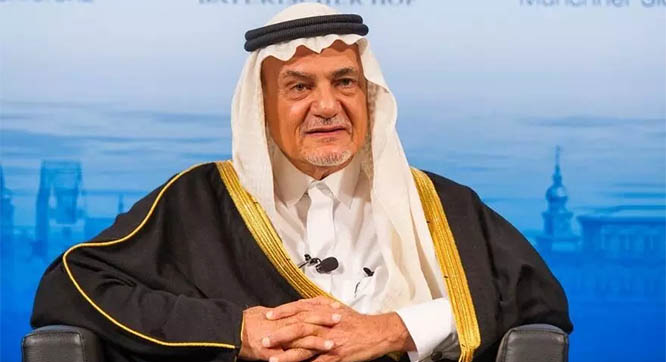
Independent Palestine state is primary condition for normalization of Saudi – Israel ties: Prince Turki

Source: Arab News
September 15, 2024

prince.jpg

London: There will be no normalization of ties between Saudi Arabia and Israel until an independent Palestinian state is established, Prince Turki Al-Faisal, the former head of the Kingdom’s intelligence services, has warned. 

During a talk at London-based think tank Chatham House, the former Saudi ambassador to the US also discussed Washington’s role in the peace process as the Gaza war approaches its first anniversary, and how talks before the outbreak of hostilities had been broadly positive.

He said the US is keen on the resumption of talks between Israel and Saudi Arabia to strengthen regional security and to forge economic ties, but Riyadh’s position is that “if there’s a Palestinian state that Israel accepts to come (into) existence, then we can talk about normalization with Israel.”

The prince added: “Before Oct. 7 … talks not only progressed along those lines, but also the Kingdom invited a Palestinian delegation to come and talk directly to the Americans about what it is that might bring about a Palestinian state.

“I’m not privy to those talks so I don’t know what happened between the Palestinians and the Americans, but the Kingdom’s position has always been we won’t speak for the Palestinians. They have to do it for themselves. Unfortunately, of course, the Oct. 7 (Hamas attack against Israel) put an end to those talks.”

Prince Turki said the establishment of a Palestinian state is not only crucial for Israeli ties with Saudi Arabia but with the rest of the Muslim world as well.

“A Palestinian state is a primary condition for Saudi Arabia to have normalization with Israel, but … on the Israeli side, the whole government is saying no Palestinian state,” he added.

Prince Turki said for Saudi Arabia, an independent Palestine would encapsulate the 1967 borders, including East Jerusalem.

He added that the Kingdom has led the way in trying to achieve a peaceful resolution to the conflict, citing the 1981 King Fahd Peace Plan and the 2002 Arab Peace Initiative proposed by King Abdullah.

During the current Gaza war, “the Kingdom led the Muslim world, and not only summits with the Arabs but with the (rest of the) Muslim world, and also … the diplomatic missions that have been taking place to convince the world that there must be an end to the fighting, led by the Saudi foreign minister,” Prince Turki said.

“The Kingdom has been in the forefront of condemning the Israeli onslaught on the Palestinians, not just in Gaza but equally in the West Bank.”

He criticized the US and other Western nations for not applying more pressure on Israel to end the war, citing how the UK had only recently begun to suspend certain arms export licenses to Israel following the election of a new government in July.

“I’d like to see more done by the UK,” he said. “I think, for example, the UK … should recognize the state of Palestine. It’s long overdue.”

Prince Turki said the US could apply direct pressure on Israeli Prime Minister Benjamin Netanyahu over the actions of his government and military, and should address funding and lobbying by groups and individuals sympathetic to Israel.

“I think the US has enormous tools to affect Israel which it isn’t using, not just simply … denial of supply of weapons and material to the Israelis,” the prince added.

“A lot of financial help goes to Israel from the US. If some of the privileges that (the) Israeli lobby, for example, in America, enjoys — of tax-free contributions to Israel — can be withdrawn from those Israeli lobbyists, that will (put) great pressure on Israel.”

In the US, “you have to register as a lobbyist for a specific country, or be prosecuted, if you want to talk for that country, but a lot of organizations in America do that for Israel and still enjoy a tax-free status because they’re considered not representing Israel per se, but simply as philanthropic or humanitarian groupings,” he said.

“There are many tools that are available to the US, not simply harsh talk, which seems to have gotten us nowhere. But is America ready to do that? As I said, I’m not too optimistic about that.”

Comments

Add new comment

  • Coastaldigest.com reserves the right to delete or block any comments.
  • Coastaldigset.com is not responsible for its readers’ comments.
  • Comments that are abusive, incendiary or irrelevant are strictly prohibited.
  • Please use a genuine email ID and provide your name to avoid reject.
News Network
November 24,2025

israelsyra.jpg

Israeli forces have pushed over the Syrian frontier, erecting a checkpoint and stopping vehicles in the southwestern city of Quneitra, in yet another breach of the Arab country’s sovereignty.

The violation took place on Sunday, when the troops made their way across the border, setting up the outpost near the Ain al-Bayda junction in northern Quneitra, Syrian outlets reported.

According to the al-Ikhbariya paper, an Israeli detachment positioned itself at the junction, halting cars and conducting searches.

The Syrian Arab News Agency (SANA) reported that three Israeli military vehicles then moved further into the northern countryside, deploying between the town of Jubata al-Khashab and the villages of Ofaniya and Ain al-Bayda. The agency added that a separate Israeli unit mounted a new incursion in the central region, approaching the villages of Umm Batina and al-Ajraf.

Residents said such activities have surged in recent months, pointing to Israeli advances onto farmland, leveling of extensive forested areas, arrests, and spread of mobile checkpoints.

The Israeli regime began markedly increasing its military aggression against Syria last year.

The escalation coincided with increasingly ferocious onslaughts throughout the country by the so-called Hay'at Tahrir al-Sham (HTS) Takfiri terrorist group, which the government of President Bashar al-Assad had confined to northwestern Syria. The HTS, however, managed to overthrow the government as the Israeli attacks would pummel the country’s civilian and defensive infrastructure.

Various reports have shown that, during the escalation, the regime conducted more than 1,000 airstrikes on the Syrian territory and over 400 ground raids into the south.

Following the collapse of the Assad government, Tel Aviv also widened its grip over the occupied Golan Heights by taking control of a demilitarized buffer zone, in defiance of a 1974 Disengagement Agreement. Earlier this month, senior Israeli officials, including Prime Minister Benjamin Netanyahu, visited the buffer zone, prompting expressions of alarm on the part of the United Nations.

The United States, the regime’s biggest ally, has, meanwhile, been fraternizing the HTS head Abu Mohammed al-Jolani amid the widely reported prospect of rapprochement with Tel Aviv.

Comments

Add new comment

  • Coastaldigest.com reserves the right to delete or block any comments.
  • Coastaldigset.com is not responsible for its readers’ comments.
  • Comments that are abusive, incendiary or irrelevant are strictly prohibited.
  • Please use a genuine email ID and provide your name to avoid reject.
News Network
November 21,2025

malpe.jpg

Udupi: The Malpe Police have arrested two men from Uttar Pradesh for allegedly sharing classified information related to Indian Navy vessels with individuals in Pakistan, posing a serious threat to national security.

According to a complaint filed by the CEO of Udupi Cochin Shipyard, Malpe—an institution under the Union Ministry of Ports, Shipping and Waterways—the prime accused, Rohit (29), was working as an insulator through subcontractor M/S Shushma Marine Pvt Ltd. He had earlier served at Cochin Shipyard Limited in Kochi, Kerala, where naval ships are under construction.

Udupi SP Hariram Shankar said the accused had unlawfully shared, via WhatsApp, confidential identification numbers of Navy-related ships and other classified details while working in Kerala, allegedly for illegal gains.

After joining the Malpe shipyard unit, Rohit reportedly continued collecting sensitive information through a friend in Kochi and circulated it to unauthorised individuals, violating national security protocols and potentially endangering India’s sovereignty, unity, and integrity.

Based on the complaint, Malpe Police registered a case under Section 152 of the Bharatiya Nyaya Sanhita (BNS) and Sections 3 and 5 of the Official Secrets Act, 1923.

A police team led by Karkala Subdivision Assistant Superintendent of Police Harsha Priyamvada—along with PSI Anil Kumar D, ASI Harish, and PC Ravi Jadhav—conducted the investigation and arrested the two accused, identified as Rohit (29) and Santri (37), both residents of Sultanpur district, Uttar Pradesh.

The duo was produced before the court, which remanded them in judicial custody till December 3. Further investigation is in progress.

Comments

Add new comment

  • Coastaldigest.com reserves the right to delete or block any comments.
  • Coastaldigset.com is not responsible for its readers’ comments.
  • Comments that are abusive, incendiary or irrelevant are strictly prohibited.
  • Please use a genuine email ID and provide your name to avoid reject.
News Network
November 26,2025

students.jpg

Bengaluru, Nov 26: Karnataka is taking its first concrete steps towards lifting a three-decade-old ban on student elections in colleges and universities. Deputy Chief Minister D.K. Shivakumar announced Wednesday that the state government will form a small committee to study the reintroduction of campus polls, a practice halted in 1989 following incidents of violence.

Speaking at a 'Constitution Day' event organised by the Karnataka Congress, Mr. Shivakumar underscored the move's aim: nurturing new political leadership from the grassroots.

"Recently, (Leader of the Opposition in Lok Sabha) Rahul Gandhi wrote a letter to me and Chief Minister (Siddaramaiah) asking us to think about restarting student elections," Shivakumar stated. "I'm announcing today that we'll form a small committee and seek a report on this."

Student elections were banned in Karnataka in 1989, largely due to concerns over violence and the infiltration of political party affiliates into campus life. The ban effectively extinguished vibrant student bodies and the pipeline of young leaders they often produced.

Mr. Shivakumar, who also serves as the Karnataka Congress president, said that former student leaders will be consulted to "study the pros and cons" of the re-introduction.

Acknowledging the history of the ban, he added, "There were many criminal activities taking place back then. We’ll see how we can conduct (student) elections by regulating such criminal activities."

The Deputy CM reminisced about his own journey, which began on campus. He recalled his political activism at Sri Jagadguru Renukacharya College leading to his first Assembly ticket in 1985 at the age of 23. "That's how student leadership was at the time. Such leadership has gone today. College elections have stopped," he lamented, adding that for many, college elections were "like a big movement" where leaders were forged.

The move, driven by the Congress high command's push to cultivate young talent, will face scrutiny from academics and university authorities who have, in the past, expressed concern that the return of polls could disrupt the peaceful academic environment and turn campuses into political battlegrounds.

Comments

Add new comment

  • Coastaldigest.com reserves the right to delete or block any comments.
  • Coastaldigset.com is not responsible for its readers’ comments.
  • Comments that are abusive, incendiary or irrelevant are strictly prohibited.
  • Please use a genuine email ID and provide your name to avoid reject.
