



Inflation set to spike in UAE, other Gulf countries due to Russia-Ukraine war

News Network
May 30, 2022

Economists have warned that Inflation in the wider Middle East including the Gulf Cooperation Council countries will spike this year due to an increase in food and commodity prices after the Russia-Ukraine war.

“The UAE economy has had a strong start to 2022, with crude oil production up 12 per cent year-on-year in the first quarter of this year. Survey data points to a solid expansion in non-oil sectors as well. We expect inflation to average 4.3 per cent this year from 2.3 per cent previously, significantly higher than last year’s 0.2 per cent average consumer price index,” said Emirates NBD Research in a recent quarterly report on the region.

It is projected that the inflation will ease to 2.5 per cent for the UAE next year.

While inflation in most of the other Gulf countries will also witness a surge this year, with average inflation reaching 3.0 per cent, 3.5 per cent, 2.5 per cent, 3.5 per cent and 3.0 per cent in Saudi Arabia, Qatar, Oman, Kuwait and Bahrain, respectively.

The increase in inflation is attributed to the impact of the Ukraine-Russia war on the global food and other commodity prices as well as high crude oil prices.

James Swanston, economist for the Mena region at Capital Economics, said non-Gulf economies are more vulnerable to the fallout from the Ukraine war.

“Higher commodity prices will increase subsidy costs in North Africa, which is likely to prompt governments to cut expenditure elsewhere. At the same time, inflation will rise further and erode households’ real incomes,” he said.

He said higher commodity prices will also cause external positions to deteriorate further.

Recently, Egypt responded to this by devaluing the pound in March, and Swanston believes Cairo will need to let the currency fall further. “This will push inflation up, even more, taking it well above the central bank’s target range and prompting another 350bp of interest rate hikes (to 12.75 per cent) by year-end – this is far more tightening than most currently expect.”

James Swanston projected that inflation will increase in Saudi Arabia in the coming months due to the impact of rising global food prices.

“However, we do not expect the headline rate to rise to levels seen elsewhere in the emerging world, particularly as the government has kept a cap on local fuel prices since July last year. Inflation should peak around 2.5 per cent and then fall back to around 1.0-1.5 per cent year-on-year where it will remain throughout 2023-24. If the government does loosen fiscal policy by cutting value-added tax (VAT), this would knock inflation further down,” he added.

Comments

Add new comment

  • Coastaldigest.com reserves the right to delete or block any comments.
  • Coastaldigset.com is not responsible for its readers’ comments.
  • Comments that are abusive, incendiary or irrelevant are strictly prohibited.
  • Please use a genuine email ID and provide your name to avoid reject.
News Network
January 23,2026

modIKERALA.jpg

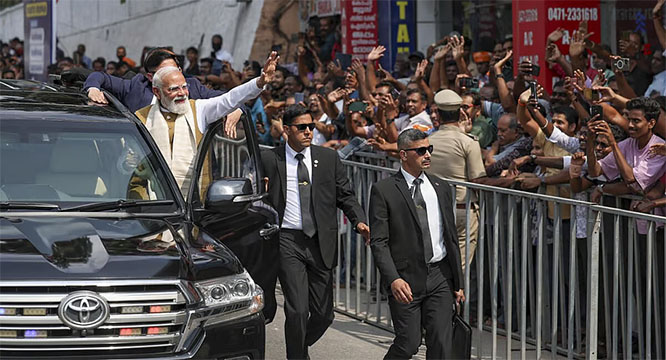
Prime Minister Narendra Modi, during his visit to Thiruvananthapuram on Friday, January 23, indicated that the Bharatiya Janata Party (BJP) is aiming to expand its political footprint in Kerala ahead of the Assembly elections scheduled in the coming months.

Speaking at a BJP-organised public meeting, Modi drew parallels between the party’s early electoral gains in Gujarat and its recent victory in the Thiruvananthapuram Municipal Corporation. The civic body win, which ended decades of Left control, was cited by the Prime Minister as a possible starting point for the party’s broader ambitions in the state.

Recalling BJP’s political trajectory in Gujarat, Modi said the party was largely insignificant before 1987 and received little media attention. He pointed out that the BJP’s first major breakthrough came with its victory in the Ahmedabad Municipal Corporation that year.

“Just as our journey in Gujarat began with one city, Kerala’s journey has also started with a single city,” Modi said, suggesting that the party’s municipal-level success could translate into wider electoral acceptance.

The Prime Minister alleged that successive governments led by the Left Democratic Front (LDF) and the United Democratic Front (UDF) had failed to adequately develop Thiruvananthapuram. He accused both fronts of corruption and neglect, claiming that basic infrastructure and facilities were denied to the capital city for decades.

According to Modi, the BJP’s control of the civic body represents a shift driven by public dissatisfaction with the existing political alternatives. He asserted that the BJP administration in Thiruvananthapuram had begun working towards development, though no specific details or timelines were outlined.

Addressing the gathering at Putharikandam Maidan, Modi said the BJP intended to project Thiruvananthapuram as a “model city,” reiterating his party’s commitment to governance-led change.

The Prime Minister’s visit to Kerala also included the inauguration of several development projects and the flagging off of new train services, as the BJP intensifies its political outreach in the poll-bound state.

Comments

Add new comment

  • Coastaldigest.com reserves the right to delete or block any comments.
  • Coastaldigset.com is not responsible for its readers’ comments.
  • Comments that are abusive, incendiary or irrelevant are strictly prohibited.
  • Please use a genuine email ID and provide your name to avoid reject.
News Network
January 23,2026

Mangaluru: The Karnataka Government Polytechnic (KPT), Mangaluru, has achieved autonomous status from the All India Council for Technical Education (AICTE), becoming the first government polytechnic in the country to receive such recognition in its 78-year history. The status was granted by AICTE, New Delhi, and subsequently approved by the Karnataka Board of Technical Education in October last year.

Officials said the autonomy was conferred a few months ago. Until recently, AICTE extended autonomous status only to engineering colleges, excluding diploma institutions. However, with a renewed national focus on skill development, several government polytechnics across India have now been granted autonomy.

KPT, the second-largest polytechnic in Karnataka, was established in 1946 with four branches and has since expanded to offer eight diploma programmes, including computer science and polymer technology. The institution is spread across a 19-acre campus.

Ravindra M Keni, the first dean of the institution, told The Times of India that AICTE had proposed autonomous status for polytechnic institutions that are over 25 years old. “Many colleges applied. In the first round, 100 institutions were shortlisted, which was further narrowed down to 15 in the second round. We have already completed one semester after becoming an autonomous institution,” he said. He added that nearly 500 students are admitted annually across eight three-year diploma courses.

Explaining the factors that helped KPT secure autonomy, Keni said the institution has consistently recorded 100 per cent admissions and placements for its graduates. He also noted its strong performance in sports, with the college emerging champions for 12 consecutive years, along with active student participation in NCC and NSS activities.

Autonomous status allows KPT to design industry-oriented curricula, conduct examinations, prepare question papers, and manage academic documentation independently. The institution can also directly collaborate with industries and receive priority funding from AICTE or the Ministry of Education. While academic autonomy has been granted, financial control will continue to rest with the state government.

“There will be separate committees for examinations, question paper setting, boards of studies, and boards of examiners. The institution will now have the freedom to conduct admissions without government notifications and issue its own marks cards,” Keni said, adding that new academic initiatives would be planned after a year of functioning under the autonomous framework.

Comments

Add new comment

  • Coastaldigest.com reserves the right to delete or block any comments.
  • Coastaldigset.com is not responsible for its readers’ comments.
  • Comments that are abusive, incendiary or irrelevant are strictly prohibited.
  • Please use a genuine email ID and provide your name to avoid reject.