



Iran rains down ballistic missiles on Tel Aviv as Israel hits Iran’s nuclear reactor

News Network
June 19, 2025

telaviv.jpg

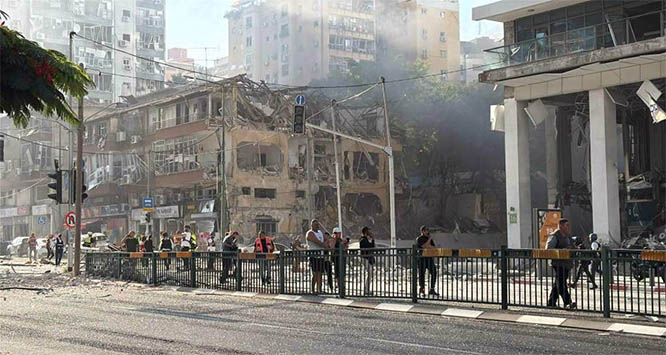
Tehran/ Tel Aviv, June 19: Iranian armed forces carried out the fourteenth phase of Operation True Promise III on Thursday, unleashing a barrage of ballistic missiles on the occupied territories.

The new wave constituted dozens of new-generation missiles that managed to pierce through multi-tier Israeli air defense systems to strike their targets in Tel Aviv.

Despite sweeping censorship, videos circulating on social media showed panic-stricken settlers rushing toward underground shelters as air raid sirens blared across the occupied territories.

According to some reports, at least 50 ballistic missiles, including those being used for the first time in Operation True Promise III, were spotted in the skies over the occupied territories.

The regime in Tel Aviv has imposed ban on publication of any report regarding casualties or collateral damage, however, some reports put the death toll on Thursday at over 50.

Many buildings belonging to the Israeli regime, including its military and intelligence, were targeted in the latest wave, proving the increasing inefficacy of much-hyped air defenses.

Nuclear reactor attacked

Meanwhile, Israel attacked Iran’s Arak heavy water reactor (a type of nuclear reactor), on Thursday morning. 

Iran had evacuated the Arak facility before the attack and there was “no radiation danger”, state TV said in a report on the bombing.

Israel authorities reported 28 people had been injured in the attacks across the country, three of them seriously. Israeli police ordered people to stay away from the hospital because of the risk of hazardous materials leaking from damaged wards.

Netanyahu’s warning

Israeli Prime Minister Benjamin Netanyahu has warned Iran will “pay a heavy price” after its missile attack damaged Israel’s Soroka hospital in Be’er Sheva.
“This morning, Iran’s terrorist dictators fired missiles at Soroka Hospital in Be’er Sheva and at civilians in the centre of the country,” Netanyahu wrote in a post on X. “We will make the tyrants in Tehran pay a heavy price.”

Comments

Add new comment

  • Coastaldigest.com reserves the right to delete or block any comments.
  • Coastaldigset.com is not responsible for its readers’ comments.
  • Comments that are abusive, incendiary or irrelevant are strictly prohibited.
  • Please use a genuine email ID and provide your name to avoid reject.
News Network
January 23,2026

Karnataka Governor Thaawarchand Gehlot read only three lines from the 122-paragraph address prepared by the Congress-led state government while addressing the joint session of the Legislature on Thursday, effectively bypassing large sections critical of the BJP-led Union government.

The omitted portions of the customary Governor’s address outlined what the state government described as a “suppressive situation in economic and policy matters” under India’s federal framework. The speech also sharply criticised the Centre’s move to replace the Mahatma Gandhi National Rural Employment Guarantee Act (MGNREGA) with the Viksit Bharat–Guarantee for Rozgar and Ajeevika Mission (Gramin) Act, commonly referred to as the VB-GRAM (G) Act.

Governor Gehlot had earlier conveyed his objection to several paragraphs that were explicitly critical of the Union government. On Thursday, he confined himself to the opening lines — “I extend a warm welcome to all of you to the joint session of the State legislature. I am extremely pleased to address this august House” — before jumping directly to the concluding sentence of the final paragraph.

He ended the address by reading the last line of paragraph 122: “Overall, my government is firmly committed to doubling the pace of the State’s economic, social and physical development. Jai Hind — Jai Karnataka.”

According to the prepared speech, the Karnataka government demanded the scrapping of the VB-GRAM (G) Act, describing it as “contractor-centric” and detrimental to rural livelihoods, and called for the full restoration of MGNREGA. The state government argued that the new law undermines decentralisation, weakens labour protections, and centralises decision-making in violation of constitutional norms.

Key points from the unread sections of the speech:

•    Karnataka facing a “suppressive” economic and policy environment within the federal system

•    Repeal of MGNREGA described as a blow to rural livelihoods

•    VB-GRAM (G) Act accused of protecting corporate and contractor interests

•    New law alleged to weaken decentralised governance

•    Decision-making said to be imposed by the Centre without consulting states

•    Rights of Adivasis, women, backward classes and agrarian communities curtailed

•    Labourers allegedly placed under contractor control

•    States facing mounting fiscal stress due to central policies

•    VB-GRAM (G) Act accused of enabling large-scale corruption

Comments

Add new comment

  • Coastaldigest.com reserves the right to delete or block any comments.
  • Coastaldigset.com is not responsible for its readers’ comments.
  • Comments that are abusive, incendiary or irrelevant are strictly prohibited.
  • Please use a genuine email ID and provide your name to avoid reject.