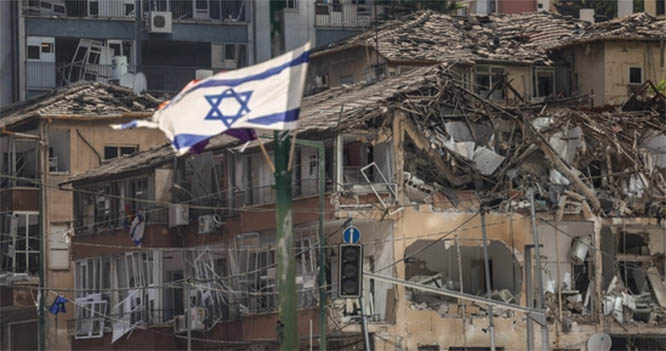
Israel-Iran air war enters 2nd week amid Netanyahu’s push for US intervention

News Network
June 20, 2025

israel.jpg

Israel and Iran’s air war entered a second week on Friday, June 20, and European officials sought to draw Tehran back to the negotiating table after President Donald Trump said any decision on potential US involvement would be made within two weeks.

Israel began attacking Iran last Friday, saying it aimed to prevent its longtime enemy from developing nuclear weapons. Iran retaliated with missile and drone strikes on Israel. It says its nuclear program is peaceful.

Israeli air attacks have killed 639 people, mostly civilians, in Iran, said the Human Rights Activists News Agency. Those killed include the military’s top echelon and nuclear scientists. Dozens of settlers also have lost their lives due to Iranian attacks across Israel. 

‘Stop attack then negotiate’

Iranian Foreign Minister Abbas Araghchi rejected any negotiations with the United States while Israel continues its attacks on Iran, in an interview with state TV broadcast on Friday.

“The Americans have repeatedly sent messages calling seriously for negotiations. But we have made clear that as long as the aggression does not stop, there will be no place for diplomacy and dialogue,” said the chief diplomat, who was due in Geneva for talks with his European counterparts.

Israeli warns Hezbollah 

Israeli defense (war) minister Israel Katz warned Lebanon’s Hezbollah to exercise caution on Friday, saying Israel’s patience with “terrorists” who threaten it had worn thin.

The head of Iran-backed Hezbollah, Naim Qassem, said on Thursday that the Lebanese group would act as it saw fit in the face of what he called “brutal Israeli-American aggression” against Iran.

Nuclear talks 

Foreign ministers from Britain, France and Germany together with the EU’s top diplomat will hold nuclear talks with their Iranian counterpart in Geneva on Friday, officials and diplomats said.

The meeting comes as European countries call for de-escalation in the face of Israel’s bombing campaign against Iran’s nuclear program — and as US President Donald Trump weighs up whether or not to join the strikes against Tehran.

“We will meet with the European delegation in Geneva on Friday,” Iran’s Foreign Minister Abbas Araghchi said in a statement carried by state news agency IRNA.

European diplomats separately confirmed the planned talks, set to involve French Foreign Minister Jean-Noel Barrot, British Foreign Secretary David Lammy and German Foreign Minister Johann Wadephul, as well as EU foreign policy chief Kaja Kallas.

Britain’s Foreign Secretary David Lammy said Thursday after meeting high-level US officials that there is still time to reach a diplomatic solution with Tehran.

Lammy met with US Secretary of State Marco Rubio and special envoy Steve Witkoff at the White House, before talks on Friday in Geneva with Iranian Foreign Minister Abbas Araghchi alongside his French, German and EU counterparts.

“The situation in the Middle East remains perilous,” Lammy said in a statement released by the UK embassy in Washington.

“We discussed how Iran must make a deal to avoid a deepening conflict. A window now exists within the next two weeks to achieve a diplomatic solution,” Lammy said.

Israel has targeted nuclear sites and missile capabilities, but also has sought to shatter the government of Supreme Leader Ayatollah Ali Khamenei, according to Western and regional officials.

“Are we targeting the downfall of the regime? That may be a result, but it’s up to the Iranian people to rise for their freedom,” Israeli Prime Minister Benjamin Netanyahu said on Thursday.

Iran has said it is targeting military and defense-related sites in Israel, but it has also hit a hospital and other civilian sites.

Israel accused Iran on Thursday of deliberately targeting civilians through the use of cluster munitions, which disperse small bombs over a wide area. Iran’s mission to the United Nations did not immediately respond to a request for comment.

With neither country backing down, the foreign ministers of Britain, France and Germany along with the European Union foreign policy chief were due to meet in Geneva with Iran’s foreign minister to try to de-escalate the conflict on Friday.

“Now is the time to put a stop to the grave scenes in the Middle East and prevent a regional escalation that would benefit no one,” said British Foreign Minister David Lammy ahead of their joint meeting with Abbas Araqchi, Iran’s foreign minister.

Trump ponders Iran attack

Trump has mused about striking Iran, possibly with a “bunker buster” bomb that could destroy nuclear sites built deep underground. The White House said on Thursday Trump would decide in the next two weeks whether to get involved in the war. That may not be a firm deadline. Trump has commonly used “two weeks” as a time frame for making decisions and has allowed other economic and diplomatic deadlines to slide.

The role of the US, meanwhile, remained uncertain. On Thursday in Washington, Lammy met with US Secretary of State Marco Rubio and Trump’s special envoy to the region, Steve Witkoff, and said they discussed a possible deal.

Witkoff has spoken with Araqchi several times since last week, sources say. Trump, meanwhile, has alternated between threatening Tehran and urging it to resume nuclear talks that were suspended over the conflict.

Russian President Vladimir Putin and Chinese President Xi Jinping both condemned Israel and agreed that de-escalation is needed, the Kremlin said on Thursday.

With the Islamic Republic facing one of its greatest external threats since the 1979 revolution, any direct challenge to its 46-year-long rule would likely require some form of popular uprising.

But activists involved in previous bouts of protest say they are unwilling to unleash mass unrest, even against a system they hate, with their nation under attack.

“How are people supposed to pour into the streets? In such horrifying circumstances, people are solely focused on saving themselves, their families, their compatriots, and even their pets,” said Atena Daemi, a prominent activist who spent six years in prison before leaving Iran.


Comments

Add new comment

  • Coastaldigest.com reserves the right to delete or block any comments.
  • Coastaldigset.com is not responsible for its readers’ comments.
  • Comments that are abusive, incendiary or irrelevant are strictly prohibited.
  • Please use a genuine email ID and provide your name to avoid reject.
News Network
December 2,2025

DKSsiddu.jpg

Bengaluru: 'Nati koli saaru' (country chicken curry) considered one of Chief Minister Siddaramaiah’s favourites along with steaming hot idlis was on the breakfast menu at Deputy CM D K Shivakumar’s residence on Tuesday, according to official sources.

The spread also included 'nati koli' fry, vada and pongal, among other items, they said.

In an apparent show of unity, Siddaramaiah visited Shivakumar’s residence for breakfast, just days after the two leaders shared a meal amid a simmering power tussle in the state Congress.

Siddaramaiah drove to the Deputy CM’s residence in Sadashivanagar, where he was received by Shivakumar and his brother D K Suresh, who is a former Congress MP.

Suresh and Kunigal MLA H D Ranganath, a relative of Shivakumar, joined them for breakfast, which featured a mix of vegetarian and non-vegetarian dishes.

Speaking to reporters later, Siddaramaiah said Shivakumar had invited him during his visit to the CM’s residence for breakfast on Saturday.

Asked about the difference between the two meals, the chief minister said, "At his (Shivakumar’s) house it was non-veg, while at my house it was veg. He is a vegetarian, I am a non-vegetarian. I had not prepared non-veg. I told DK to get chicken from the village as you won’t get the original in Bengaluru."

Shivakumar said he had initially invited Siddaramaiah to his residence, but the CM had suggested visiting his place first and reciprocating later. "It was a vegetarian breakfast at the CM’s house on Saturday," he noted.

"Today, I invited him (the CM) to my house. He enjoyed the breakfast, which had his Mysuru taste," Shivakumar added. At this point, Siddaramaiah remarked that Shivakumar’s wife is also from Mysuru.

Saturday’s breakfast at Siddaramaiah’s official residence, held as part of efforts by the Congress high command to ease tensions in the leadership dispute between the two, reportedly included idlis and sambar, according to official sources.

Comments

Add new comment

  • Coastaldigest.com reserves the right to delete or block any comments.
  • Coastaldigset.com is not responsible for its readers’ comments.
  • Comments that are abusive, incendiary or irrelevant are strictly prohibited.
  • Please use a genuine email ID and provide your name to avoid reject.
News Network
December 2,2025

Puttur: The long-cherished dream of a government medical college in Puttur has moved a decisive step closer to reality, with the Karnataka State Finance Department granting its official approval for the construction of a new 300-bed hospital.

Puttur MLA Ashok Kumar Rai announced the crucial development to reporters on Monday, confirming that the official communication from the finance department was issued on November 27. This 300-bed facility is intended to be the cornerstone for the establishment of the government medical college, a project announced in the state budget.

Fast-Track Implementation

The MLA outlined an aggressive timeline for the project:

•    A Detailed Project Report (DPR) for the hospital is expected to be ready within 45 days.

•    The tender process for the construction will be completed within two months.

Following the completion of the tender process, Chief Minister Siddaramaiah is scheduled to lay the foundation stone for the project.

"Setting up a medical college in Puttur is a historical decision by the Congress government in Karnataka," Rai stated. The project has an estimated budget allocation of Rs 1,000 crore for the medical college.

Focus on Medical Education Department

The MLA highlighted a key strategic move: requesting the government to implement the hospital construction through the Medical Education Department instead of the Health and Family Welfare Department. This is intended to streamline the entire process of establishing the full medical college, ensuring the facilities—including labs, operation theatres, and other necessary infrastructure—adhere to the strict guidelines set by the Medical Council of India (MCI). The proposed site for the project is in Bannur.

Rai also took the opportunity to address political criticism, stating that the government has fulfilled its promise despite "apprehensions" and "mocking and criticising" from opposition parties who had failed to take similar initiatives when they were in power. "Chief Minister Siddaramaiah has kept his word," he added.

Comments

Add new comment

  • Coastaldigest.com reserves the right to delete or block any comments.
  • Coastaldigset.com is not responsible for its readers’ comments.
  • Comments that are abusive, incendiary or irrelevant are strictly prohibited.
  • Please use a genuine email ID and provide your name to avoid reject.
News Network
December 6,2025

pilot.jpg

New Delhi: IndiGo, India’s largest airline, faced major operational turbulence this week after failing to prepare for new pilot-fatigue regulations issued by the Directorate General of Civil Aviation (DGCA). The stricter rules—designed to improve flight safety—took effect in phases through 2024, with the latest implementation on November 1. IndiGo has acknowledged that inadequate roster planning led to widespread cancellations and delays.

Below are the key DGCA rules that affected IndiGo’s operations:

1. Longer Mandatory Weekly Rest

Weekly rest for pilots has been increased from 36 hours to 48 hours.

The government says the extended break is essential to curb cumulative fatigue. This rule remains in force despite the current crisis.

2. Cap on Night Landings

Pilots can now perform only two night landings per week—a steep reduction from the earlier limit of six.

Night hours, defined as midnight to early morning, are considered the least alert period for pilots.

Given the disruptions, this rule has been temporarily relaxed for IndiGo until February 10.

3. Reduced Maximum Night Flight Duty

Flight duty that stretches into the night is now capped at 10 hours.

This measure has also been kept on hold for IndiGo until February 10 to stabilize operations.

4. Weekly Rest Cannot Be Replaced With Personal Leave

Airlines can no longer count a pilot’s personal leave as part of the mandatory 48-hour rest.

Pilots say this closes a loophole that previously reduced actual rest time.

Currently, all airlines are exempt from this rule to normalise travel.

5. Mandatory Fatigue Monitoring

Airlines must submit quarterly fatigue reports along with corrective actions to DGCA.

This system aims to create a transparent fatigue-tracking framework across the industry.

The DGCA has stressed that these rules were crafted to strengthen flight safety and align India with global fatigue-management standards. The temporary relaxations are expected to remain until February 2025, giving IndiGo time to stabilise its schedules and restore normal air travel.

Comments

Add new comment

  • Coastaldigest.com reserves the right to delete or block any comments.
  • Coastaldigset.com is not responsible for its readers’ comments.
  • Comments that are abusive, incendiary or irrelevant are strictly prohibited.
  • Please use a genuine email ID and provide your name to avoid reject.