



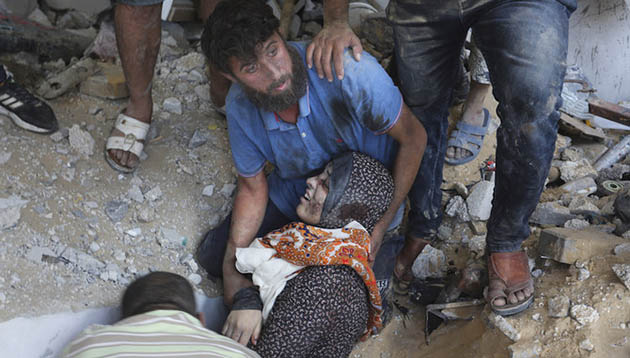
Israel pushes deeper into Gaza as it bombards vicinity of hospitals; 1 female Israeli soldier released

News Network
October 31, 2023

bombard.jpg

Israeli troops and tanks pushed deeper into Gaza on Monday advancing on two sides of the territory’s main city as one of its soldiers held captive by Hamas fighters, was released. 

The UN and medical staff warned that airstrikes have hit closer to hospitals where tens of thousands of Palestinians have sought shelter alongside thousands of wounded.

The military said a female soldier captured during Hamas’ wide-ranging Oct. 7 attack inside the land occupied by Israel had been released during its ground operation — the first such instance since the weekslong war began. The statement provided few details, but said Pvt. Ori Megidish “is doing well” and has met with her family.

Prime Minister Benjamin Netanyahu welcomed her home in a brief statement, saying “our forces” had freed her from Hamas. He said the “achievement” by Israel’s security forces “illustrates our commitment to free all the hostages.”

Hamas and other fighters are believed to be holding some 240 captives. Netanyahu has faced mounting pressure to secure their release even as Israel wages a punishing war it says is aimed at crushing Hamas and ending its 16-year rule over the territory.

Hamas, which has released four hostages, has said it would let the others go in return for thousands of Palestinian prisoners held by Israel, including many implicated in deadly attacks on Israelis. Israel has dismissed the offer. Earlier Monday, Netanyahu had said that the ground invasion “creates opportunities to release hostages.”

Hamas released a short video Monday showing three other female captives. One of the women delivers a brief statement — likely under duress — criticizing Israel’s response to the hostage crisis.

The military has been vague about its operations inside Gaza, including the location and number of troops. Israel has declared a new “phase” in the war but stopped short of declaring an all-out ground invasion, even as it has deployed tens of thousands of troops to the border.

The movements of recent days, including larger ground operations both north and east of Gaza City, point to a focus on the city. Israel says much of Hamas’ forces and infrastructure, including hundreds of miles (kilometers) of tunnels, are in Gaza City, which before the war was home to over 650,000 people, a population comparable to that of Washington, D.C.

Casualties on both sides are expected to rise sharply if Israeli forces expand their ground operation and end up battling Palestinian fighters in dense residential areas.

Though Israel ordered Palestinians to flee the north, where Gaza City is located, and move south, hundreds of thousands remain, in part because Israel has also bombarded targets in so-called safe zones. Around 117,000 displaced people hoping to stay safe from strikes are staying in hospitals in northern Gaza, alongside thousands of patients and staff, according to UN figures.

The UN agency for Palestinian refugees, known as UNRWA, says nearly 672,000 Palestinians are sheltering in its schools and other facilities across Gaza, which have reached four times their capacity.

The death toll among Palestinians passed 8,300, mostly women and children, the Gaza Health Ministry said Monday. The figure is without precedent in decades of Israeli-Palestinian violence. More than 1.4 million people in Gaza have fled their homes.

Video circulating on social media showed an Israeli tank and bulldozer in central Gaza blocking the territory’s main highway, which the Israeli military in recent weeks has suggested Palestinians use to evacuate to the south. Hundreds of thousands of Palestinians who remain in the north would no longer be able to escape if the road is blocked.

The video, taken by a local journalist, shows a car approaching an earth barrier across the road. The car stops and turns around. As it heads away, a tank appears to open fire, and an explosion engulfs the car. The journalist, in another car, races away in terror, screaming, “Go back! Go back!” at an approaching ambulance and other vehicles.

The Gaza Health Ministry later said three people were killed in the car that was hit.

Hamas said its fighters clashed with Israeli troops who entered the northwest. It was not possible to independently confirm battlefield claims made by either side.

Meanwhile, crowded hospitals in northern Gaza came under growing threat.

Gaza’s Health Ministry shared video footage that appeared to show an explosion and a column of smoke near the Turkish-Palestinian Friendship Hospital for cancer patients. The hospital director, Dr. Sobhi Skaik, said it had sustained damage in a strike that endangered patients.

All 10 hospitals operating in northern Gaza have received evacuation orders, the UN’s office for the coordination of humanitarian affairs said. Staff have refused to leave, saying evacuation would mean death for patients on ventilators.

Strikes hit within 50 meters (yards) of Al Quds Hospital after it received two calls from Israeli authorities on Sunday ordering it to evacuate, the Palestinian Red Crescent rescue service said. Some windows were blown out, and rooms were covered in debris. It said 14,000 people are sheltering there.

Beyond the fighting, conditions for civilians in Gaza are continually deteriorating as food, medicine and fuel run dangerously low amid a weekslong Israeli siege.

The siege has pushed Gaza’s infrastructure nearly to collapse. With no central power for weeks and little fuel, hospitals are struggling to keep emergency generators running to operate incubators and other life-saving equipment. UNRWA has been trying to keep water pumps and bakeries running.

The fighting has raised concerns that the violence could spread across the region. Israel and the Lebanese group Hezbollah have engaged in daily skirmishes along Israel’s northern border.

In the occupied West Bank, Israel said its warplanes carried out airstrikes Monday against militants clashing with its forces in the Jenin refugee camp, the scene of repeated Israeli raids. Hamas said four of its fighters were killed there. As of Sunday, Israeli forces and settlers have killed 123 Palestinians, including 33 minors, in the West Bank, half of them during search-and-arrest operations, the UN said.


Comments

Add new comment

  • Coastaldigest.com reserves the right to delete or block any comments.
  • Coastaldigset.com is not responsible for its readers’ comments.
  • Comments that are abusive, incendiary or irrelevant are strictly prohibited.
  • Please use a genuine email ID and provide your name to avoid reject.
News Network
December 2,2025

A major upgrade in safety and monitoring is planned for Haj 2026, with every Indian pilgrim set to receive a Haj Suvidha smart wristband linked to the official Haj Suvidha mobile app. The initiative aims to support pilgrims—especially senior citizens—who may struggle with smartphones during the 45-day journey.

What the Smart Wristband Will Do

Officials said the device will come with:
•    Location tracking
•    Pedometer
•    SOS emergency button
•    Qibla compass
•    Prayer timings
•    Basic health monitoring

SP Tiwari, secretary of the UP State Haj Committee, said the goal is to make the pilgrimage safer and more comfortable.

“Most Hajis are elderly and not comfortable with mobile apps,” he said. “The smartwatch will help locate pilgrims who forget their way or cannot communicate their location.”

The wristbands will be monitored by the Consulate General of India in Saudi Arabia, similar to mobile tracking via the Haj Suvidha App.

Free Distribution and Training

•    Smart wristbands will be given free of cost.
•    Training for pilgrims will be conducted between January and February 2026.
•    Sample units will reach state Haj committees soon.
•    Final devices will be distributed as pilgrims begin their journey.

New Rules for Accommodation

Two major decisions have also been finalised for Haj 2026:
1.    Separate rooms for men and women – including married couples. They may stay on the same floor but must occupy different rooms, following stricter Saudi guidelines.
2.    Cooking banned – gas cylinders will not be allowed; all meals will be provided through official catering services arranged by the Haj Committee of India.

These decisions were finalised during a meeting of the Haj Committee of India and state representatives in Mumbai.

Haj Suvidha App Launched Earlier

The government launched the Haj Suvidha App in 2024, offering:

•    Training modules
•    Accommodation and flight details
•    Baggage information
•    SOS and translation tools
•    Grievance redressal

Haj 2026 Quota and Key States

•    India’s total Haj quota for 2026: 1,75,025 pilgrims
•    70% (1,25,000) allotted to the Haj Committee of India
•    30% (around 50,000) reserved for Haj Group Organisers

Uttar Pradesh has the largest allocation (around 30,000 seats), though approximately 18,000 pilgrims are expected to go this year. States with high pilgrim numbers include Kerala, Maharashtra and Gujarat.

Dates of Haj 2026

The pilgrimage is scheduled to take place from 24 May to 29 May, 2026 (tentative).
Haj is one of the five pillars of Islam and is mandatory for Muslims who meet the required conditions.

Comments

Add new comment

  • Coastaldigest.com reserves the right to delete or block any comments.
  • Coastaldigset.com is not responsible for its readers’ comments.
  • Comments that are abusive, incendiary or irrelevant are strictly prohibited.
  • Please use a genuine email ID and provide your name to avoid reject.
News Network
December 4,2025

indigocrisis.jpg

Angry outbursts, long queues, and desperate appeals filled airports across India today as IndiGo grappled with a severe operational breakdown. Hundreds of flights have been cancelled or delayed, leaving thousands of passengers stranded through the night and forcing many to spend long hours at helpdesks.

Social media was flooded with videos of fliers pleading for assistance, accusing the airline of misleading updates, and demanding accommodation after being stuck for 10 to 12 hours at airports such as Hyderabad and Bengaluru.

What Triggered the Meltdown?

IndiGo has attributed the widespread disruption to “a multitude of unforeseen operational challenges.” These include:

•    Minor technology glitches
•    Winter-season schedule adjustments
•    Bad weather
•    Congestion in the aviation network
•    New crew rostering rules (Flight Duty Time Limitations or FDTL)

Among these, the most disruptive has been the implementation of the updated FDTL norms introduced by the Directorate General of Civil Aviation (DGCA) in January 2024.

These rules were designed to reduce pilot fatigue and improve passenger safety. Key changes include:

•    Longer weekly rest periods for flight crew
•    A revised definition of “night,” extending it by an extra hour
•    Tighter caps on flight duty timing and night landings
•    Cutting night shifts for pilots and crew from six per roster cycle to just two

Once these norms became fully enforceable, airlines were required to overhaul rosters well in advance. For IndiGo, this triggered a sudden shortage of crew available for duty, leading to cascading delays and cancellations.

Why IndiGo Was Hit the Hardest

IndiGo is India’s largest airline by a wide margin, operating over 2,200 flights daily. That’s roughly double the number operated by Air India.

When an airline of this size experiences even a 10–20% disruption, it translates to 200–400 flights being delayed or grounded — producing massive spillover effects across the country.

IndiGo also relies heavily on high-frequency overnight operations, a model typical of low-cost carriers that aim to maximise aircraft utilisation and reduce downtime. The stricter FDTL norms clash with these overnight-heavy schedules, forcing the airline to pull back services.

Aviation bodies have also criticised IndiGo’s preparedness. The Airline Pilots' Association of India (ALPA) said airlines were given a two-year window to plan for the new rules but “started preparing rather late.” IndiGo, it said, failed to rebuild crew rosters 15 days in advance as required.

The Federation of Indian Pilots (FIP) went further, calling the crisis the result of IndiGo’s “prolonged and unorthodox lean manpower strategy,” and alleging that the airline adopted a hiring freeze even as it knew the new rules would require more careful staffing.

How Many Flights Are Affected?

In the past 48 hours, over 300 flights have been cancelled. At least 100 more are expected to be cancelled today.

City-wise impact:

•    Hyderabad: 33 expected cancellations; several fliers stranded overnight
•    Bengaluru: over 70 expected cancellations
•    Delhi, Mumbai, Chennai, Kolkata: widespread delays and missed connections

Passengers shared distressing accounts online.

One customer at Hyderabad airport said they waited from 6 PM to 9 AM with “no action taken” regarding their delayed Pune flight. Another said IndiGo repeatedly told them the crew was “arriving soon,” only for the delay to stretch over 12 hours.

IndiGo has apologised for the disruption and promised that operations will stabilise within 48 hours, adding that “calibrated adjustments” are being made to contain the chaos.

What Should Passengers Do Now?

For those flying in the next few days, especially with IndiGo, here are key precautions:

1. Keep Checking Flight Status
Monitor your flight closely before leaving for the airport, as delays may be announced last-minute.

2. Arrive Early
Expect long queues at counters and security due to crowding and rescheduling.

3. Carry Essentials
Pack snacks, water, basic medicines, chargers, and items for children or senior citizens. Extended waiting times should be anticipated.

4. Use Flexible Booking Options
If you booked tickets with a free-date-change or cancellation option, consider using them.
If you haven’t booked yet, prefer refundable or flexible fares, or even consider alternate airlines.

5. Follow IndiGo’s Updates
Keep an eye on IndiGo’s official social media channels and contact customer support for rebooking and refund queries.

What Needs to Change?

Pilot groups have raised concerns not just about staffing but also the planning practices behind it.
The Federation of Indian Pilots accused IndiGo of:

•    Imposing an unexplained hiring freeze despite knowing the FDTL changes were coming
•    Entering non-poaching agreements that limited talent movement
•    Keeping pilot pay frozen
•    Underestimating the need to restructure operations in advance

They have urged DGCA to approve seasonal schedules only after airlines prove they have adequate pilot strength under the new norms.

ALPA also warned that some airlines might be using the delays as an “immature pressure tactic” to push DGCA for relaxations in the new rules — which, if granted, could compromise the very safety standards the norms were meant to protect.

Both pilot bodies stressed that no exemption should dilute safety, and any deviations should be based solely on scientific risk assessment.

Is a Solution in Sight?

While IndiGo says normalcy will return within two days, aviation experts believe that fully stabilising operations could take longer, depending on how quickly the airline can:
•    Re-align rosters
•    Mobilise rested crew
•    Boost staffing
•    Adjust its winter schedule to match regulatory requirements
Passengers are advised to remain prepared for continued delays over the next few days as the airline works through its backlog. 

Comments

Add new comment

  • Coastaldigest.com reserves the right to delete or block any comments.
  • Coastaldigset.com is not responsible for its readers’ comments.
  • Comments that are abusive, incendiary or irrelevant are strictly prohibited.
  • Please use a genuine email ID and provide your name to avoid reject.
News Network
November 28,2025

ministerPM.jpg

Mangaluru, Nov 28: Karnataka Health Minister and Dakshina Kannada district in-charge minister Dinesh Gundu Rao on Friday handed over Chief Minister Siddaramaiah’s letter to Prime Minister Narendra Modi, highlighting the severe distress faced by farmers due to crashing crop prices.

PM Modi arrived at the Mangaluru International Airport en route to Udupi, where Gundu Rao welcomed him and submitted the letter. The chief minister’s message stressed that farmers are suffering heavy losses because maize and green gram are being bought far below the Minimum Support Price (MSP). The state urged the Centre to immediately begin procurement at MSP.

According to the letter, Karnataka has a bumper harvest this year—over 54.74 lakh metric tons of maize and 1.98 lakh metric tons of green gram—yet farmers are unable to secure fair prices. Against the MSP of ₹2,400/MT for maize and ₹8,768/MT for green gram, market rates have plunged to ₹1,600–₹1,800 and ₹5,400 respectively.

The chief minister has requested the Centre to:

• Direct NAFED, FCI and NCCF to start MSP procurement immediately.
• Ensure ethanol units purchase maize directly from farmers or FPOs.
• Increase Karnataka’s ethanol allocation, citing high production capacity.
• Stop maize imports, which have depressed domestic prices.
• Relax quality norms for green gram, allowing up to 10% discoloration due to rains.

The letter stresses that MSP is crucial for farmer dignity and income stability and calls for swift central intervention to prevent a deepening crisis.

Comments

Add new comment

  • Coastaldigest.com reserves the right to delete or block any comments.
  • Coastaldigset.com is not responsible for its readers’ comments.
  • Comments that are abusive, incendiary or irrelevant are strictly prohibited.
  • Please use a genuine email ID and provide your name to avoid reject.