Israel refuses to allow food, medicines into Gaza as it massacres 1,000 Palestinians including 270 children, 250 women

News Network
October 11, 2023

gazadeaths.jpg

Jerusalem, Oct 11: Israeli warplanes continued to hammer the Gaza Strip neighborhood by neighborhood on Wednesday, reducing buildings to rubble and sending people scrambling to find safety in the tiny, sealed-off territory now suffering severe retaliation for the deadly weekend attack by Hamas.

The Israeli military said more than 1,000 people, including 155 soldiers, have been killed in Israel. 

In Gaza, nearly 1,000 people have been killed, including nearly 270 children and 250 women, according to authorities there; Israel says hundreds of Hamas fighters are among them. Thousands have been wounded on both sides.

Humanitarian groups pleaded for the creation of corridors to get aid into Gaza and warned that hospitals overwhelmed with wounded people were running out of supplies. Israel has stopped entry of food, fuel and medicines into Gaza, and the sole remaining access from Egypt shut down Tuesday after airstrikes hit near the border crossing.

The war, which has claimed at least 1,900 lives on both sides, is expected to escalate. The weekend attack that Hamas said was retribution for worsening conditions for Palestinians under Israeli occupation has inflamed Israel’s determination to crush the group’s hold in Gaza. New exchanges of fire over Israel’s northern borders with fighters in Lebanon and Syria on Tuesday pointed to the risk of an expanded regional conflict.
Hamas fighters stormed into Israel on Saturday morning, slaying hundreds of residents in homes and streets near the Gaza border and bringing gunbattles to Israeli towns for the first time in decades. Hamas and other freedom fighters in Gaza hold about 150 soldiers and civilians hostage, according to Israel.

Israel stepped up its offensive on Tuesday, expanding the mobilization of reservists to 360,000. Israel’s military said it had regained effective control over areas Hamas attacked in its south and of the Gaza border.

A looming question is whether Israel will launch a ground assault into Gaza — a 40-kilometer-long (25-mile) strip of land wedged among Israel, Egypt and the Mediterranean Sea that is home to 2.3 million people and has been governed by Hamas since 2007.

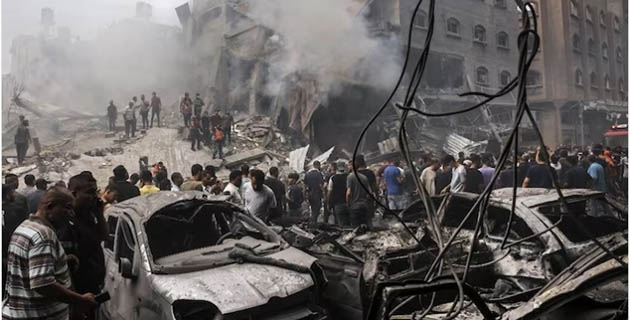
Rescue officials in Gaza said “large numbers” of people were still trapped under the remnants of leveled buildings, with rescue equipment and ambulances unable to reach the area.

On Tuesday, a large part of Gaza City’s Rimal neighborhood was reduced to rubble after hours of airstrikes the night before. Residents found buildings torn in half or demolished to mounds of concrete and rebar. Cars were flattened and trees burned out on residential streets transformed into moonscapes.

Palestinian Civil Defense forces pulled Abdullah Musleh out of his basement together with 30 others after their apartment building was flattened.

“I sell toys, not missiles,’’ the 46-year-old said, weeping. “I want to leave Gaza. Why do I have to stay here? I lost my home and my job.”

The Israeli military said it struck hundreds of targets in Rimal, an upscale district home to ministries of the Hamas-run government, universities, media organizations and the aid agency offices.

In a new tactic, Israel is warning civilians to evacuate neighborhood after neighborhood, and then inflicting devastation, in what could be a prelude to a ground offensive. On Tuesday, the military told residents of the nearby al-Daraj neighborhood to evacuate. New explosions soon rocked it and other areas, continuing into the night.

Fighter jets returned multiple times to another neighborhood, al-Furqan, striking 450 targets in 24 hours, the Israeli military said.

One blast hit Gaza City’s seaport, setting fishing boats aflame.

“There is no safe place in Gaza right now. You see decent people being killed every day,” Gaza journalist Hasan Jabar said after three Palestinian journalists were killed in the Rimal bombardment. “I am genuinely afraid for my life.”

On Tuesday afternoon, Hamas fired barrages of rockets toward the southern Israeli city of Ashkelon and Tel Aviv. There were no immediate reports of casualties. On Tuesday night, a group of fighters entered an industrial zone in Ashkelon, sparking a gunbattle with Israeli troops, the military said. Three fighters were killed, and troops were searching the area for others.

Israel’s new tactics could point to its new objective.

Four previous rounds of Israel-Hamas fighting between 2008 and 2021 all ended inconclusively, with Hamas battered but still in control. This time, Israel’s government is under intense pressure from the public to topple Hamas, a goal considered unachievable in the past because it would require a reoccupation of the Gaza Strip, at least temporarily.

“The objective is for this war to end very differently from all of the previous rounds. There has to be a clear victory,” said Chuck Freilich, a former deputy national security adviser in Israel. “Whatever has to be done to fundamentally change the situation will have to be done,” he said.

The devastation also sharpened questions about Hamas’ strategy and objectives. Hamas officials have said they planned for all possibilities, including a punishing Israeli escalation. Desperation has grown among Palestinians, many of whom see nothing to lose under unending Israeli control and increasing settlements in the West Bank, a 16-year-long blockade in Gaza and what they see as the world’s apathy.

Hamas may have been counting on the fight to spread to the West Bank and possibly for Lebanon’s Hezbollah to open a front in the north. Days of clashes between rock-throwing Palestinians and Israeli forces in the West Bank have left 15 Palestinians dead, but Israel has clamped down heavily on the territory, preventing movement between communities. The violence also spread into east Jerusalem, where Israeli police said they killed two Palestinians who hurled stones at police late Tuesday.

Brief exchanges of fire across Israel’s northern border have taken place nearly daily. Palestinian fighters fired rockets into northern Israel from Lebanon and from Syria on Tuesday, each bringing Israeli artillery and mortar fire in return. But so far they have not escalated.

In hopes of blunting the bombardment in Gaza, Hamas has threatened to kill one Israeli civilian captive any time Israel targets civilians in their homes in Gaza “without prior warning.”

The Hamas’ attack stunned Israel with a death toll unseen since the 1973 war with Egypt and Syria — and those deaths happened over a longer period of time. It brought horrific scenes of Hamas gunning down settlers in their illegal homes, on streets and at a mass outdoor music festival, while dragging men, women and children into captivity.

U.S. President Joe Biden said Tuesday at least 14 U.S. citizens were killed in Hamas’ attack and that Americans are among those being held hostage in Gaza. 

Biden added an apparent warning to Hezbollah, saying, “To any country, any organization, anyone thinking of taking advantage of the situation, I have one word: Don’t.”

The State Department announced that Secretary of State Antony Blinken would travel in the coming days to Israel to deliver a message of solidarity and support.

Hamas responded to Biden, saying his administration should “review its biased position” and “move away from the policy of double standards” over Palestinian rights to defend themselves against Israeli occupation.

The bodies of roughly 1,500 Hamas fighters were found on Israeli territory, the military said. It wasn’t clear whether those numbers overlapped with deaths reported by Palestinian authorities. Tens of thousands of people in southern Israel have been evacuated since Sunday.

In Gaza, more than 200,000 people have fled their homes, the U.N. said, the most since a 2014 air and ground offensive by Israel uprooted about 400,000. The vast majority are sheltering in schools run by the U.N. agency for Palestinian refugees. Damage to three water and sanitation sites have cut off services to 400,000 people, the U.N. said.

The U.N.’s World Health Organization said that supplies it had pre-positioned for seven hospitals in Gaza have already run out amid the flood of wounded. The head of the medical aid group Doctors Without Borders said surgical equipment, antibiotics, fuel and other supplies were running out at two hospitals it runs in Gaza. 

Comments

Add new comment

  • Coastaldigest.com reserves the right to delete or block any comments.
  • Coastaldigset.com is not responsible for its readers’ comments.
  • Comments that are abusive, incendiary or irrelevant are strictly prohibited.
  • Please use a genuine email ID and provide your name to avoid reject.
News Network
February 1,2026

US President Donald Trump on Saturday claimed that the government of India led by Prime Minister Narendra Modi has made a deal to buy Venezuelan oil, as opposed to purchasing it from Iran.

"We've already made that deal, the concept of the deal," he told reporters on Air Force One.

Trump had imposed 25% tariffs on countries buying Venezuelan oil, including India, in March 2025. He had also hit India with tariffs for buying Russian oil, saying it was "funding" President Vladimir Putin's war against Ukraine.

Trump has said that the US has taken control of the oil-rich Venezuela after capturing former President Nicolas Maduro in January.

A fleet of 18 ships loaded with crude oil bound for refineries in Texas, Louisiana, and Mississippi in January, the most since December 2024, according to a report by the news agency Bloomberg.

Combined crude deliveries to the US will reach about 2,75,000 barrels a day, more than doubling volumes seen in December last year. Shipments to China, which averaged 4,00,000 barrels a day last year, fell to zero in January.

PM Modi, Venezuelan President Agree To Expand Ties

Prime Minister Narendra Modi and Venezuela's acting President Delcy Rodriguez spoke on Friday and agreed to take the bilateral relations to "new heights" in the years ahead.

It was the first phone call between the two leaders since the capture of Maduro and his wife by the US on January 3.

"Spoke with Acting President of Venezuela, Ms. Delcy Rodriguez. We agreed to further deepen and expand our bilateral partnership in all areas, with a shared vision of taking India-Venezuela relations to new heights in the years ahead," PM Modi said in a post on X.

A statement from Prime Minister Modi's office said the two leaders agreed to further expand and deepen the India-Venezuela partnership in all areas, including trade and investment, energy, digital technology, health, agriculture, and people-to-people ties.

They exchanged views on various regional and global issues of mutual interest and underscored the importance of their close cooperation for the Global South, the statement said.

Rodriguez also said that they discussed partnerships in the fields of agriculture, science and technology, mining, and tourism, as well as the pharmaceutical and automotive industries.

Comments

Add new comment

  • Coastaldigest.com reserves the right to delete or block any comments.
  • Coastaldigset.com is not responsible for its readers’ comments.
  • Comments that are abusive, incendiary or irrelevant are strictly prohibited.
  • Please use a genuine email ID and provide your name to avoid reject.
News Network
January 23,2026

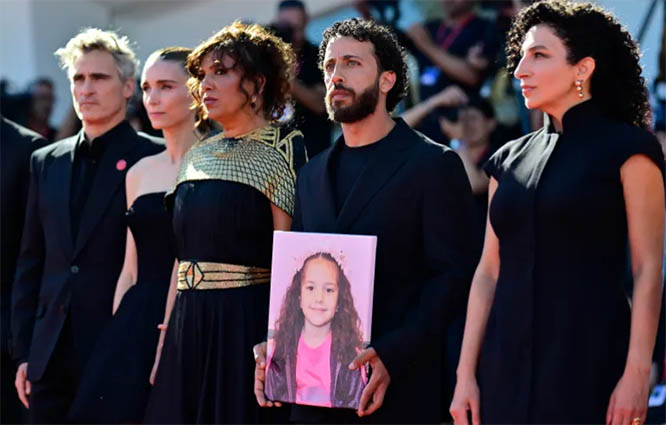
oscar.jpg

The Voice of Hind Rajab, inspired by the tragic final moments of a young Palestinian girl killed by Israeli fire in Gaza, has been nominated for an Academy Award in the Best International Feature Film category.

Directed by Tunisian filmmaker Kaouther Ben Hania, the film recounts the true story of five-year-old Hind Rajab, who lost her life in January 2024 while fleeing Israeli bombardment with her family.

The film features the real audio of Hind’s desperate call to the Palestinian Red Crescent Society, where she pleaded for help moments before the vehicle she was in was struck by 355 bullets.

The haunting narrative begins with a brief call made from the besieged Tel al-Hawa neighborhood of Gaza, where gunfire and armored vehicles drowned out every sound.

After witnessing the brutal killing of her family, she made a trembling call, her voice reduced to a whisper as she spoke of the massacre and her unbearable loneliness as the sole survivor.

Premiering at the Venice International Film Festival in September 2025, The Voice of Hind Rajab garnered widespread acclaim, receiving a record-setting 23-minute standing ovation and the Silver Lion Grand Jury Prize, the festival’s second-highest honor.

In her acceptance speech, Ben Hania dedicated the film to humanitarian workers and first responders in Gaza, emphasizing that Hind's voice symbolizes countless civilians affected by war.

She aims to give voice to victims often reduced to mere statistics, highlighting the broader suffering of civilians in war zones.

The film’s Oscar nomination underscores its powerful storytelling and ethical approach to depicting real-life tragedy, making it a crucial piece of contemporary cinema.

It serves not only as a narration of individual tragedy but also as an artistic and documentary response to the silence and censorship that often overshadow West Asian struggles and wars.

Using an innovative method she calls docufiction, Ben Hania bridges unvarnished reality and narrative structure, creating a work that is both artistically valuable and socially impactful.

Born in 1977 in Sidi Bouzid—later the epicenter of the Arab revolution—her background profoundly influenced her worldview and artistic approach.

She is a graduate of the Higher School of Audiovisual Arts of Tunis, Pantheon-Sorbonne University, and La Fémis in Paris, where her studies equipped her with the technical and theoretical tools needed to address complex subjects. 

Comments

Add new comment

  • Coastaldigest.com reserves the right to delete or block any comments.
  • Coastaldigset.com is not responsible for its readers’ comments.
  • Comments that are abusive, incendiary or irrelevant are strictly prohibited.
  • Please use a genuine email ID and provide your name to avoid reject.
News Network
January 23,2026

Karnataka Governor Thaawarchand Gehlot read only three lines from the 122-paragraph address prepared by the Congress-led state government while addressing the joint session of the Legislature on Thursday, effectively bypassing large sections critical of the BJP-led Union government.

The omitted portions of the customary Governor’s address outlined what the state government described as a “suppressive situation in economic and policy matters” under India’s federal framework. The speech also sharply criticised the Centre’s move to replace the Mahatma Gandhi National Rural Employment Guarantee Act (MGNREGA) with the Viksit Bharat–Guarantee for Rozgar and Ajeevika Mission (Gramin) Act, commonly referred to as the VB-GRAM (G) Act.

Governor Gehlot had earlier conveyed his objection to several paragraphs that were explicitly critical of the Union government. On Thursday, he confined himself to the opening lines — “I extend a warm welcome to all of you to the joint session of the State legislature. I am extremely pleased to address this august House” — before jumping directly to the concluding sentence of the final paragraph.

He ended the address by reading the last line of paragraph 122: “Overall, my government is firmly committed to doubling the pace of the State’s economic, social and physical development. Jai Hind — Jai Karnataka.”

According to the prepared speech, the Karnataka government demanded the scrapping of the VB-GRAM (G) Act, describing it as “contractor-centric” and detrimental to rural livelihoods, and called for the full restoration of MGNREGA. The state government argued that the new law undermines decentralisation, weakens labour protections, and centralises decision-making in violation of constitutional norms.

Key points from the unread sections of the speech:

•    Karnataka facing a “suppressive” economic and policy environment within the federal system

•    Repeal of MGNREGA described as a blow to rural livelihoods

•    VB-GRAM (G) Act accused of protecting corporate and contractor interests

•    New law alleged to weaken decentralised governance

•    Decision-making said to be imposed by the Centre without consulting states

•    Rights of Adivasis, women, backward classes and agrarian communities curtailed

•    Labourers allegedly placed under contractor control

•    States facing mounting fiscal stress due to central policies

•    VB-GRAM (G) Act accused of enabling large-scale corruption

Comments

Add new comment

  • Coastaldigest.com reserves the right to delete or block any comments.
  • Coastaldigset.com is not responsible for its readers’ comments.
  • Comments that are abusive, incendiary or irrelevant are strictly prohibited.
  • Please use a genuine email ID and provide your name to avoid reject.