



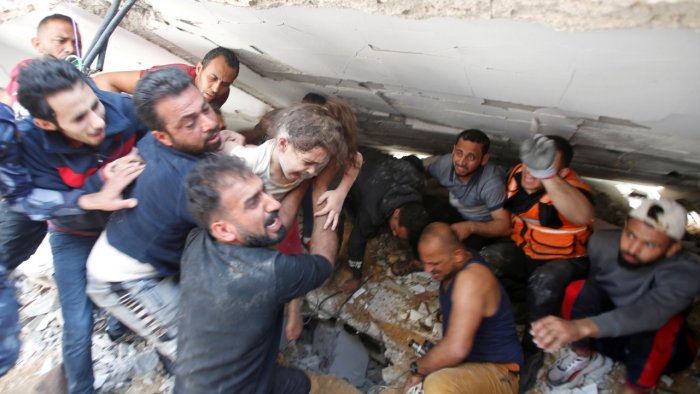
Israel strikes kill 42 in Gaza ahead of UNSC meet; toll mounts to 188 including 55 kids, 33 women

Agencies
May 16, 2021

injured.jpg

Gaza City, May 16: Israeli strikes killed at least 42 Palestinians in the Gaza Strip Sunday (May 16), the worst reported daily death toll yet in the almost week-long clashes, as the UN Security Council prepared to meet amid global alarm at the escalating conflict.

The heaviest fighting since 2014, sparked by unrest in Jerusalem, saw the rivals again trade heavy fire, with the death toll rising to 188 in the crowded coastal enclave of Gaza since Monday and at 10 in Israel, according to authorities on either side.

Among 188 martyrs there are at least 55 children and 33 women. More than 1,200 others have been wounded. In the occupied West Bank, Israeli forces have killed at least 13 Palestinians.

Israel said Sunday morning its "continuing wave of strikes" had in the past 24 hours struck over 90 targets across Gaza, where the destruction of a building housing news media organisations sparked an international outcry.

In Gaza, emergency teams worked to pull out bodies from vast piles of smoking rubble and toppled buildings, as relatives wailed in horror and grief.

UN Secretary-General Antonio Guterres was "dismayed" by civilian casualties in Gaza and "deeply disturbed" by Israel's strike on Saturday on the tower housing the Associated Press and Al Jazeera bureaus, a spokesperson said.

Israel's army said Sunday that about 3,000 rockets had been fired from the coastal strip towards Israel, the highest rate ever recorded, of which about 450 failed launches fell in the Gaza Strip.

Israel's Iron Dome anti-missile system had intercepted over a thousand rockets, the army said, in almost a week during which Israeli residential buildings have been hit, with over 500 people wounded.

"The intensity of the conflict is something we have not seen before, with non-stop airstrikes in densely populated Gaza and rockets reaching big cities in Israel," said the International Committee of the Red Cross.

"As a result, children are dying on both sides."

Pope Francis said the violence risked degenerating further "into a spiral of death and destruction" and said: "Where will hatred and revenge lead? Do we really think we will build peace by destroying the other?"

The bloodiest military conflict in seven years has also sparked a wave of inter-communal violence and mob attacks between Jews and Arab-Israelis, as well as deadly clashes in the occupied West Bank, where 19 Palestinians have been killed since last Monday.

The Israel Defense Forces (IDF) said it had targeted the infrastructure of Hamas and Islamic Jihad, including by pounding a vast tunnel system with some 100 strikes, and by targeting weapon factories and storage sites.

Israeli air strikes also hit the home of Yahya Sinwar, head of Hamas' political wing in the Gaza Strip, the army said, releasing a video showing plumes of smoke and intense damage, but without saying if he was killed.

The IDF says it takes all possible precautions to avoid harming civilians and has blamed Hamas for deliberately placing military targets in densely populated areas. One strike on Gaza killed 10 members of an extended family.

The children "didn't carry weapons, they didn't fire rockets", said Mohammad al-Hadidi, one of the grieving fathers.

Some 10,000 Gazans have fled their homes near the Israeli border for fear of a ground offensive, the UN said.

"They are sheltering in schools, mosques and other places during a global Covid-19 pandemic with limited access to water, food, hygiene and health services," UN humanitarian official Lynn Hastings said.

Balls of flame and a cloud of debris shot into the sky Saturday afternoon as Israel's air force flattened the 13-floor Gaza building housing Qatar-based Al Jazeera and the Associated Press news agency, after giving a warning to evacuate.

Al Jazeera's Jerusalem bureau chief, Walid al-Omari, told AFP: "It is clear that those who are waging this war do not only want to spread destruction and death in Gaza, but also to silence media that are witnessing, documenting and reporting the truth."

AP President and CEO Gary Pruitt said he was "shocked and horrified" by the attack.

Israeli defence officials said the building housed not only news bureaus but offices of Hamas militants.

AFP Chairman Fabrice Fries said the agency "stands in solidarity with all the media whose offices were destroyed in Gaza" and called on all parties "to respect the media's freedom to report on events".

The UN Security Council was due to meet at 1400 GMT Sunday.

Israel ally Washington, which had blocked a UNSC meeting scheduled for Friday, has been criticised for not doing enough to stem the bloodshed.

US President Joe Biden again underscored Israel's right to defend itself in a phone call with Israeli Prime Minister Benjamin Netanyahu but also expressed his "grave concern" over the violence as well as for the safety of journalists.

US Secretary for Israel-Palestinian Affairs Hady Amr was to hold talks Sunday with Israeli leaders before meeting Palestinian officials to seek a "sustainable calm", the State Department said.

The escalating conflict was sparked by unrest in Jerusalem that had simmered for weeks and led to clashes between riot police and Palestinians, fuelled by anger over planned Israeli expulsions of Palestinians in the Sheikh Jarrah neighbourhood of east Jerusalem.

Palestinian foreign minister Riyad al-Maliki criticised the countries that had moved to normalise relations with Israel last year, the United Arab Emirates, Bahrain, Sudan and Morocco.

"Normalisation and running towards this colonial Israeli system without achieving peace and ending the Israeli occupation of Arab and Palestinian lands represents support for the apartheid regime and participation in its crimes," Maliki told an emergency meeting of the Organisation of Islamic Cooperation.

In Gaza, the grieving father Hadidi said he had lost most of his family in a strike Saturday on a three-storey building in the Shati refugee camp that killed 10 relatives -- two mothers and their four children each.

"They are striking our children -- children -- without prior warning," said the devastated father, whose five-month-old baby was wounded in the explosion.

Comments

Add new comment

  • Coastaldigest.com reserves the right to delete or block any comments.
  • Coastaldigset.com is not responsible for its readers’ comments.
  • Comments that are abusive, incendiary or irrelevant are strictly prohibited.
  • Please use a genuine email ID and provide your name to avoid reject.
News Network
January 20,2026

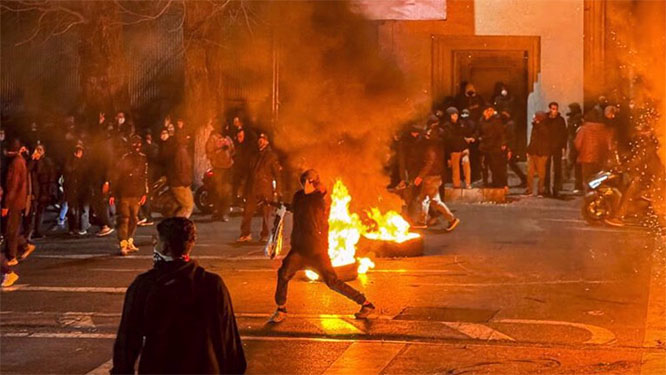
iran.jpg

Iranian security and intelligence forces have captured more than 470 individuals in three provinces, identified as key figures behind the recent wave of violent unrest and terrorist activities linked to foreign-backed networks.

The Intelligence Ministry's provincial office in Khorasan Razavi announced on Monday the arrest of 192 armed terrorists, identified as the main agents behind recent riots in the region. 

According to an official statement, the detainees were involved in the killing of several security personnel and civilians, setting fire to mosques, public service facilities, and buses, as well as attacks on military and law enforcement centers.

The seized items from the group include several bulletproof vests, Kalashnikov rifles, hunting weapons, Winchester rifles, and various cold weapons such as daggers, swords, brass knuckles, tactical knives, crossbows, and chains.

Evidence indicates that some of the individuals were tied to hostile movements and terrorist organizations, with links overseas. Others were identified as members of violent criminal gangs, actively taking part in the unrest alongside their associates.

Simultaneously, in the western province of Lorestan, the IRGC announced the arrest of 134 individuals as the main leaders and influential field agents of a US-Israeli terrorist network.

The IRGC statement stated that these individuals formed terrorist cells during the recent unrest, committing "Daesh-like" acts.

They wounded security forces with firearms and cold weapons, and burned and destroyed public and private properties, including mosques, shops, banks, and private and public vehicles.

In the northwestern province of Zanjan, the police reported detaining 150 people identified as principal leaders and agents behind recent riots.

Authorities noted that these individuals were responsible for destroying public and private property and intentionally setting fire to vehicles in the province's squares.

Their crimes include shedding the blood of innocent people, destroying public and private property, attempting to enter military sites, disrupting public order, and spreading terror among citizens.

A variety of cold weapons were reportedly seized from the detainees.

What began late last month as peaceful protests over economic hardship across Iran turned violent after public statements by US and Israeli regime figures encouraged vandalism and disorder.

During the unrest, foreign-backed mercenaries rampaged through cities, killing security forces and civilians and damaging public property.

Comments

Add new comment

  • Coastaldigest.com reserves the right to delete or block any comments.
  • Coastaldigset.com is not responsible for its readers’ comments.
  • Comments that are abusive, incendiary or irrelevant are strictly prohibited.
  • Please use a genuine email ID and provide your name to avoid reject.
News Network
January 31,2026

Roy.jpg

Bengaluru: The shooting incident involving CJ Roy, founder of the Confident Group, has once again put the spotlight on a businessman whose life has swung between flamboyant global success and persistent controversy at home.

Though Roy’s business interests extended across continents, his roots lay firmly in Karnataka. An alumnus of Christ School in Bengaluru, he later moved to Tumakuru to pursue an engineering degree. Those familiar with his early years describe him as intensely ambitious, beginning his career as a salesman at a small electronics firm dealing in computers.

Roy’s entry into large-scale real estate came through the Crystal Group, where he worked closely with Latha Namboothiri and rose from manager to director. However, the launch of the Confident Group in 2005 was clouded by industry speculation. Insiders speak of a fallout involving alleged “benami” properties and claims of deception that ultimately led to his independent venture—an episode Roy spent years trying to distance himself from, according to associates.

A tale of two cities

Roy’s professional trajectory diverged sharply across geographies.

In Dubai, he built a reputation as a bold and efficient developer, completing massive luxury residential projects in record time—some reportedly within 11 months. His rapid project delivery and lavish lifestyle in the Emirates earned him admiration and visibility in the real estate sector.

In Bengaluru, however, his image remained far more fractured. Sources say Roy stayed away from the city for several years amid disputes over unpaid dues to vendors and suppliers. Several projects were allegedly stalled, with accusations of unfulfilled commitments to cement and steel suppliers continuing to follow him.

Roy’s return to Bengaluru’s business and social circles began around 2018, marked by a conscious attempt at rebranding. His appointment as Honorary Consul of the Slovak Republic added diplomatic legitimacy, which he complemented with visible CSR initiatives, including ambulance donations and high-profile charity events.

Heavy police presence in Langford Town

Following the incident, police personnel from the Central division were deployed outside the Confident Group building in Langford Town, which also houses the Slovak Honorary Consulate in Bengaluru.

The otherwise busy premises near Hosur Road wore a deserted look on Friday, reflecting the shock and uncertainty that followed the tragedy.

Comments

Add new comment

  • Coastaldigest.com reserves the right to delete or block any comments.
  • Coastaldigset.com is not responsible for its readers’ comments.
  • Comments that are abusive, incendiary or irrelevant are strictly prohibited.
  • Please use a genuine email ID and provide your name to avoid reject.
News Network
January 23,2026

Mangaluru: The Karnataka Government Polytechnic (KPT), Mangaluru, has achieved autonomous status from the All India Council for Technical Education (AICTE), becoming the first government polytechnic in the country to receive such recognition in its 78-year history. The status was granted by AICTE, New Delhi, and subsequently approved by the Karnataka Board of Technical Education in October last year.

Officials said the autonomy was conferred a few months ago. Until recently, AICTE extended autonomous status only to engineering colleges, excluding diploma institutions. However, with a renewed national focus on skill development, several government polytechnics across India have now been granted autonomy.

KPT, the second-largest polytechnic in Karnataka, was established in 1946 with four branches and has since expanded to offer eight diploma programmes, including computer science and polymer technology. The institution is spread across a 19-acre campus.

Ravindra M Keni, the first dean of the institution, told The Times of India that AICTE had proposed autonomous status for polytechnic institutions that are over 25 years old. “Many colleges applied. In the first round, 100 institutions were shortlisted, which was further narrowed down to 15 in the second round. We have already completed one semester after becoming an autonomous institution,” he said. He added that nearly 500 students are admitted annually across eight three-year diploma courses.

Explaining the factors that helped KPT secure autonomy, Keni said the institution has consistently recorded 100 per cent admissions and placements for its graduates. He also noted its strong performance in sports, with the college emerging champions for 12 consecutive years, along with active student participation in NCC and NSS activities.

Autonomous status allows KPT to design industry-oriented curricula, conduct examinations, prepare question papers, and manage academic documentation independently. The institution can also directly collaborate with industries and receive priority funding from AICTE or the Ministry of Education. While academic autonomy has been granted, financial control will continue to rest with the state government.

“There will be separate committees for examinations, question paper setting, boards of studies, and boards of examiners. The institution will now have the freedom to conduct admissions without government notifications and issue its own marks cards,” Keni said, adding that new academic initiatives would be planned after a year of functioning under the autonomous framework.

Comments

Add new comment

  • Coastaldigest.com reserves the right to delete or block any comments.
  • Coastaldigset.com is not responsible for its readers’ comments.
  • Comments that are abusive, incendiary or irrelevant are strictly prohibited.
  • Please use a genuine email ID and provide your name to avoid reject.
