



Israeli army bombs Gaza 100 times in 24 hours; 125 starved to death due to blockade

Agencies
July 26, 2025

gazabombs.jpg

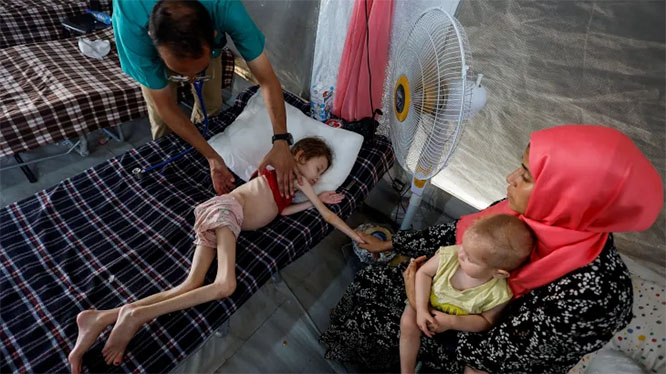
Gaza, July 26: The humanitarian catastrophe in Gaza deepened further today as two more Palestinian infants succumbed to malnutrition, bringing the total number of starvation-related deaths to around 125, including more than 80 children. This grim milestone underscores the devastating toll of Israel’s months-long blockade and relentless military campaign on the besieged enclave.

Infants at Imminent Risk: “Mothers Feeding Water Instead of Milk”

The Gaza Government Media Office issued an urgent warning, describing the situation as an “unprecedented and imminent humanitarian disaster.” According to their statement:

100,000 children under the age of two are now at risk of death.

Of them, 40,000 newborns and infants face life-threatening malnutrition due to a complete absence of baby milk and supplements.

Crossings into Gaza remain sealed, and humanitarian aid is blocked, preventing even “the simplest basic supplies” from entering.

The office accused Israel of deliberately targeting civilians through starvation, saying:

“We are witnessing a slow, deliberate mass killing. Mothers are forced to breastfeed water to their infants — a direct consequence of Israel’s starvation and extermination policy.”

Bombardment Intensifies: 100 Strikes in 24 Hours

In parallel with the food crisis, Gaza endured another wave of intense Israeli air and ground assaults:

Israeli warplanes carried out over 100 airstrikes in the last 24 hours, striking what the military termed “terror targets.”

At least 25 Palestinians have been killed since dawn, including 13 civilians who were seeking aid.

The Israeli 36th Division expanded ground operations in Khan Younis, claiming to target tunnels and weapons caches, in coordination with the Shin Bet security agency.

Mounting Toll Amid Blockade

Human rights groups and UN officials warn that Gaza’s humanitarian infrastructure has completely collapsed, with hospitals unable to treat starvation cases or bombing victims. Fuel, clean water, and medical supplies remain virtually nonexistent.

The rising starvation deaths, combined with escalating bombardment, highlight what observers describe as a systematic campaign of collective punishment against Gaza’s civilian population.

Comments

Add new comment

  • Coastaldigest.com reserves the right to delete or block any comments.
  • Coastaldigset.com is not responsible for its readers’ comments.
  • Comments that are abusive, incendiary or irrelevant are strictly prohibited.
  • Please use a genuine email ID and provide your name to avoid reject.
News Network
January 23,2026

Mangaluru: The Karnataka Government Polytechnic (KPT), Mangaluru, has achieved autonomous status from the All India Council for Technical Education (AICTE), becoming the first government polytechnic in the country to receive such recognition in its 78-year history. The status was granted by AICTE, New Delhi, and subsequently approved by the Karnataka Board of Technical Education in October last year.

Officials said the autonomy was conferred a few months ago. Until recently, AICTE extended autonomous status only to engineering colleges, excluding diploma institutions. However, with a renewed national focus on skill development, several government polytechnics across India have now been granted autonomy.

KPT, the second-largest polytechnic in Karnataka, was established in 1946 with four branches and has since expanded to offer eight diploma programmes, including computer science and polymer technology. The institution is spread across a 19-acre campus.

Ravindra M Keni, the first dean of the institution, told The Times of India that AICTE had proposed autonomous status for polytechnic institutions that are over 25 years old. “Many colleges applied. In the first round, 100 institutions were shortlisted, which was further narrowed down to 15 in the second round. We have already completed one semester after becoming an autonomous institution,” he said. He added that nearly 500 students are admitted annually across eight three-year diploma courses.

Explaining the factors that helped KPT secure autonomy, Keni said the institution has consistently recorded 100 per cent admissions and placements for its graduates. He also noted its strong performance in sports, with the college emerging champions for 12 consecutive years, along with active student participation in NCC and NSS activities.

Autonomous status allows KPT to design industry-oriented curricula, conduct examinations, prepare question papers, and manage academic documentation independently. The institution can also directly collaborate with industries and receive priority funding from AICTE or the Ministry of Education. While academic autonomy has been granted, financial control will continue to rest with the state government.

“There will be separate committees for examinations, question paper setting, boards of studies, and boards of examiners. The institution will now have the freedom to conduct admissions without government notifications and issue its own marks cards,” Keni said, adding that new academic initiatives would be planned after a year of functioning under the autonomous framework.

Comments

Add new comment

  • Coastaldigest.com reserves the right to delete or block any comments.
  • Coastaldigset.com is not responsible for its readers’ comments.
  • Comments that are abusive, incendiary or irrelevant are strictly prohibited.
  • Please use a genuine email ID and provide your name to avoid reject.