



‘Largest yet’ Israeli airstrikes hit southern suburbs of Lebanon’s capital

News Network
October 4, 2024

airstrike.jpg

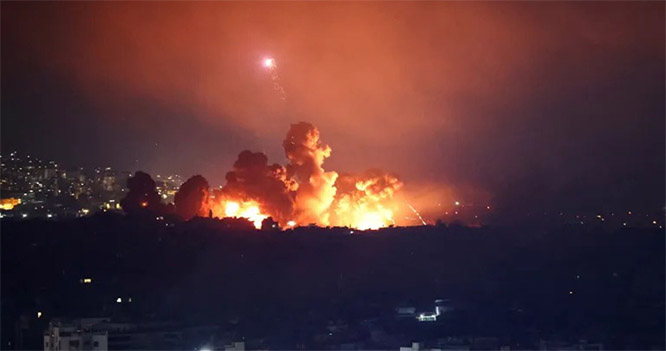
Powerful blasts rocked Beirut overnight in some of the heaviest Israeli strikes on the capital of Lebanon so far as the Lebanese Health Ministry reports dozens killed and over 150 wounded in bombing attacks across the country in the past 24 hours.

Israel launched several waves of airstrikes on Beirut’s southern neighborhood of Dahiyeh on Thursday.

The regime used powerful bunker-buster bombs in its latest attacks, whose number was more than a dozen.

Several civilian buildings were the main goals of the regime’s latest strikes.

Reports indicate that more bombs were used in the latest attacks compared to the strike that killed the leader of the Hezbollah resistance movement, Sayyed Hassan Nasrallah, last Friday.

The attacks also hit the vicinity of Beirut International Airport.

Israel’s strikes also targeted several other locations, including Hezbollah’s media relations office and a warehouse near the Beirut airport.

A source close to Hezbollah said Israel had conducted 11 consecutive strikes in south Beirut on Thursday night.

AFP correspondents in the Lebanese capital heard loud bangs that made car alarms go off and buildings shake.

"Israel struck the southern suburbs 11 consecutive times," the source said on the condition of anonymity.

Giant balls of flame rose from the targeted site with thick smoke billowing and flares shooting out.

Lebanon's official National News Agency (NNA) said that "more than 10 consecutive strikes have been recorded so far, in one of the strongest raids on the southern suburbs of Beirut since the start of the Israeli war on Lebanon."

The strikes echoed to mountain regions outside Beirut, the NNA said.

Earlier Thursday, the Israeli army issued an “urgent warning” to the residents of the south Beirut area of Burj al-Barajneh to evacuate along with maps of the area.

“You are located near Hezbollah facilities and interests, against which the [Israeli army] will operate in the near future,” its official Arabic language spokesperson posted on X.

The death toll from Israeli aerial assaults across Lebanon since early October 2023 has passed the 1,700 mark with nearly 8,770 injured, according to Lebanese government data.

In response, Hezbollah has fired barrages of rockets and drones towards Israeli targets.

Hezbollah has been responding to the aggression with numerous retaliatory operations, including with hypersonic ballistic missiles, targeting the occupied Palestinian territories.

The Lebanese resistance movement has vowed to keep up its operations against Israel as long as the Israeli regime continues its Gaza war, which has so far killed more than 41,780 Palestinians, mostly women and children.

The qualitative strikes of Hezbollah have so far thwarted any hostile "Israeli" advance into Lebanese territory.

Hezbollah said in a statement that at least 17 Israeli troops have been killed since the regime launched its incursion into southern Lebanon.

Since dawn on Thursday, the Lebanese resistance fighters have been repelling every attempt by the Israeli elite forces to advance on multiple fronts in southern Lebanon, inflicting heavy losses in equipment and personnel.

A Lebanese political analyst recently praised Hezbollah’s operational capabilities, warning that Israeli forces will become "sitting ducks" for the Lebanese resistance group should they attempt a ground invasion of southern Lebanon.

Comments

Add new comment

  • Coastaldigest.com reserves the right to delete or block any comments.
  • Coastaldigset.com is not responsible for its readers’ comments.
  • Comments that are abusive, incendiary or irrelevant are strictly prohibited.
  • Please use a genuine email ID and provide your name to avoid reject.
News Network
January 20,2026

Mangaluru: In a major step towards strengthening rural innovation, the Office of the Principal Scientific Adviser (PSA) to the Government of India is supporting the establishment of RuTAGe Smart Village Centres (RSVCs) across the country through collaborations with academic institutions, civil society organisations and philanthropic partners.

As part of this national initiative, Nitte (Deemed to be University) will set up the first RSVCs in the region at Nitte GP in Udupi district and at the Nitte Health Centre, Sevanjali Trust, Farangipete, in Dakshina Kannada district. The centres will be inaugurated on January 21. In South India, the programme is being implemented by the Section Infin-8 Foundation (SI-8).

Speaking to reporters on Monday, SI-8 founder-director Vishwas US said experts from Nitte University and SI-8 would work closely with farmers, students, youth and local entrepreneurs to adapt and deploy technologies tailored to local needs.

Project head Prof Iddya Karunasagar, representing Nitte DU, said the RSVCs at Nitte and Farangipete would serve as demonstration hubs for a wide range of agriculture, energy, skill-development and assistive technologies. These include solar dryers for fruits, vegetables and crops; soil-testing solutions; power weeders and women-friendly farm tools; wind-powered devices for rural artisans; grain storage systems; grass-cutting and tree-climbing equipment; and liquid fertiliser production using cowshed waste.

SI-8 CEO Aravind C Kumar said the centres would also provide access to digital and knowledge-based platforms such as ISRO applications, government scheme portals, market linkage tools and gamified learning resources, along with assistive technologies for persons with visual impairments.

Highlighting the broader impact of the initiative, Principal Scientific Adviser Prof Ajay Kumar Sood said it demonstrated how applied research could bridge the rural–urban divide and help create self-reliant, technology-enabled villages.

The initiative has been made possible through philanthropic support from Dr NC Murthy of ACM Business Solutions, LLC, USA. Dr Sapna Poti, Director (Strategic Alliances) at the Office of the Principal Scientific Adviser, said the long-term objective is to build self-sufficient, technology-driven communities capable of generating sustainable livelihoods on their own.

Comments

Add new comment

  • Coastaldigest.com reserves the right to delete or block any comments.
  • Coastaldigset.com is not responsible for its readers’ comments.
  • Comments that are abusive, incendiary or irrelevant are strictly prohibited.
  • Please use a genuine email ID and provide your name to avoid reject.
News Network
January 23,2026

Karnataka Governor Thaawarchand Gehlot read only three lines from the 122-paragraph address prepared by the Congress-led state government while addressing the joint session of the Legislature on Thursday, effectively bypassing large sections critical of the BJP-led Union government.

The omitted portions of the customary Governor’s address outlined what the state government described as a “suppressive situation in economic and policy matters” under India’s federal framework. The speech also sharply criticised the Centre’s move to replace the Mahatma Gandhi National Rural Employment Guarantee Act (MGNREGA) with the Viksit Bharat–Guarantee for Rozgar and Ajeevika Mission (Gramin) Act, commonly referred to as the VB-GRAM (G) Act.

Governor Gehlot had earlier conveyed his objection to several paragraphs that were explicitly critical of the Union government. On Thursday, he confined himself to the opening lines — “I extend a warm welcome to all of you to the joint session of the State legislature. I am extremely pleased to address this august House” — before jumping directly to the concluding sentence of the final paragraph.

He ended the address by reading the last line of paragraph 122: “Overall, my government is firmly committed to doubling the pace of the State’s economic, social and physical development. Jai Hind — Jai Karnataka.”

According to the prepared speech, the Karnataka government demanded the scrapping of the VB-GRAM (G) Act, describing it as “contractor-centric” and detrimental to rural livelihoods, and called for the full restoration of MGNREGA. The state government argued that the new law undermines decentralisation, weakens labour protections, and centralises decision-making in violation of constitutional norms.

Key points from the unread sections of the speech:

•    Karnataka facing a “suppressive” economic and policy environment within the federal system

•    Repeal of MGNREGA described as a blow to rural livelihoods

•    VB-GRAM (G) Act accused of protecting corporate and contractor interests

•    New law alleged to weaken decentralised governance

•    Decision-making said to be imposed by the Centre without consulting states

•    Rights of Adivasis, women, backward classes and agrarian communities curtailed

•    Labourers allegedly placed under contractor control

•    States facing mounting fiscal stress due to central policies

•    VB-GRAM (G) Act accused of enabling large-scale corruption

Comments

Add new comment

  • Coastaldigest.com reserves the right to delete or block any comments.
  • Coastaldigset.com is not responsible for its readers’ comments.
  • Comments that are abusive, incendiary or irrelevant are strictly prohibited.
  • Please use a genuine email ID and provide your name to avoid reject.