Masks come off in Israel as the country vaunts covid-19 victory

Agencies
April 19, 2021

israel.jpg

Tel Aviv, Apr 19: Israelis stepped into the streets without masks on Sunday for the first time in a year, a key milestone as the country vaccinates its way out of a coronavirus nightmare.

"It's very strange but it's very nice," said Eliana Gamulka, 26, after getting off a bus near the busy Jerusalem shopping boulevard of Jaffa Street and removing her face covering.

"You can't pretend that you don't know anyone any more," she smiled.

With over half the population fully vaccinated in one of the world's fastest anti-Covid 19 inoculation campaigns, the health ministry announced on Thursday that masks would no longer be required in public outdoor spaces.
For Gamulka, a project manager, the good news came at the perfect time: just two weeks before her wedding.

It will be "very nice to celebrate with everyone, now without masks," she said. "The pictures will be great! I'm very relieved. We can start living again."

The vaccination of close to five million people has sent Israel's coronavirus caseload tumbling from some 10,000 new infections per day as recently as mid-January, to around 200 cases a day.

That has allowed the re-opening of schools, bars, restaurants and other indoor gatherings -- although masks are still required in indoor public spaces.

And even before Health Minister Yuli Edelstein's announcement came into effect, punters in the popular bars of Jerusalem's Mahane Yehuda market were mask-free and smiling on Thursday evening.

Yet on Sunday, office worker Ester Malka said she wasn't quite ready to let down her guard.

"We're allowed, but I'm still afraid, I got used to (wearing a mask)," she said.

"I feel like it's part of my life. We'll see what happens when everyone has taken them off. If it goes well for a couple of months, then I'll remove mine."

Israel just months ago had the world's highest infection rate, a coronavirus outbreak that left 6,300 people dead among 836,000 cases.

But the Jewish state sent its coronavirus caseload tumbling after striking a deal for a vast stock of Pfizer/BioNTech jabs.

In exchange, it agreed to pay above market price and share data it gathers on the recipients, using one of the world's most sophisticated medical data systems.

Since December, some 53 per cent of Israel's 9.3 million people have received both doses of the jab, including around four-fifths of the population aged over 20.

As recently as January it was registering 10,000 cases per day.

But as the effects of mass vaccination kicked in, by March it was able to implement a gradual re-opening.

"There's no better advertisement for Pfizer," said Shalom Yatzkan, a computer programmer who had been in quarantine after catching the virus.

"I was sick for three days, I had neck pains and felt weak," he said as he walked through central Jerusalem. "I just hope the new variants don't catch up with us."

Another Sunday landmark in Israel's exit from coronavirus restrictions was the full resumption of the country's educational system, without restrictions on the numbers of pupils in classrooms.

Speaking at a Jerusalem high school, Prime Minister Benjamin Netanyahu hailed the "festivity" of the day for the schools, while warning of complacency.

"We're not done with the coronavirus yet, since it can return," he said, stressing the need to obtain "millions more vaccinations".

"Sooner or later, we'll need another vaccination (dose)," he said.

The situation in Israel is in stark contrast to the occupied West Bank and the blockaded Gaza Strip, where infection rates remain high and vaccinations are low.

Gaza, which is ruled by the Islamist movement Hamas, said on Sunday it had recorded 23 deaths over the past 24 hours -- the highest ever daily coronavirus toll, with 761 deaths since the start of the pandemic.

Rights groups have urged Israel to supply vaccines to the 4.8 million Palestinians living there, but Israel says that falls under the Palestinian Authority's responsibility.

It has however vaccinated over 105,000 Palestinian workers who hold permits for employment in Israel and the settlements.

In Jerusalem, meanwhile, Gamulka was enjoying the simple pleasure of new-found freedoms.

"It's nice not to have something on your face any more," she said.

Comments

Add new comment

  • Coastaldigest.com reserves the right to delete or block any comments.
  • Coastaldigset.com is not responsible for its readers’ comments.
  • Comments that are abusive, incendiary or irrelevant are strictly prohibited.
  • Please use a genuine email ID and provide your name to avoid reject.
News Network
January 20,2026

iran.jpg

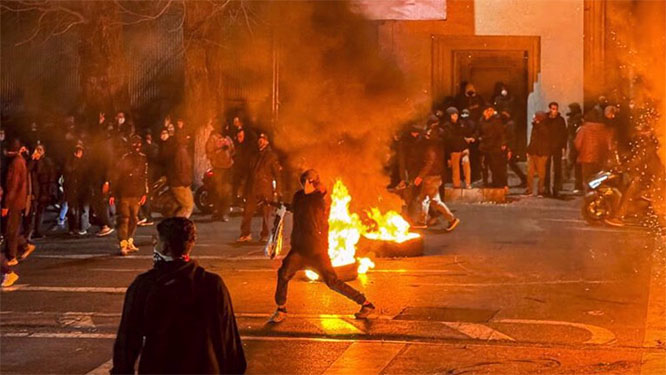
Iranian security and intelligence forces have captured more than 470 individuals in three provinces, identified as key figures behind the recent wave of violent unrest and terrorist activities linked to foreign-backed networks.

The Intelligence Ministry's provincial office in Khorasan Razavi announced on Monday the arrest of 192 armed terrorists, identified as the main agents behind recent riots in the region. 

According to an official statement, the detainees were involved in the killing of several security personnel and civilians, setting fire to mosques, public service facilities, and buses, as well as attacks on military and law enforcement centers.

The seized items from the group include several bulletproof vests, Kalashnikov rifles, hunting weapons, Winchester rifles, and various cold weapons such as daggers, swords, brass knuckles, tactical knives, crossbows, and chains.

Evidence indicates that some of the individuals were tied to hostile movements and terrorist organizations, with links overseas. Others were identified as members of violent criminal gangs, actively taking part in the unrest alongside their associates.

Simultaneously, in the western province of Lorestan, the IRGC announced the arrest of 134 individuals as the main leaders and influential field agents of a US-Israeli terrorist network.

The IRGC statement stated that these individuals formed terrorist cells during the recent unrest, committing "Daesh-like" acts.

They wounded security forces with firearms and cold weapons, and burned and destroyed public and private properties, including mosques, shops, banks, and private and public vehicles.

In the northwestern province of Zanjan, the police reported detaining 150 people identified as principal leaders and agents behind recent riots.

Authorities noted that these individuals were responsible for destroying public and private property and intentionally setting fire to vehicles in the province's squares.

Their crimes include shedding the blood of innocent people, destroying public and private property, attempting to enter military sites, disrupting public order, and spreading terror among citizens.

A variety of cold weapons were reportedly seized from the detainees.

What began late last month as peaceful protests over economic hardship across Iran turned violent after public statements by US and Israeli regime figures encouraged vandalism and disorder.

During the unrest, foreign-backed mercenaries rampaged through cities, killing security forces and civilians and damaging public property.

Comments

Add new comment

  • Coastaldigest.com reserves the right to delete or block any comments.
  • Coastaldigset.com is not responsible for its readers’ comments.
  • Comments that are abusive, incendiary or irrelevant are strictly prohibited.
  • Please use a genuine email ID and provide your name to avoid reject.
News Network
January 23,2026

Mangaluru: The Karnataka Government Polytechnic (KPT), Mangaluru, has achieved autonomous status from the All India Council for Technical Education (AICTE), becoming the first government polytechnic in the country to receive such recognition in its 78-year history. The status was granted by AICTE, New Delhi, and subsequently approved by the Karnataka Board of Technical Education in October last year.

Officials said the autonomy was conferred a few months ago. Until recently, AICTE extended autonomous status only to engineering colleges, excluding diploma institutions. However, with a renewed national focus on skill development, several government polytechnics across India have now been granted autonomy.

KPT, the second-largest polytechnic in Karnataka, was established in 1946 with four branches and has since expanded to offer eight diploma programmes, including computer science and polymer technology. The institution is spread across a 19-acre campus.

Ravindra M Keni, the first dean of the institution, told The Times of India that AICTE had proposed autonomous status for polytechnic institutions that are over 25 years old. “Many colleges applied. In the first round, 100 institutions were shortlisted, which was further narrowed down to 15 in the second round. We have already completed one semester after becoming an autonomous institution,” he said. He added that nearly 500 students are admitted annually across eight three-year diploma courses.

Explaining the factors that helped KPT secure autonomy, Keni said the institution has consistently recorded 100 per cent admissions and placements for its graduates. He also noted its strong performance in sports, with the college emerging champions for 12 consecutive years, along with active student participation in NCC and NSS activities.

Autonomous status allows KPT to design industry-oriented curricula, conduct examinations, prepare question papers, and manage academic documentation independently. The institution can also directly collaborate with industries and receive priority funding from AICTE or the Ministry of Education. While academic autonomy has been granted, financial control will continue to rest with the state government.

“There will be separate committees for examinations, question paper setting, boards of studies, and boards of examiners. The institution will now have the freedom to conduct admissions without government notifications and issue its own marks cards,” Keni said, adding that new academic initiatives would be planned after a year of functioning under the autonomous framework.

Comments

Add new comment

  • Coastaldigest.com reserves the right to delete or block any comments.
  • Coastaldigset.com is not responsible for its readers’ comments.
  • Comments that are abusive, incendiary or irrelevant are strictly prohibited.
  • Please use a genuine email ID and provide your name to avoid reject.