



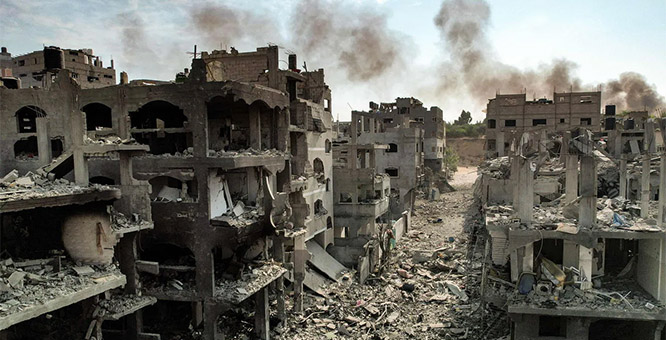
In Numbers: 200 days of Israeli genocidal war against humans of Gaza

News Network
April 23, 2024

gazadestruction.jpg

The genocidal war on Gaza launched by Israel on October 7 last year, with the support of the US and its other Western allies, completes 200 days on Tuesday, leaving behind a trail of death, destruction, displacement and starvation.

These 200 days – between October 7, 2023, and April 23, 2024 – have been marked by unprecedented crimes against the people of Gaza, especially children and women, the bombardment of hospitals and schools, abuse and torture of women and abduction of young boys.

Human rights groups and international bodies have described the harrowing events unfolding in the besieged Palestinian territory as a textbook case of genocide and ethnic cleansing.

Israeli regime’s key international allies – Washington, London, Paris and Berlin – have also been at the receiving end of massive public backlash for their continued military support for the regime.

The death toll in the apartheid regime’s genocidal campaign has already topped 34,150 since October 7, more than 75 percent of them being women and children, according to the Gaza government office.

The 2.3 million people in the besieged territory continue to deal with a catastrophic humanitarian crisis amid relentless bombings and crippling siege imposed by the Israeli regime with the backing of the US.

Following are the statistics related to 200 days of war waged by the Israeli occupation on Gaza. 

200 – the number of days of the latest Israeli genocidal war on Gaza

41,183 – the total number of those killed and missing in Gaza since Oct. 7

34,183 – the total number of fatalities in Gaza since Oct. 7 (confirmed dead)

7,000 – the number of people still under the rubble of destroyed buildings in Gaza (presumed dead)

77,183 – the number of wounded persons in Gaza since Oct. 7

3,025 – the number of massacres committed by the regime since Oct. 7

14,778 – the number of children killed since Oct. 7

30 – the number of children who died due to starvation and famine

9,752 – the number of women killed since Oct. 7

485 – the number of doctors and paramedics killed since Oct. 7

67 – the number of civil defense personnel killed since Oct. 7

140 – the number of Palestinian journalists killed since Oct. 7

72 – the percentage of children and women killed since Oct. 7

17,000 – the number of children who have lost one or both parents since Oct. 7

11,000 – the number of injured people who need to travel for treatment

10,000 – the number of cancer patients who face the risk of death

1,090,000 – the number of people with infectious diseases due to displacement

8,000 – the number of cases of viral hepatitis due to displacement

60,000 – the number of pregnant women at risk due to lack of healthcare

350,000 – the number of chronically ill patients suffering due to lack of medicine

5,000 – the number of people arbitrarily detained in Gaza since Oct. 7

310 – the number of health practitioners who have been arrested

20 – the number of known journalists arbitrarily detained since Oct. 7

2 million – the number of displaced people in the Gaza Strip

181 – the number of government buildings destroyed since Oct. 7

103 – the number of schools and universities completely destroyed since Oct. 7

317 – the number of schools and universities partially destroyed by the occupation

239 – the number of mosques completely destroyed since Oct. 7

317 – the number of mosques partially destroyed since Oct. 7

3 – the number of churches targeted and destroyed since Oct. 7

86,000 – the number of housing units completely destroyed since Oct. 7

294,000 – the number of housing units partially destroyed since Oct. 7

75,000 – tons of explosives dropped by the occupation on Gaza since Oct. 7

32 – the number of hospitals taken out of service by the occupation since Oct. 7

53 – the number of health centers that have become non-functional since Oct. 7

160 – the number of health institutions partially or fully destroyed since Oct. 7

126 – the number of ambulances destroyed by the occupation army since Oct. 7

206 – the number of archaeological and heritage sites destroyed since Oct. 7

$30 – billions in preliminary direct losses as a result of the genocidal war on Gaza

Comments

Add new comment

  • Coastaldigest.com reserves the right to delete or block any comments.
  • Coastaldigset.com is not responsible for its readers’ comments.
  • Comments that are abusive, incendiary or irrelevant are strictly prohibited.
  • Please use a genuine email ID and provide your name to avoid reject.
News Network
January 23,2026

Karnataka Governor Thaawarchand Gehlot read only three lines from the 122-paragraph address prepared by the Congress-led state government while addressing the joint session of the Legislature on Thursday, effectively bypassing large sections critical of the BJP-led Union government.

The omitted portions of the customary Governor’s address outlined what the state government described as a “suppressive situation in economic and policy matters” under India’s federal framework. The speech also sharply criticised the Centre’s move to replace the Mahatma Gandhi National Rural Employment Guarantee Act (MGNREGA) with the Viksit Bharat–Guarantee for Rozgar and Ajeevika Mission (Gramin) Act, commonly referred to as the VB-GRAM (G) Act.

Governor Gehlot had earlier conveyed his objection to several paragraphs that were explicitly critical of the Union government. On Thursday, he confined himself to the opening lines — “I extend a warm welcome to all of you to the joint session of the State legislature. I am extremely pleased to address this august House” — before jumping directly to the concluding sentence of the final paragraph.

He ended the address by reading the last line of paragraph 122: “Overall, my government is firmly committed to doubling the pace of the State’s economic, social and physical development. Jai Hind — Jai Karnataka.”

According to the prepared speech, the Karnataka government demanded the scrapping of the VB-GRAM (G) Act, describing it as “contractor-centric” and detrimental to rural livelihoods, and called for the full restoration of MGNREGA. The state government argued that the new law undermines decentralisation, weakens labour protections, and centralises decision-making in violation of constitutional norms.

Key points from the unread sections of the speech:

•    Karnataka facing a “suppressive” economic and policy environment within the federal system

•    Repeal of MGNREGA described as a blow to rural livelihoods

•    VB-GRAM (G) Act accused of protecting corporate and contractor interests

•    New law alleged to weaken decentralised governance

•    Decision-making said to be imposed by the Centre without consulting states

•    Rights of Adivasis, women, backward classes and agrarian communities curtailed

•    Labourers allegedly placed under contractor control

•    States facing mounting fiscal stress due to central policies

•    VB-GRAM (G) Act accused of enabling large-scale corruption

Comments

Add new comment

  • Coastaldigest.com reserves the right to delete or block any comments.
  • Coastaldigset.com is not responsible for its readers’ comments.
  • Comments that are abusive, incendiary or irrelevant are strictly prohibited.
  • Please use a genuine email ID and provide your name to avoid reject.
News Network
February 1,2026

Bengaluru, Feb 1: For travelers landing at Kempegowda International Airport (KIA), the sleek, wood-paneled curves of Terminal 2 promise a world-class welcome. But the famed “Garden City” charm quickly withers at the curb. As India’s aviation sector swells to record numbers—handling over 43 million passengers in Bengaluru alone this past year—the “last mile” has turned into a marathon of frustration.

The Bengaluru Logjam: Rules vs Reality

While the city awaits the 2027 completion of the Namma Metro Blue Line, the interim has been chaotic. Recent “decongestion” rules at Terminal 1 have pushed app-based cab pickups to distant parking zones, forcing weary passengers into a 20-minute walk with luggage.

“I landed after ten months away and felt like a stranger in my own city,” says Ruchitha Jain, a Koramangala resident. “My driver couldn’t find me, staff couldn’t guide me, and the so-called ‘Premium’ lane is just a fancy tax on convenience.”

•    The Cost of Distance: A 40-km cab ride can now easily cross ₹1,500, driven by demand pricing and airport surcharges.

•    The Bus Gap: While Vayu Vajra remains a lifeline, its ₹300–₹400 fare is often cited as the most expensive airport bus service in the country.

A National Pattern of Disconnect

The struggle is not unique to Karnataka. From Chennai’s coast to Hyderabad’s plateau, India’s airports tell a familiar story: brilliant runways, broken exits.

City:    Primary Issue   |    Recent Development

Bengaluru:    Cab pickup restrictions & distance  |    App-based taxis shifted to far parking zones; long walks and fare spikes reported

Chennai:    Multi-Level Parking (MLCP) hike  |    Passengers report 40-minute walks to reach cab pickup points

Hyderabad:    “Taxi mafia” & touting  |    Over 440 touting cases reported; security presence intensified

Mumbai:    Fare scams  |     Tourists charged ₹18,000 for just 400 metres, triggering police action

In Hyderabad, travelers continue to battle entrenched local groups that intimidate Uber and Ola drivers, pushing passengers toward overpriced private taxis. Chennai flyers, meanwhile, complain that reaching the designated pickup zones now takes longer than short-haul flights from cities like Coimbatore.

The ‘Budget Day’ Hope

As Finance Minister Nirmala Sitharaman presents the Union Budget 2026 today, the aviation sector is watching closely. With the government’s renewed emphasis on multimodal integration, there is cautious hope for funding toward seamless airport-metro-bus hubs.

The vision is clear: a future where planes, trains, and metros speak the same language. Until then, passengers at KIA—and airports across India—will continue to discover that the hardest part of flying isn’t the thousands of kilometres in the air, but the last few on the ground.

Comments

Add new comment

  • Coastaldigest.com reserves the right to delete or block any comments.
  • Coastaldigset.com is not responsible for its readers’ comments.
  • Comments that are abusive, incendiary or irrelevant are strictly prohibited.
  • Please use a genuine email ID and provide your name to avoid reject.
News Network
January 19,2026

New Delhi: Setting speculation to the rest, the CPI(M) has made it clear that it is open to have an electoral understanding with the Congress “to defeat” the Trinamool Congress and the BJP in West Bengal Assembly election even as it is all set to take on the grand old party in Kerala accusing it of “found wanting” in fighting the Hindutva forces.

The CPI(M) also said that it will contest the Tamil Nadu election “with DMK and its allies to defeat the BJP and its allies”, amid a section in the Congress triggering confusion about its participation in the M K Stalin-led coalition over demand over power-sharing and more seats. It is also willing to join hands with Congress and others in Assam and Puducherry to defeat the BJP.

The decisions came at a three-day meeting of the CPI(M) Central Committee in Thiruvananthapuram, which ended on Sunday after reviewing the poll preparations in the poll-bound states.

The CPI(M)'s decision came even as a section led by West Bengal Congress president Subhankar Sarkar is averse to tying up with the Left Front, claiming that their party is not benefitted by the electoral understanding. Both Congress and CPI(M)-led Left Front had electoral understanding in 2016 and 2021 Assembly elections and 2024 Lok Sabha polls.

Congress and the Left Front fought together for the first time in 2016 when Congress won 44 seats and the CPI(M) got 26. In 2021, the Left Front and the Congress drew a blank. In the 2024 Lok Sabha polls, Congress managed to win one seat while the Left did not win any. In the 2019 Lok Sabha polls, both fought against each other with Congress winning two and the Left none.

“In Bengal, the party will work for the defeat of both the TMC and the BJP, which are trying to polarise the society. We will try to rally all the forces that are ready to work against them,” the CPI(M) said in a statement without naming Congress by name. Senior leaders said there is no change in its strategy of pooling all non-BJP, non-TMC votes.

However, the party was critical of the Congress in Kerala where both will fight against each other.

The CPI(M) said it would "expose the BJP-led Union government’s denial of rightful dues to Kerala, the fiscal constraints imposed and the overall attack on federalism" as also "expose the failure of the Congress to effectively counter this attack on federalism, as the largest opposition party in the Parliament".

"The Congress, especially in Kerala, was found wanting in the fight against communal RSS-BJP, ideologically and this will also be exposed before the people," it added.

In Assam, it said, the CPI(M) will work for the mobilisation of all the anti-BJP parties and forces and defeat the rabidly communal and divisive BJP government. The Left parties are cooperating with Congress in the north-eastern state. In Puducherry, it said it will work for the defeat of the BJP alliance government.

Comments

Add new comment

  • Coastaldigest.com reserves the right to delete or block any comments.
  • Coastaldigset.com is not responsible for its readers’ comments.
  • Comments that are abusive, incendiary or irrelevant are strictly prohibited.
  • Please use a genuine email ID and provide your name to avoid reject.