



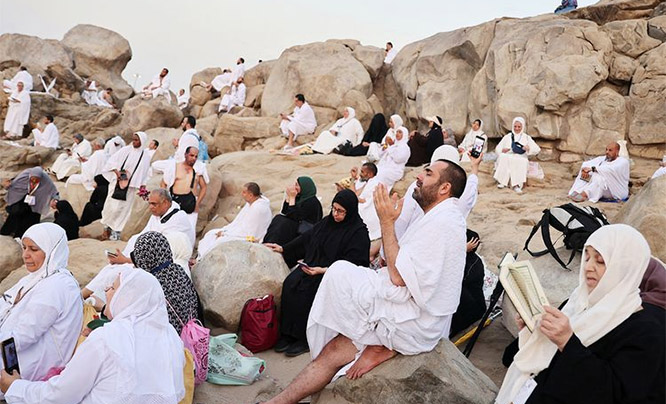
Over 2 million Muslim pilgrims converge at Mount Arafat for daylong worship as Hajj reaches its peak

Agencies
June 15, 2024

arafa1.jpg

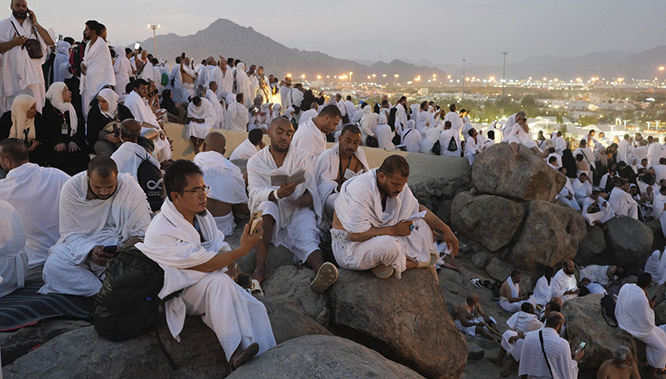
Mount Arafat, June 15: Following the footsteps of prophets beneath a burning sun, Muslims from around the world congregated Saturday at a sacred hill in Saudi Arabia for intense, daylong worship and reflection.

The ritual at Mount Arafat, known as the hill of mercy, is considered the peak of the Hajj pilgrimage. It is often the most memorable for pilgrims, who stand shoulder to shoulder, feet to feet, asking God for mercy, blessings, prosperity and good health. The mount is about 20 kilometers (12 miles) southeast of Makkah.

It’s believed that Prophet Muhammad delivered his final speech, known as the Farewell Sermon, at the sacred mount 1,435 years ago. In the sermon, the prophet called for equality and unity among Muslims.

“It’s indescribable,” Ahmed Tukeyia, an Egyptian pilgrim, said on his arrival Friday evening at a tent camp at the foot of Mount Arafat.

Hajj is one of the largest religious gatherings on earth. The rituals officially started Friday when pilgrims moved from Makkah’s Grand Mosque to Mina, a desert plain just outside the city.

Saudi authorities expect the number of pilgrims this year to exceed 2 million, approaching pre-coronavirus pandemic levels.

The pilgrimage is one of the Five Pillars of Islam. All Muslims are required to make the five-day Hajj at least once in their lives if they are physically and financially able to make the demanding pilgrimage.

The rituals largely commemorate the Qur’an’s accounts of Prophet Ibrahim, his son Prophet Ismail and Ismail’s mother Hajjar — or Abraham and Ismael as they are named in the Bible.

The time of year when the Hajj takes place varies, given that it is set for five days in the second week of Dhu Al-Hijjah, the last month in the Islamic lunar calendar.

Most of the Hajj rituals are held outdoors with little if any shade. When it falls in the summer months, temperatures can soar to over 40 Celsius (104 Fahrenheit). The Health Ministry has cautioned that temperatures at the holy sites could reach 48 C (118 F). It urged pilgrims to use umbrellas and drink more water to stay hydrated.

After Saturday’s worship in Arafat, pilgrims will travel a few kilometers (miles) to a site known as Muzdalifa to collect pebbles that they will use in the symbolic stoning of pillars representing the devil back in Mina.

Pilgrims then return to Mina for three days, coinciding with the festive Eid Al-Adha holiday, when financially able Muslims around the world slaughter livestock and distribute the meat to poor people. Afterward, they return to Makkah for a final circumambulation, known as Farewell Tawaf.

Once the Hajj is over, men are expected to shave their heads, and women to snip a lock of hair in a sign of renewal. Most of the pilgrims then leave Makkah for the city of Medina, some 340 kilometers (210 miles) away, to pray in Prophet Muhammad’s tomb, the Sacred Chamber. The tomb is part of the prophet’s mosque, which is one of the three holiest sites in Islam, along with the Grand Mosque in Makkah and the Al Aqsa Mosque in Jerusalem.

In recent years, Saudi authorities have made significant efforts to improve access and avoid deadly accidents. Tens of thousands of security personnel were deployed across the city, especially around the holy sites, to control the crowds, and the government built a high-speed rail link to ferry people between holy sites in the city, which has been jammed with traffic during the Hajj season. Pilgrims enter through special electronic gates.

Saudi authorities have also expanded and renovated the Grand Mosque where cranes are seen around some of its seven minarets as construction was underway in the holy site.

arafa.jpg

Comments

Add new comment

  • Coastaldigest.com reserves the right to delete or block any comments.
  • Coastaldigset.com is not responsible for its readers’ comments.
  • Comments that are abusive, incendiary or irrelevant are strictly prohibited.
  • Please use a genuine email ID and provide your name to avoid reject.
News Network
January 20,2026

Mangaluru: In a major step towards strengthening rural innovation, the Office of the Principal Scientific Adviser (PSA) to the Government of India is supporting the establishment of RuTAGe Smart Village Centres (RSVCs) across the country through collaborations with academic institutions, civil society organisations and philanthropic partners.

As part of this national initiative, Nitte (Deemed to be University) will set up the first RSVCs in the region at Nitte GP in Udupi district and at the Nitte Health Centre, Sevanjali Trust, Farangipete, in Dakshina Kannada district. The centres will be inaugurated on January 21. In South India, the programme is being implemented by the Section Infin-8 Foundation (SI-8).

Speaking to reporters on Monday, SI-8 founder-director Vishwas US said experts from Nitte University and SI-8 would work closely with farmers, students, youth and local entrepreneurs to adapt and deploy technologies tailored to local needs.

Project head Prof Iddya Karunasagar, representing Nitte DU, said the RSVCs at Nitte and Farangipete would serve as demonstration hubs for a wide range of agriculture, energy, skill-development and assistive technologies. These include solar dryers for fruits, vegetables and crops; soil-testing solutions; power weeders and women-friendly farm tools; wind-powered devices for rural artisans; grain storage systems; grass-cutting and tree-climbing equipment; and liquid fertiliser production using cowshed waste.

SI-8 CEO Aravind C Kumar said the centres would also provide access to digital and knowledge-based platforms such as ISRO applications, government scheme portals, market linkage tools and gamified learning resources, along with assistive technologies for persons with visual impairments.

Highlighting the broader impact of the initiative, Principal Scientific Adviser Prof Ajay Kumar Sood said it demonstrated how applied research could bridge the rural–urban divide and help create self-reliant, technology-enabled villages.

The initiative has been made possible through philanthropic support from Dr NC Murthy of ACM Business Solutions, LLC, USA. Dr Sapna Poti, Director (Strategic Alliances) at the Office of the Principal Scientific Adviser, said the long-term objective is to build self-sufficient, technology-driven communities capable of generating sustainable livelihoods on their own.

Comments

Add new comment

  • Coastaldigest.com reserves the right to delete or block any comments.
  • Coastaldigset.com is not responsible for its readers’ comments.
  • Comments that are abusive, incendiary or irrelevant are strictly prohibited.
  • Please use a genuine email ID and provide your name to avoid reject.
News Network
January 31,2026

Roy.jpg

Bengaluru: The shooting incident involving CJ Roy, founder of the Confident Group, has once again put the spotlight on a businessman whose life has swung between flamboyant global success and persistent controversy at home.

Though Roy’s business interests extended across continents, his roots lay firmly in Karnataka. An alumnus of Christ School in Bengaluru, he later moved to Tumakuru to pursue an engineering degree. Those familiar with his early years describe him as intensely ambitious, beginning his career as a salesman at a small electronics firm dealing in computers.

Roy’s entry into large-scale real estate came through the Crystal Group, where he worked closely with Latha Namboothiri and rose from manager to director. However, the launch of the Confident Group in 2005 was clouded by industry speculation. Insiders speak of a fallout involving alleged “benami” properties and claims of deception that ultimately led to his independent venture—an episode Roy spent years trying to distance himself from, according to associates.

A tale of two cities

Roy’s professional trajectory diverged sharply across geographies.

In Dubai, he built a reputation as a bold and efficient developer, completing massive luxury residential projects in record time—some reportedly within 11 months. His rapid project delivery and lavish lifestyle in the Emirates earned him admiration and visibility in the real estate sector.

In Bengaluru, however, his image remained far more fractured. Sources say Roy stayed away from the city for several years amid disputes over unpaid dues to vendors and suppliers. Several projects were allegedly stalled, with accusations of unfulfilled commitments to cement and steel suppliers continuing to follow him.

Roy’s return to Bengaluru’s business and social circles began around 2018, marked by a conscious attempt at rebranding. His appointment as Honorary Consul of the Slovak Republic added diplomatic legitimacy, which he complemented with visible CSR initiatives, including ambulance donations and high-profile charity events.

Heavy police presence in Langford Town

Following the incident, police personnel from the Central division were deployed outside the Confident Group building in Langford Town, which also houses the Slovak Honorary Consulate in Bengaluru.

The otherwise busy premises near Hosur Road wore a deserted look on Friday, reflecting the shock and uncertainty that followed the tragedy.

Comments

Add new comment

  • Coastaldigest.com reserves the right to delete or block any comments.
  • Coastaldigset.com is not responsible for its readers’ comments.
  • Comments that are abusive, incendiary or irrelevant are strictly prohibited.
  • Please use a genuine email ID and provide your name to avoid reject.
