



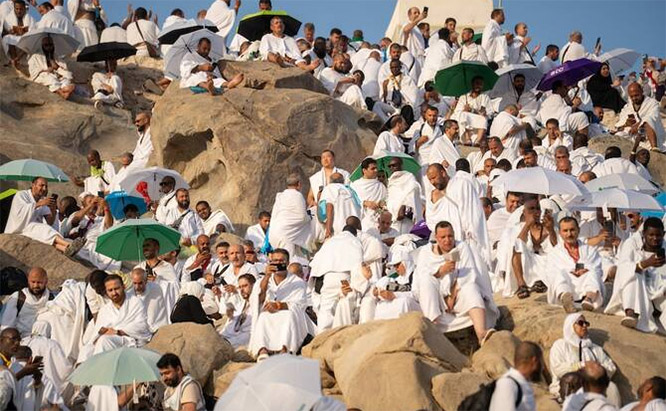
Mount Arafat: Beneath the blazing sun, with temperatures touching 41°C, over a million Muslim pilgrims stood in prayer and reflection on the plains of Mount Arafat on Saturday, marking the spiritual pinnacle of the annual Hajj pilgrimage. For Muslims, the Day of Arafat is the most sacred in the Islamic calendar — a day believed to be rich with divine mercy and forgiveness.
From the early hours, the scene at Arafat was one of solemn devotion and unity. Pilgrims, clad in simple white garments symbolizing equality before God, raised their hands in supplication, seeking forgiveness and spiritual renewal.
“This is the place where our beloved Prophet Muhammad (peace be upon him) delivered his final sermon. Standing here, you feel history and faith meet,” said Marwa Al-Said, a pilgrim from Egypt. “It’s an overwhelming moment — one that humbles you entirely.”
Despite the sweltering weather, Saudi authorities had made extensive arrangements to ensure the comfort and safety of the pilgrims. Cooling mist sprays, shaded zones expanded by 50,000 square meters, and over 400 cooling units were installed throughout the site. Emergency medical personnel and health teams were deployed in large numbers, and smart technologies — including AI and drones — helped regulate crowd movement and monitor pilgrim health.
Nazim Khalifa, an Indian pilgrim residing in the United States, was visibly emotional as he shared his journey. “This is my first time performing Hajj. I’ve never even done Umrah. The road here was not easy, financially and personally. But today, I feel like Allah has accepted me. I want to be closer to Him — that’s the real goal.”
He added, “We’re standing in the sun, and it’s a test — perhaps a glimpse of what the Day of Judgment may feel like. I pray this experience transforms not only me but everyone here.”
Rehman, a pilgrim from Indonesia, echoed that sentiment with simple joy: “I am so happy this year. Everything is organized. And it feels like God is near.”
The Saudi Ministry of Health issued advisories ahead of the gathering, urging pilgrims to avoid direct sun exposure and stay hydrated. Free umbrellas were distributed, and medical tents with emergency care were strategically located across the site.
Alongside physical safety, spiritual guidance was prioritized. The Ministry of Islamic Affairs set up multilingual information booths and digital screens to offer real-time support and religious rulings. Over 15 million awareness messages were sent to pilgrims’ mobile phones, and more than 200,000 brochures explaining Hajj rituals were distributed.
“This year’s arrangements are a reflection of both Saudi Arabia’s logistical expertise and its commitment to the sanctity of Hajj,” said Dr. Saud Al-Harbi, a religious affairs coordinator. “It’s not just about safety; it’s about ensuring that pilgrims can focus on their spiritual goals without worry.”
The Day of Arafat is considered by many scholars as the essence of Hajj itself, echoing the Prophet Muhammad’s (PBUH) hadith: “Hajj is Arafat.” Muslims believe that prayers made on this day are especially powerful, with sins forgiven and lives spiritually renewed.
As the sun set over Arafat, the pilgrims made their way to Muzdalifah to collect pebbles for the symbolic stoning of the devil — the next phase of Hajj. But the moments spent on Mount Arafat will remain etched in their hearts forever — a day of connection, redemption, and hope.

Comments
Add new comment