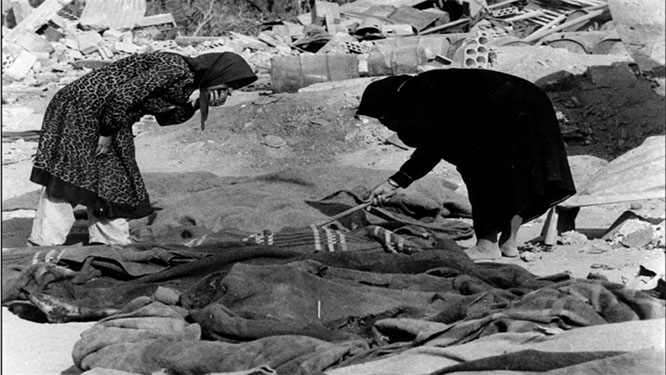
Sabra and Shatila: 43 Years Since 43 Hours of Israeli Terror That Shook Humanity

News Network
September 17, 2025

massacre.jpg

It was dusk on September 16, 1982. In the narrow alleys of Beirut’s Sabra and Shatila refugee camps, the bodies of men, women, and children lay scattered. For 43 relentless hours, the Phalange militia—backed by Israeli occupying forces—turned the camps into a slaughterhouse.

Israeli troops lit the night sky with flares, guiding the militias as they hunted down civilians. From September 16 to 18, nearly 3,500 Palestinians—mostly women, children, and the elderly—were massacred. The killings began at 6 p.m. on Thursday and did not end until 1 p.m. Saturday.

“The stench lingered for more than six months. It was unbearable,” recalled Najib al-Khatib, a refugee who lost his father and ten relatives. Rescuers were unable to recover countless decomposing corpses; bulldozers dug mass graves instead.

One survivor, Umm Abbas, described the horror: “A pregnant woman—her baby was torn from her womb. They sliced her in half.”

Eyewitnesses told of rape, mutilation, and children butchered in front of their families. The United Nations condemned it as an “act of genocide.” A UN commission later concluded that Israeli forces were “involved, directly or indirectly.”

Even Israel’s own Kahan Commission found Ariel Sharon, then defense minister, “personally responsible” for allowing the massacre. Yet Sharon went on to become Prime Minister in 2001.

How the Massacre Was Set in Motion

Between 1947 and 1949, Israel destroyed more than 500 Palestinian villages, displacing 750,000 people. Many ended up in Lebanon’s refugee camps.

In June 1982, Israel invaded Lebanon under Sharon’s command to crush the PLO. By September 1, the PLO withdrew after the US promised that refugees left behind would be protected. A multinational force was deployed but withdrew early on September 10, leaving the camps defenseless.

When Lebanese president-elect Bachir Gemayel was assassinated on September 14, the Phalangists sought revenge. Israeli forces swiftly surrounded Sabra and Shatila, sealing them off. The militias entered with Israeli coordination, and the massacre began.

Reports later revealed Israeli and Phalangist leaders had pre-planned the killings. Afterward, officials even met to strategize how to hide Israel’s role.

America’s Complicity

The Kahan Commission records reveal that the US was fully aware the PLO had left Beirut. Yet Washington ignored Sharon’s lie that “2,000 terrorists” remained and greenlit Israel’s entry into West Beirut.

The US not only supplied Israel with the weapons used but also broke its written guarantee to protect Palestinian civilians. Secret annexes later exposed that Washington knew the camps were defenseless and that massacres would follow if the Phalangists were allowed in.

The Legacy of Ethnic Cleansing

Four decades later, the echoes of Sabra and Shatila remain. Survivors still live with unhealed trauma.

Today, the pattern continues. Since October 7, 2023, Israel’s war on Gaza—armed and shielded diplomatically by the US—has killed more than 41,200 Palestinians, most of them women and children.

As with Sabra and Shatila, the world watches. The names change, but the brutality endures.

Comments

Add new comment

  • Coastaldigest.com reserves the right to delete or block any comments.
  • Coastaldigset.com is not responsible for its readers’ comments.
  • Comments that are abusive, incendiary or irrelevant are strictly prohibited.
  • Please use a genuine email ID and provide your name to avoid reject.
News Network
November 28,2025

fire.jpg

Several Syrians were killed and more than two dozen others injured in Israeli strikes on the outskirts of Damascus, amid intensified incursions by the occupying regime since the fall of former president Bashar al-Assad and the rise of Hayat Tahrir al-Sham (HTS) rule.

Syrian state TV reported that the casualties occurred during an overnight Israeli assault involving helicopters and drones on the town of Beit Jinn in the Damascus countryside. The attack followed an Israeli military unit’s entry into the town, where they were surrounded by local residents, leading to gunfire and direct confrontations.

According to the report, “The occupation army’s helicopters and artillery shelled Beit Jinn, located at the foothills of Mount Hermon, resulting in 13 martyrs and 25 injured civilians.” The broadcaster did not specify the full extent of damage.

Al-Ikhbariyah Syria confirmed that the shelling coincided with Israeli soldiers entering Beit Jinn, while artillery pounded surrounding areas. The broadcaster stated that the escalation began after local residents clashed with an Israeli patrol that had infiltrated the southern town and “kidnapped” three young men.

Following a two-hour exchange of heavy fire, Israeli forces withdrew and repositioned on the hill of Butt al-Warda at the town’s outskirts.

Israeli media acknowledged that six soldiers were wounded in the clashes—three of them seriously—describing the confrontation as a “sudden ambush” that forced the deployment of reserve units and air support to secure an exit route. No further details were provided.

The aggression has fueled renewed displacement from Beit Jinn, with residents fleeing to nearby villages amid increasingly frequent Israeli attacks.

The raid came just a day after Israeli troops carried out another ground incursion into Umm al-Luqas village in Quneitra province. According to SANA, an Israeli unit in four vehicles entered the village, raided several homes, and later withdrew.

Syria condemned the repeated incursions as violations of the 1974 Disengagement Agreement and UN resolutions, urging the international community to enforce compliance and pressure Israel to halt its operations and withdraw fully.

Israel has expanded its attacks across Syrian territory following the collapse of the Assad government last year. Prime Minister Benjamin Netanyahu has reportedly instructed his forces to push deeper into Syrian territory and seize strategic positions.

Meanwhile, critics say the HTS-led interim government’s inaction and growing normalization gestures toward Israel have emboldened Tel Aviv to intensify its military operations. HTS, formerly linked to al-Qaeda, seized control of Damascus last December, formally ending Assad’s rule.

Comments

Add new comment

  • Coastaldigest.com reserves the right to delete or block any comments.
  • Coastaldigset.com is not responsible for its readers’ comments.
  • Comments that are abusive, incendiary or irrelevant are strictly prohibited.
  • Please use a genuine email ID and provide your name to avoid reject.
News Network
December 4,2025

indigocrisis.jpg

Angry outbursts, long queues, and desperate appeals filled airports across India today as IndiGo grappled with a severe operational breakdown. Hundreds of flights have been cancelled or delayed, leaving thousands of passengers stranded through the night and forcing many to spend long hours at helpdesks.

Social media was flooded with videos of fliers pleading for assistance, accusing the airline of misleading updates, and demanding accommodation after being stuck for 10 to 12 hours at airports such as Hyderabad and Bengaluru.

What Triggered the Meltdown?

IndiGo has attributed the widespread disruption to “a multitude of unforeseen operational challenges.” These include:

•    Minor technology glitches
•    Winter-season schedule adjustments
•    Bad weather
•    Congestion in the aviation network
•    New crew rostering rules (Flight Duty Time Limitations or FDTL)

Among these, the most disruptive has been the implementation of the updated FDTL norms introduced by the Directorate General of Civil Aviation (DGCA) in January 2024.

These rules were designed to reduce pilot fatigue and improve passenger safety. Key changes include:

•    Longer weekly rest periods for flight crew
•    A revised definition of “night,” extending it by an extra hour
•    Tighter caps on flight duty timing and night landings
•    Cutting night shifts for pilots and crew from six per roster cycle to just two

Once these norms became fully enforceable, airlines were required to overhaul rosters well in advance. For IndiGo, this triggered a sudden shortage of crew available for duty, leading to cascading delays and cancellations.

Why IndiGo Was Hit the Hardest

IndiGo is India’s largest airline by a wide margin, operating over 2,200 flights daily. That’s roughly double the number operated by Air India.

When an airline of this size experiences even a 10–20% disruption, it translates to 200–400 flights being delayed or grounded — producing massive spillover effects across the country.

IndiGo also relies heavily on high-frequency overnight operations, a model typical of low-cost carriers that aim to maximise aircraft utilisation and reduce downtime. The stricter FDTL norms clash with these overnight-heavy schedules, forcing the airline to pull back services.

Aviation bodies have also criticised IndiGo’s preparedness. The Airline Pilots' Association of India (ALPA) said airlines were given a two-year window to plan for the new rules but “started preparing rather late.” IndiGo, it said, failed to rebuild crew rosters 15 days in advance as required.

The Federation of Indian Pilots (FIP) went further, calling the crisis the result of IndiGo’s “prolonged and unorthodox lean manpower strategy,” and alleging that the airline adopted a hiring freeze even as it knew the new rules would require more careful staffing.

How Many Flights Are Affected?

In the past 48 hours, over 300 flights have been cancelled. At least 100 more are expected to be cancelled today.

City-wise impact:

•    Hyderabad: 33 expected cancellations; several fliers stranded overnight
•    Bengaluru: over 70 expected cancellations
•    Delhi, Mumbai, Chennai, Kolkata: widespread delays and missed connections

Passengers shared distressing accounts online.

One customer at Hyderabad airport said they waited from 6 PM to 9 AM with “no action taken” regarding their delayed Pune flight. Another said IndiGo repeatedly told them the crew was “arriving soon,” only for the delay to stretch over 12 hours.

IndiGo has apologised for the disruption and promised that operations will stabilise within 48 hours, adding that “calibrated adjustments” are being made to contain the chaos.

What Should Passengers Do Now?

For those flying in the next few days, especially with IndiGo, here are key precautions:

1. Keep Checking Flight Status
Monitor your flight closely before leaving for the airport, as delays may be announced last-minute.

2. Arrive Early
Expect long queues at counters and security due to crowding and rescheduling.

3. Carry Essentials
Pack snacks, water, basic medicines, chargers, and items for children or senior citizens. Extended waiting times should be anticipated.

4. Use Flexible Booking Options
If you booked tickets with a free-date-change or cancellation option, consider using them.
If you haven’t booked yet, prefer refundable or flexible fares, or even consider alternate airlines.

5. Follow IndiGo’s Updates
Keep an eye on IndiGo’s official social media channels and contact customer support for rebooking and refund queries.

What Needs to Change?

Pilot groups have raised concerns not just about staffing but also the planning practices behind it.
The Federation of Indian Pilots accused IndiGo of:

•    Imposing an unexplained hiring freeze despite knowing the FDTL changes were coming
•    Entering non-poaching agreements that limited talent movement
•    Keeping pilot pay frozen
•    Underestimating the need to restructure operations in advance

They have urged DGCA to approve seasonal schedules only after airlines prove they have adequate pilot strength under the new norms.

ALPA also warned that some airlines might be using the delays as an “immature pressure tactic” to push DGCA for relaxations in the new rules — which, if granted, could compromise the very safety standards the norms were meant to protect.

Both pilot bodies stressed that no exemption should dilute safety, and any deviations should be based solely on scientific risk assessment.

Is a Solution in Sight?

While IndiGo says normalcy will return within two days, aviation experts believe that fully stabilising operations could take longer, depending on how quickly the airline can:
•    Re-align rosters
•    Mobilise rested crew
•    Boost staffing
•    Adjust its winter schedule to match regulatory requirements
Passengers are advised to remain prepared for continued delays over the next few days as the airline works through its backlog. 

Comments

Add new comment

  • Coastaldigest.com reserves the right to delete or block any comments.
  • Coastaldigset.com is not responsible for its readers’ comments.
  • Comments that are abusive, incendiary or irrelevant are strictly prohibited.
  • Please use a genuine email ID and provide your name to avoid reject.
News Network
December 2,2025

Puttur: The long-cherished dream of a government medical college in Puttur has moved a decisive step closer to reality, with the Karnataka State Finance Department granting its official approval for the construction of a new 300-bed hospital.

Puttur MLA Ashok Kumar Rai announced the crucial development to reporters on Monday, confirming that the official communication from the finance department was issued on November 27. This 300-bed facility is intended to be the cornerstone for the establishment of the government medical college, a project announced in the state budget.

Fast-Track Implementation

The MLA outlined an aggressive timeline for the project:

•    A Detailed Project Report (DPR) for the hospital is expected to be ready within 45 days.

•    The tender process for the construction will be completed within two months.

Following the completion of the tender process, Chief Minister Siddaramaiah is scheduled to lay the foundation stone for the project.

"Setting up a medical college in Puttur is a historical decision by the Congress government in Karnataka," Rai stated. The project has an estimated budget allocation of Rs 1,000 crore for the medical college.

Focus on Medical Education Department

The MLA highlighted a key strategic move: requesting the government to implement the hospital construction through the Medical Education Department instead of the Health and Family Welfare Department. This is intended to streamline the entire process of establishing the full medical college, ensuring the facilities—including labs, operation theatres, and other necessary infrastructure—adhere to the strict guidelines set by the Medical Council of India (MCI). The proposed site for the project is in Bannur.

Rai also took the opportunity to address political criticism, stating that the government has fulfilled its promise despite "apprehensions" and "mocking and criticising" from opposition parties who had failed to take similar initiatives when they were in power. "Chief Minister Siddaramaiah has kept his word," he added.

Comments

Add new comment

  • Coastaldigest.com reserves the right to delete or block any comments.
  • Coastaldigset.com is not responsible for its readers’ comments.
  • Comments that are abusive, incendiary or irrelevant are strictly prohibited.
  • Please use a genuine email ID and provide your name to avoid reject.