



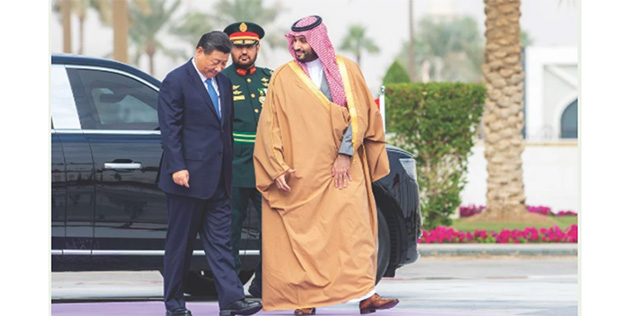
Riyadh: Saudi Arabia and China agreed to strengthen their strategic relations and expand commercial ties during Chinese President Xi Jinping’s three-day state visit to the Kingdom.
Xi and his delegation held talks with Saudi Arabia’s King Salman, Crown Prince Mohammed bin Salman, and the heads of key ministries, resulting in 35 memorandums of understanding and deals worth $30 billion.
The two sides signed a Comprehensive Strategic Partnership Agreement, committing to support each other’s core interests, sovereignty and territorial integrity, and to defend the principle of non-interference in the internal affairs of states.
Addressing the media at the conclusion of Xi’s visit on Friday, Prince Faisal bin Farhan, the Saudi minister of foreign affairs, said the deepening of relations with China did not mean the Kingdom was turning its back on the US and other Western allies.
He said: “Saudi Arabia’s main focus is how to grow economically, and through the work with strategic partners we will continue to find ways to enhance bilateral cooperation with all.
“The Kingdom is a member of the G20 and is aiming to become one of the top 15 economies globally. We have to be open to cooperation with everyone.
“There is no doubt that working together with the second largest economy in the world is vital to Saudi Arabia’s growth, but that does not mean that we cannot continue to work with the world’s largest economy.
“We strive to work with all large economies and others around the world. By working with various partners, it will ensure the transition of the Kingdom to another level of growth that cannot happen by declining opportunities from one country to another.
“We have to be open to cooperating with others and that has been the Kingdom’s philosophy to achieve mutual interests.”
The Saudi side reaffirmed its adherence to the one-China principle during the summit, while the Chinese side expressed support for the Kingdom in maintaining its security and stability, and rejected any attacks targeting civilians, civilian infrastructure, territories, and Saudi interests.
“We look to enhance our Comprehensive Strategic Partnership with China and find means to develop it beyond trade,” said Prince Faisal. “The partnership supports the Kingdom’s development and serves its interests.”
Regarding regional and international issues, the two sides welcomed the first China-GCC Summit and the first Arab-Chinese Summit, both of which were also held in Riyadh on Friday.
The two sides stressed the importance of enhancing cooperation through the high-level Saudi-Chinese Joint Committee to achieve common goals, enhance cooperation, and intensify communication between government and private sectors.
Both sides stressed the importance of stability in the global oil markets and agreed to explore common investment opportunities in petrochemicals, and to enhance cooperation in solar, wind, and other sources of renewable energy.
They also agreed to cooperate on hydrocarbons, energy efficiency, localization of energy sector components and supply chains, in addition to the peaceful uses of nuclear energy and the development of technologies like artificial intelligence.
In particular, the delegations stressed the importance of deepening cooperation with regard to the Belt and Road Initiative, including involvement in energy and investment partnerships and making use of the Kingdom’s location as a regional center.
The two sides welcomed the signing of the “harmonization plan” between the Kingdom’s Vision 2030 social reform and economic diversification agenda and China’s Belt and Road Initiative.
Xi announced the launch of the Belt and Road Initiative — formerly known as One Belt One Road — in 2013.
The initiative sets out to connect the markets and manufacturers of East Asia to those of Europe via a vast logistical and digital network running through Central Asia, the Middle East and North Africa in a modern-day reimagining of the ancient Silk Road.
China’s Belt and Road Initiative shares the same goal of boosting interconnectivity through cooperation in energy, trade, investment and technology as Saudi Arabia’s Vision 2030 agenda, launched in 2016 by the Saudi crown prince.
China is Saudi Arabia’s largest trading partner. According to Reuters news agency, bilateral trade between the two countries hit $87.3 billion in 2021, with Chinese exports to the Kingdom reaching $30.3 billion and China’s imports from Saudi Arabia totaling $57 billion.
China’s main exports to Saudi Arabia are textiles, electronics and machinery, while China mainly imports crude oil and primary plastics from the Kingdom. In the first 10 months of 2022, China’s Saudi oil imports reached 1.77 million barrels per day, valued at $55.5 billion, according to Chinese customs data.
The delegations agreed to boost the volume of non-oil trade, increase joint investments, expand capacity for commercial airlines, motivate private sector investment, and create an attractive investment environment.
In particular they agreed to deepen cooperation in the automotive industry, supply chains, logistics, water desalination, infrastructure, manufacturing, mining, and the financial sector.
The Saudi side said it hopes to attract Chinese expertise to participate in the Kingdom’s forthcoming mega-projects, and for Chinese companies to open regional headquarters in Saudi Arabia.
The two sides also welcomed agreements concerning hydrogen energy, the judiciary, Chinese language education, housing, direct investment, radio and television, the digital economy, economic development, standardization, the news media, tax administration, and anti-corruption.
The Chinese delegation also expressed its keenness to deepen investment cooperation in the digital economy and green development, enhance cooperation in e-commerce, and explore means of joint economic and trade cooperation with Africa.
Regarding the shared challenge of climate change, the Chinese delegation welcomed the Kingdom’s Saudi Green Initiative and Middle East Green Initiative and expressed its support for Saudi Arabia’s application of the circular carbon economy.
They also agreed to urge developed countries to take their historic responsibilities seriously, through the fulfillment of their obligations by greatly reducing emissions before the target date, and to tangibly help developing countries through financial, technical, and capacity-building support.
The two sides stressed the need to strengthen partnership in communications, digital economy, innovation, and space, to achieve better digital infrastructure for the future generations in both countries.
They also stressed the importance of enhancing cooperation and joint action on developing the air and sea transport sectors, modern transport modes and railways, and expediting the completion of studies on the Saudi land bridge project.
Both delegations affirmed their determination to develop cooperation in defense to combat organized crime, terrorism, and cybercrimes.
They also stressed the importance of strengthening health cooperation to combat current and future health threats and pandemics, and agreed to develop cooperation in the areas of heritage, culture, sport, tourism, and science.

Comments
Add new comment