



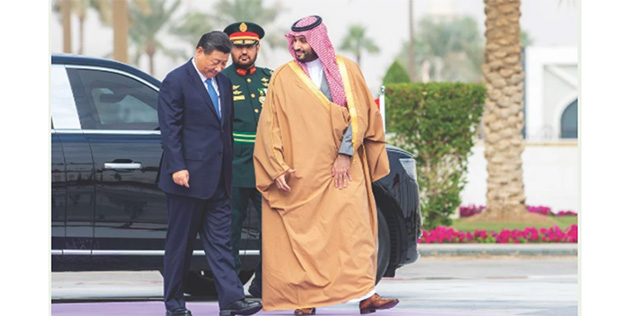
Saudi Arabia, China emerge as comprehensive strategic partners as Xi wraps up kingdom visit

News Network
December 10, 2022

arab.jpg

Riyadh: Saudi Arabia and China agreed to strengthen their strategic relations and expand commercial ties during Chinese President Xi Jinping’s three-day state visit to the Kingdom.

Xi and his delegation held talks with Saudi Arabia’s King Salman, Crown Prince Mohammed bin Salman, and the heads of key ministries, resulting in 35 memorandums of understanding and deals worth $30 billion.

The two sides signed a Comprehensive Strategic Partnership Agreement, committing to support each other’s core interests, sovereignty and territorial integrity, and to defend the principle of non-interference in the internal affairs of states.

Addressing the media at the conclusion of Xi’s visit on Friday, Prince Faisal bin Farhan, the Saudi minister of foreign affairs, said the deepening of relations with China did not mean the Kingdom was turning its back on the US and other Western allies.

He said: “Saudi Arabia’s main focus is how to grow economically, and through the work with strategic partners we will continue to find ways to enhance bilateral cooperation with all.

“The Kingdom is a member of the G20 and is aiming to become one of the top 15 economies globally. We have to be open to cooperation with everyone.

“There is no doubt that working together with the second largest economy in the world is vital to Saudi Arabia’s growth, but that does not mean that we cannot continue to work with the world’s largest economy.

“We strive to work with all large economies and others around the world. By working with various partners, it will ensure the transition of the Kingdom to another level of growth that cannot happen by declining opportunities from one country to another.

“We have to be open to cooperating with others and that has been the Kingdom’s philosophy to achieve mutual interests.”

The Saudi side reaffirmed its adherence to the one-China principle during the summit, while the Chinese side expressed support for the Kingdom in maintaining its security and stability, and rejected any attacks targeting civilians, civilian infrastructure, territories, and Saudi interests.

“We look to enhance our Comprehensive Strategic Partnership with China and find means to develop it beyond trade,” said Prince Faisal. “The partnership supports the Kingdom’s development and serves its interests.”

Regarding regional and international issues, the two sides welcomed the first China-GCC Summit and the first Arab-Chinese Summit, both of which were also held in Riyadh on Friday.

The two sides stressed the importance of enhancing cooperation through the high-level Saudi-Chinese Joint Committee to achieve common goals, enhance cooperation, and intensify communication between government and private sectors.

Both sides stressed the importance of stability in the global oil markets and agreed to explore common investment opportunities in petrochemicals, and to enhance cooperation in solar, wind, and other sources of renewable energy.

They also agreed to cooperate on hydrocarbons, energy efficiency, localization of energy sector components and supply chains, in addition to the peaceful uses of nuclear energy and the development of technologies like artificial intelligence.

In particular, the delegations stressed the importance of deepening cooperation with regard to the Belt and Road Initiative, including involvement in energy and investment partnerships and making use of the Kingdom’s location as a regional center.

The two sides welcomed the signing of the “harmonization plan” between the Kingdom’s Vision 2030 social reform and economic diversification agenda and China’s Belt and Road Initiative.

Xi announced the launch of the Belt and Road Initiative — formerly known as One Belt One Road — in 2013.

The initiative sets out to connect the markets and manufacturers of East Asia to those of Europe via a vast logistical and digital network running through Central Asia, the Middle East and North Africa in a modern-day reimagining of the ancient Silk Road.

China’s Belt and Road Initiative shares the same goal of boosting interconnectivity through cooperation in energy, trade, investment and technology as Saudi Arabia’s Vision 2030 agenda, launched in 2016 by the Saudi crown prince.

China is Saudi Arabia’s largest trading partner. According to Reuters news agency, bilateral trade between the two countries hit $87.3 billion in 2021, with Chinese exports to the Kingdom reaching $30.3 billion and China’s imports from Saudi Arabia totaling $57 billion.

China’s main exports to Saudi Arabia are textiles, electronics and machinery, while China mainly imports crude oil and primary plastics from the Kingdom. In the first 10 months of 2022, China’s Saudi oil imports reached 1.77 million barrels per day, valued at $55.5 billion, according to Chinese customs data.

The delegations agreed to boost the volume of non-oil trade, increase joint investments, expand capacity for commercial airlines, motivate private sector investment, and create an attractive investment environment.

In particular they agreed to deepen cooperation in the automotive industry, supply chains, logistics, water desalination, infrastructure, manufacturing, mining, and the financial sector.

The Saudi side said it hopes to attract Chinese expertise to participate in the Kingdom’s forthcoming mega-projects, and for Chinese companies to open regional headquarters in Saudi Arabia.

The two sides also welcomed agreements concerning hydrogen energy, the judiciary, Chinese language education, housing, direct investment, radio and television, the digital economy, economic development, standardization, the news media, tax administration, and anti-corruption.

The Chinese delegation also expressed its keenness to deepen investment cooperation in the digital economy and green development, enhance cooperation in e-commerce, and explore means of joint economic and trade cooperation with Africa.

Regarding the shared challenge of climate change, the Chinese delegation welcomed the Kingdom’s Saudi Green Initiative and Middle East Green Initiative and expressed its support for Saudi Arabia’s application of the circular carbon economy.

They also agreed to urge developed countries to take their historic responsibilities seriously, through the fulfillment of their obligations by greatly reducing emissions before the target date, and to tangibly help developing countries through financial, technical, and capacity-building support.

The two sides stressed the need to strengthen partnership in communications, digital economy, innovation, and space, to achieve better digital infrastructure for the future generations in both countries.

They also stressed the importance of enhancing cooperation and joint action on developing the air and sea transport sectors, modern transport modes and railways, and expediting the completion of studies on the Saudi land bridge project.

Both delegations affirmed their determination to develop cooperation in defense to combat organized crime, terrorism, and cybercrimes.

They also stressed the importance of strengthening health cooperation to combat current and future health threats and pandemics, and agreed to develop cooperation in the areas of heritage, culture, sport, tourism, and science.

Comments

Add new comment

  • Coastaldigest.com reserves the right to delete or block any comments.
  • Coastaldigset.com is not responsible for its readers’ comments.
  • Comments that are abusive, incendiary or irrelevant are strictly prohibited.
  • Please use a genuine email ID and provide your name to avoid reject.
News Network
January 20,2026

Mangaluru: In a major step towards strengthening rural innovation, the Office of the Principal Scientific Adviser (PSA) to the Government of India is supporting the establishment of RuTAGe Smart Village Centres (RSVCs) across the country through collaborations with academic institutions, civil society organisations and philanthropic partners.

As part of this national initiative, Nitte (Deemed to be University) will set up the first RSVCs in the region at Nitte GP in Udupi district and at the Nitte Health Centre, Sevanjali Trust, Farangipete, in Dakshina Kannada district. The centres will be inaugurated on January 21. In South India, the programme is being implemented by the Section Infin-8 Foundation (SI-8).

Speaking to reporters on Monday, SI-8 founder-director Vishwas US said experts from Nitte University and SI-8 would work closely with farmers, students, youth and local entrepreneurs to adapt and deploy technologies tailored to local needs.

Project head Prof Iddya Karunasagar, representing Nitte DU, said the RSVCs at Nitte and Farangipete would serve as demonstration hubs for a wide range of agriculture, energy, skill-development and assistive technologies. These include solar dryers for fruits, vegetables and crops; soil-testing solutions; power weeders and women-friendly farm tools; wind-powered devices for rural artisans; grain storage systems; grass-cutting and tree-climbing equipment; and liquid fertiliser production using cowshed waste.

SI-8 CEO Aravind C Kumar said the centres would also provide access to digital and knowledge-based platforms such as ISRO applications, government scheme portals, market linkage tools and gamified learning resources, along with assistive technologies for persons with visual impairments.

Highlighting the broader impact of the initiative, Principal Scientific Adviser Prof Ajay Kumar Sood said it demonstrated how applied research could bridge the rural–urban divide and help create self-reliant, technology-enabled villages.

The initiative has been made possible through philanthropic support from Dr NC Murthy of ACM Business Solutions, LLC, USA. Dr Sapna Poti, Director (Strategic Alliances) at the Office of the Principal Scientific Adviser, said the long-term objective is to build self-sufficient, technology-driven communities capable of generating sustainable livelihoods on their own.

Comments

Add new comment

  • Coastaldigest.com reserves the right to delete or block any comments.
  • Coastaldigset.com is not responsible for its readers’ comments.
  • Comments that are abusive, incendiary or irrelevant are strictly prohibited.
  • Please use a genuine email ID and provide your name to avoid reject.
News Network
January 28,2026

ajit.jpg

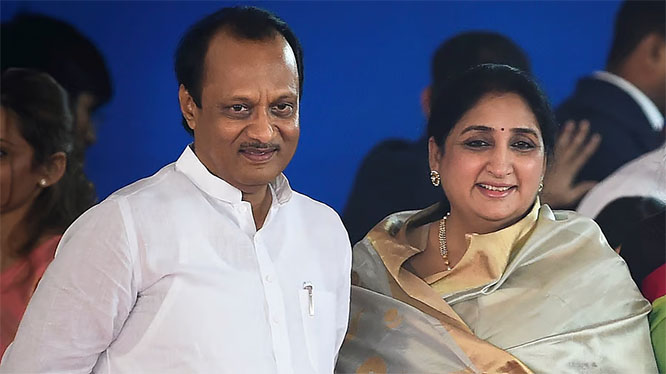
Mumbai: The sudden death of Maharashtra Deputy Chief Minister Ajit Pawar in a plane crash in his hometown of Baramati has plunged the state into political uncertainty, raising a pressing question for both the Nationalist Congress Party (NCP) and its rival faction, the Nationalist Congress Party (Sharadchandra Pawar): what next?

For the two factions that emerged after the dramatic split of June–July 2023, the moment marks their gravest challenge yet. Many believe the answer now rests with party founder Sharad Pawar.

Sharad Pawar, who founded the NCP in 1999 after parting ways with the Congress over Sonia Gandhi’s foreign origin, has already indicated his intention to step away from electoral politics once his Rajya Sabha term ends in April 2026.

Speaking at a public event in Baramati ahead of his 85th birthday on December 12, 2025, Pawar said he would not contest any further elections. “I have contested 14 elections. The younger generation needs to be given an opportunity,” he said, adding that he would decide later whether to seek another Rajya Sabha term.

Often described as the Bhishma Pitamah of Indian politics, Pawar also spoke of his gradual withdrawal from active leadership. “For the first 30 years, I handled everything. For the next 25–30 years, Ajit Dada handled responsibilities. Now, arrangements must be made for new leadership,” he said.

Ajit Pawar’s death has dramatically altered that transition, especially as he was working towards reunifying the two NCP factions.

“After the developments of June–July 2023 and the 2024 Lok Sabha and Vidhan Sabha elections, there were deep changes within the family and the party. In the last six months, serious efforts were made to reunite. Even workers from both sides wanted unity. This is a massive blow,” a Pawar family insider told DH over phone from Baramati.

Electoral outcomes over the past year reflected the split. In the 2024 Lok Sabha elections, NCP (SP) recorded the best strike rate in Maharashtra, winning eight of the 10 seats it contested. The NCP, by contrast, won just one seat out of four.

However, the trend reversed in the subsequent Vidhan Sabha elections, where the NCP emerged stronger, securing 41 of the 288 seats, while NCP (SP) managed only 10.

Within NCP (SP), Sharad Pawar’s daughter Supriya Sule serves as Working President, followed by leaders such as Rohit Pawar, state president Shashikant Shinde and former state chief Jayant Patil.

In the NCP, Praful Patel is the Working President and Raigad MP Sunil Tatkare heads the state unit. Ajit Pawar’s wife, Sunetra Pawar, is a Rajya Sabha MP, while their sons Parth and Jay are not actively involved in day-to-day politics. Parth Pawar briefly entered electoral politics in 2019 but lost the Lok Sabha election from Maval. Jay Pawar’s political debut was under consideration.

With Ajit Pawar gone, speculation has intensified that a member of the family may be asked to assume a larger role. For now, Sunetra Pawar is expected to play a key coordinating role in party affairs, alongside Patel and Tatkare.

The NCP continues to have several heavyweight leaders, including Chhagan Bhujbal, Hasan Mushrif, Dattatreya Bharne, Manikrao Kokate and Dhananjay Munde.

Ajit Pawar had already begun steps towards reconciliation between the two factions. While they contested the Pune and Pimpri-Chinchwad municipal elections separately, they later decided to fight the zilla parishad elections together under the ‘clock’ symbol—seen as the first formal step towards reunification.

Nagpur meet and party roadmap

Both NCP factions claim adherence to the ideology of ‘Shiv–Shahu–Phule–Ambedkar’. At the Rashtravadi Chintan Shivir held in Nagpur on September 19, 2025, the NCP reaffirmed its commitment to sarva dharma sambhav and discussed strengthening ties with the BJP “for the welfare and development of Maharashtra”.

In recent days, reports had suggested Ajit Pawar might return to the Maha Vikas Aghadi following the party’s poor performance in Pune municipal elections, but these claims were denied.

Big question for Maha Yuti

Ajit Pawar’s death also presents an immediate challenge for the Devendra Fadnavis-led Maha Yuti government. Pawar held crucial portfolios, including Finance, Planning and Excise. With the Budget Session approaching, appointing a new Finance Minister has become urgent.

Beyond numbers and portfolios, Maha Yuti has lost a swift decision-maker known for his administrative grip and political finesse—leaving a vacuum that will not be easy to fill.

Comments

Add new comment

  • Coastaldigest.com reserves the right to delete or block any comments.
  • Coastaldigset.com is not responsible for its readers’ comments.
  • Comments that are abusive, incendiary or irrelevant are strictly prohibited.
  • Please use a genuine email ID and provide your name to avoid reject.
News Network
January 19,2026

New Delhi: Setting speculation to the rest, the CPI(M) has made it clear that it is open to have an electoral understanding with the Congress “to defeat” the Trinamool Congress and the BJP in West Bengal Assembly election even as it is all set to take on the grand old party in Kerala accusing it of “found wanting” in fighting the Hindutva forces.

The CPI(M) also said that it will contest the Tamil Nadu election “with DMK and its allies to defeat the BJP and its allies”, amid a section in the Congress triggering confusion about its participation in the M K Stalin-led coalition over demand over power-sharing and more seats. It is also willing to join hands with Congress and others in Assam and Puducherry to defeat the BJP.

The decisions came at a three-day meeting of the CPI(M) Central Committee in Thiruvananthapuram, which ended on Sunday after reviewing the poll preparations in the poll-bound states.

The CPI(M)'s decision came even as a section led by West Bengal Congress president Subhankar Sarkar is averse to tying up with the Left Front, claiming that their party is not benefitted by the electoral understanding. Both Congress and CPI(M)-led Left Front had electoral understanding in 2016 and 2021 Assembly elections and 2024 Lok Sabha polls.

Congress and the Left Front fought together for the first time in 2016 when Congress won 44 seats and the CPI(M) got 26. In 2021, the Left Front and the Congress drew a blank. In the 2024 Lok Sabha polls, Congress managed to win one seat while the Left did not win any. In the 2019 Lok Sabha polls, both fought against each other with Congress winning two and the Left none.

“In Bengal, the party will work for the defeat of both the TMC and the BJP, which are trying to polarise the society. We will try to rally all the forces that are ready to work against them,” the CPI(M) said in a statement without naming Congress by name. Senior leaders said there is no change in its strategy of pooling all non-BJP, non-TMC votes.

However, the party was critical of the Congress in Kerala where both will fight against each other.

The CPI(M) said it would "expose the BJP-led Union government’s denial of rightful dues to Kerala, the fiscal constraints imposed and the overall attack on federalism" as also "expose the failure of the Congress to effectively counter this attack on federalism, as the largest opposition party in the Parliament".

"The Congress, especially in Kerala, was found wanting in the fight against communal RSS-BJP, ideologically and this will also be exposed before the people," it added.

In Assam, it said, the CPI(M) will work for the mobilisation of all the anti-BJP parties and forces and defeat the rabidly communal and divisive BJP government. The Left parties are cooperating with Congress in the north-eastern state. In Puducherry, it said it will work for the defeat of the BJP alliance government.

Comments

Add new comment

  • Coastaldigest.com reserves the right to delete or block any comments.
  • Coastaldigset.com is not responsible for its readers’ comments.
  • Comments that are abusive, incendiary or irrelevant are strictly prohibited.
  • Please use a genuine email ID and provide your name to avoid reject.