



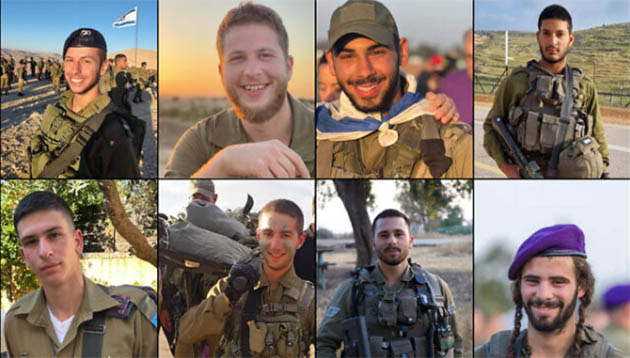
Senior commander, Indian-origin youth among 19 Israeli soldiers killed during Gaza ground invasion

News Network
November 3, 2023

israeli.jpg

Israeli tanks and troops have met fierce resistance from Hamas fighters using mortars and hit-and-run attacks from tunnels to fight off Tel Aviv's ground invasion of Gaza City after nearly four weeks of bombardments.

Fighters of Hamas and its ally Islamic Jihad were emerging from tunnels to fire at tanks, then disappearing back into the network, residents said and videos from both groups showed Thursday, in guerrilla-style operations against Israeli troops. 

"They never stopped bombing Gaza City all night, the house never stopped shaking," Reuters quoted an unnamed man living there. "But in the morning we discover the Israeli forces are still outside the city, in the outskirts and that means the resistance is heavier than they expected."

Military commanders said Israeli troops were "at the gates of Gaza City". Herzi Halevi, chief of the general staff of the Israeli military, said Israeli troops were fighting in a dense and complex urban area, that required professional combat.

“This is certainly terrain that is more heavily sown than in the past with minefields and booby-traps. Hamas has learned and prepared itself well,” said Brigadier General Iddo Mizrahi, chief of Israel's military engineers.

The Israeli army said Palestinian fighters killed a commander of an armored brigade's battalion in Gaza. Lt Col Salman Habaka is among the 19 soldiers killed in Gaza in two days of heavy fighting.

He is the most senior Israeli soldier to be killed since the ground invasion escalated on Tuesday. 

An Israeli soldier was seriously wounded in an "incident" on the Egyptian border, Israeli media said, citing the army. 

Lebanon's Hezbollah said two drones attacked an Israeli military position in the Israeli-occupied Shebaa Farms on Thursday.  

In a brief communique, the group said the two drones used "a large amount of explosives" and hit their targets with "high accuracy".

Earlier on Thursday, sirens warning of incoming rockets sounded in northern Israel.  

Hamas rockets launched from Lebanon wounded at least two people and caused damage in the northern Israeli city of Kiryat Shmona.

Footage shared on Israel's Channel 13 showed cars and shops on fire as a result of the rocket. 

Hamas said in a statement on Thursday that its armed wing in Lebanon had launched 12 rockets into the city. 

Israel’s military authorities have stressed the difficulties of urban warfare. Their strategy for now seems to be concentrating large forces in the northern Gaza Strip rather than launching a ground invasion on the entire territory.

Indian-origin Israeli soldier killed

Among the Israeli soldiers killed in Gaza, a 20-year-old soldier identified by the Israeli military is believed to be of Indian-origin.

Staff-Sgt. Halel Solomon, who hailed from the southern Israeli Dimona town, was killed when a Namer armoured personnel carrier he was in was hit by an anti-tank guided missile fired by Hamas on Wednesday (Nov 1), the IDF said, according to Times of Israel newspaper.

At least 11 soldiers from the Givati Infantry Brigade’s Tzabar Battalion were killed in that incident.

Dimona's Mayor Benny Bitton expressed condolences to Solomon’s family in his Facebook post.

“It is with great sorrow and grief that we announce the death of a son of Dimona, Halel Solomon, in the battle in Gaza,” Dimona's Mayor, Benny Bitton said in a Facebook post.

Comments

Add new comment

  • Coastaldigest.com reserves the right to delete or block any comments.
  • Coastaldigset.com is not responsible for its readers’ comments.
  • Comments that are abusive, incendiary or irrelevant are strictly prohibited.
  • Please use a genuine email ID and provide your name to avoid reject.
News Network
January 20,2026

iran.jpg

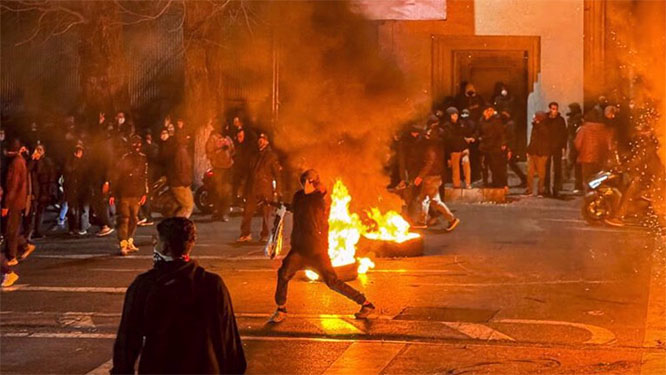
Iranian security and intelligence forces have captured more than 470 individuals in three provinces, identified as key figures behind the recent wave of violent unrest and terrorist activities linked to foreign-backed networks.

The Intelligence Ministry's provincial office in Khorasan Razavi announced on Monday the arrest of 192 armed terrorists, identified as the main agents behind recent riots in the region. 

According to an official statement, the detainees were involved in the killing of several security personnel and civilians, setting fire to mosques, public service facilities, and buses, as well as attacks on military and law enforcement centers.

The seized items from the group include several bulletproof vests, Kalashnikov rifles, hunting weapons, Winchester rifles, and various cold weapons such as daggers, swords, brass knuckles, tactical knives, crossbows, and chains.

Evidence indicates that some of the individuals were tied to hostile movements and terrorist organizations, with links overseas. Others were identified as members of violent criminal gangs, actively taking part in the unrest alongside their associates.

Simultaneously, in the western province of Lorestan, the IRGC announced the arrest of 134 individuals as the main leaders and influential field agents of a US-Israeli terrorist network.

The IRGC statement stated that these individuals formed terrorist cells during the recent unrest, committing "Daesh-like" acts.

They wounded security forces with firearms and cold weapons, and burned and destroyed public and private properties, including mosques, shops, banks, and private and public vehicles.

In the northwestern province of Zanjan, the police reported detaining 150 people identified as principal leaders and agents behind recent riots.

Authorities noted that these individuals were responsible for destroying public and private property and intentionally setting fire to vehicles in the province's squares.

Their crimes include shedding the blood of innocent people, destroying public and private property, attempting to enter military sites, disrupting public order, and spreading terror among citizens.

A variety of cold weapons were reportedly seized from the detainees.

What began late last month as peaceful protests over economic hardship across Iran turned violent after public statements by US and Israeli regime figures encouraged vandalism and disorder.

During the unrest, foreign-backed mercenaries rampaged through cities, killing security forces and civilians and damaging public property.

Comments

Add new comment

  • Coastaldigest.com reserves the right to delete or block any comments.
  • Coastaldigset.com is not responsible for its readers’ comments.
  • Comments that are abusive, incendiary or irrelevant are strictly prohibited.
  • Please use a genuine email ID and provide your name to avoid reject.
News Network
January 23,2026

Mangaluru: The Karnataka Government Polytechnic (KPT), Mangaluru, has achieved autonomous status from the All India Council for Technical Education (AICTE), becoming the first government polytechnic in the country to receive such recognition in its 78-year history. The status was granted by AICTE, New Delhi, and subsequently approved by the Karnataka Board of Technical Education in October last year.

Officials said the autonomy was conferred a few months ago. Until recently, AICTE extended autonomous status only to engineering colleges, excluding diploma institutions. However, with a renewed national focus on skill development, several government polytechnics across India have now been granted autonomy.

KPT, the second-largest polytechnic in Karnataka, was established in 1946 with four branches and has since expanded to offer eight diploma programmes, including computer science and polymer technology. The institution is spread across a 19-acre campus.

Ravindra M Keni, the first dean of the institution, told The Times of India that AICTE had proposed autonomous status for polytechnic institutions that are over 25 years old. “Many colleges applied. In the first round, 100 institutions were shortlisted, which was further narrowed down to 15 in the second round. We have already completed one semester after becoming an autonomous institution,” he said. He added that nearly 500 students are admitted annually across eight three-year diploma courses.

Explaining the factors that helped KPT secure autonomy, Keni said the institution has consistently recorded 100 per cent admissions and placements for its graduates. He also noted its strong performance in sports, with the college emerging champions for 12 consecutive years, along with active student participation in NCC and NSS activities.

Autonomous status allows KPT to design industry-oriented curricula, conduct examinations, prepare question papers, and manage academic documentation independently. The institution can also directly collaborate with industries and receive priority funding from AICTE or the Ministry of Education. While academic autonomy has been granted, financial control will continue to rest with the state government.

“There will be separate committees for examinations, question paper setting, boards of studies, and boards of examiners. The institution will now have the freedom to conduct admissions without government notifications and issue its own marks cards,” Keni said, adding that new academic initiatives would be planned after a year of functioning under the autonomous framework.

Comments

Add new comment

  • Coastaldigest.com reserves the right to delete or block any comments.
  • Coastaldigset.com is not responsible for its readers’ comments.
  • Comments that are abusive, incendiary or irrelevant are strictly prohibited.
  • Please use a genuine email ID and provide your name to avoid reject.