Tension escalates in Middle East amidst Israel’s deadly attack on Iran’s nuclear and missile sites

News Network
June 13, 2025

nuclear.jpg

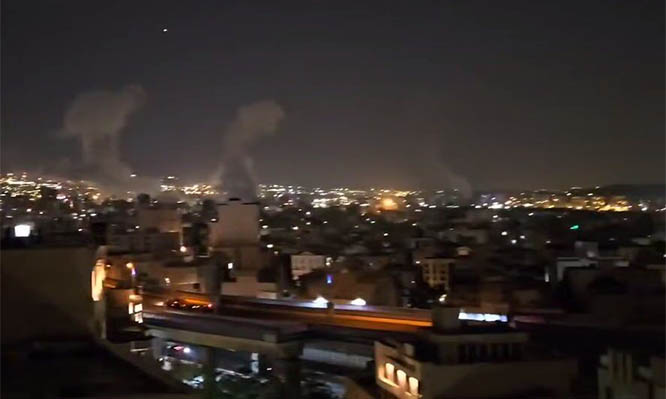
Israel attacked Iran’s capital early Friday, June 13, in strikes that targeted the country’s nuclear program and raised the potential for an all-out war between the two bitter Middle East adversaries. It appeared to be the most significant attack Iran has faced since its 1980s war with Iraq.

Multiple sites around the country were hit, and black smoke was seen rising from the nation’s main nuclear enrichment facility.

The leader of Iran’s paramilitary Revolutionary Guard was confirmed dead, Iranian state television reported, a development that would be a body blow to Tehran’s governing theocracy and an immediate escalation of the nations’ long-simmering conflict. 

The report offered few details about what happened to Gen. Hossein Salami but said that another top Guard official, as well as two nuclear scientists, were also feared dead.

The strikes, which came amid simmering tensions over Iran’s rapidly advancing nuclear program, appeared certain to lead to a reprisal that Israel warned could target its own civilian population. In Washington, the Trump administration, which had cautioned Israel against an attack during continued negotiations over Iran’s nuclear enrichment program, said that it had not been involved and warned against any retaliation targeting US interests or personnel.

Israeli leaders cast the preemptive assault as a fight for the nation’s survival and necessary to head off what they described as an imminent threat that Iran would build nuclear bombs, though it remains unclear how close the country is to achieving that or whether it had actually had been planning a strike.

“It could be a year. It could be within a few months,” Prime Minister Benjamin Netanyahu said as he vowed to pursue the attack for as long as necessary to “remove this threat.”

“This is a clear and present danger to Israel’s very survival,” he said.

For Netanyahu, the operation distracts attention from Israel’s ongoing and increasingly unpopular war in Gaza, which is now over 20 months old. There is a broad consensus in the Israeli public that Iran is a major threat, and Israel’s opposition leader, Yair Lapid, a staunch critic of Netanyahu, offered his “full support” for the mission against Iran. But if Iranian reprisals cause heavy Israeli casualties or major disruptions to daily life, Netanyahu could see public opinion quickly shift.

Multiple sites in the Iranian capital were hit in the attack, which Netanyahu said targeted both nuclear and military sites. Also targeted were officials leading Iran’s nuclear program and its ballistic missile arsenal. It wasn’t clear how bad the damage was at Iran’s main nuclear enrichment facility at Natanz.

The strike on Iran pushed the Israeli military to its limits, requiring the use of aging air-to-air refuelers to get its fighter jets close enough to attack. It wasn’t immediately clear if Israeli jets entered Iranian airspace or just fired so-called “standoff missiles” over another country. People in Iraq heard fighter jets overhead at the time of the attack. Israel previously attacked Iran from over the border in Iraq.

The potential for an attack had been apparent for weeks. President Donald Trump on Thursday said that he did not believe an attack was imminent but also acknowledged that it “could very well happen.” As tensions rose, the US pulled some diplomats from Iraq’s capital and offered voluntary evacuations for the families of US troops in the wider Middle East.

US Secretary of State Marco Rubio said Israel took “unilateral action against Iran” and that Israel advised the US that it believed the strikes were necessary for its self-defense.

“We are not involved in strikes against Iran, and our top priority is protecting American forces in the region,” Rubio said in a statement released by the White House.

Trump is scheduled to attend a meeting of his National Security Council on Friday in the White House Situation Room, were he is expected to discuss the conflict with top advisers. It is not clear if he plans to make a public remarks on the strikes in Iran.

Israel has long been determined to thwart Iran’s nuclear potential.

Meanwhile, the Board of Governors at the International Atomic Energy Agency for the first time in 20 years on Thursday censured Iran over its refusal to work with its inspectors. Iran immediately announced it would establish a third enrichment site in the country and swap out some centrifuges for more-advanced ones.

Even so, there are multiple assessments on how many nuclear weapons it could conceivably build, should it choose to do so. Iran would need months to assemble, test and field any weapon, which it so far has said it has no desire to do. US intelligence agencies also assess Iran does not have a weapons program at this time.

In a sign of the far-reaching implications of the emerging conflict, Israel’s main airport was closed and benchmark Brent crude spiked on news of the attack, rising nearly 8 percent. Both Iran and Israel closed their airspace.

Israeli Defense Minister Israel Katz warned that in the aftermath of the strikes, “missile and drone attacks against Israel and its civilian population are expected immediately.”

“It is essential to listen to instructions from the home front command and authorities to stay in protected areas,” he said in a statement.

As the explosions in Tehran started, Trump was on the lawn of the White House mingling with members of Congress. It was unclear if he had been informed, but the president continued shaking hands and posing for pictures for several minutes.

Trump earlier said he urged Netanyahu to hold off on any action while the administration negotiated with Iran.

“As long as I think there is a (chance for an) agreement, I don’t want them going in because I think it would blow it,” Trump told reporters.

Comments

Add new comment

  • Coastaldigest.com reserves the right to delete or block any comments.
  • Coastaldigset.com is not responsible for its readers’ comments.
  • Comments that are abusive, incendiary or irrelevant are strictly prohibited.
  • Please use a genuine email ID and provide your name to avoid reject.
News Network
December 2,2025

A major upgrade in safety and monitoring is planned for Haj 2026, with every Indian pilgrim set to receive a Haj Suvidha smart wristband linked to the official Haj Suvidha mobile app. The initiative aims to support pilgrims—especially senior citizens—who may struggle with smartphones during the 45-day journey.

What the Smart Wristband Will Do

Officials said the device will come with:
•    Location tracking
•    Pedometer
•    SOS emergency button
•    Qibla compass
•    Prayer timings
•    Basic health monitoring

SP Tiwari, secretary of the UP State Haj Committee, said the goal is to make the pilgrimage safer and more comfortable.

“Most Hajis are elderly and not comfortable with mobile apps,” he said. “The smartwatch will help locate pilgrims who forget their way or cannot communicate their location.”

The wristbands will be monitored by the Consulate General of India in Saudi Arabia, similar to mobile tracking via the Haj Suvidha App.

Free Distribution and Training

•    Smart wristbands will be given free of cost.
•    Training for pilgrims will be conducted between January and February 2026.
•    Sample units will reach state Haj committees soon.
•    Final devices will be distributed as pilgrims begin their journey.

New Rules for Accommodation

Two major decisions have also been finalised for Haj 2026:
1.    Separate rooms for men and women – including married couples. They may stay on the same floor but must occupy different rooms, following stricter Saudi guidelines.
2.    Cooking banned – gas cylinders will not be allowed; all meals will be provided through official catering services arranged by the Haj Committee of India.

These decisions were finalised during a meeting of the Haj Committee of India and state representatives in Mumbai.

Haj Suvidha App Launched Earlier

The government launched the Haj Suvidha App in 2024, offering:

•    Training modules
•    Accommodation and flight details
•    Baggage information
•    SOS and translation tools
•    Grievance redressal

Haj 2026 Quota and Key States

•    India’s total Haj quota for 2026: 1,75,025 pilgrims
•    70% (1,25,000) allotted to the Haj Committee of India
•    30% (around 50,000) reserved for Haj Group Organisers

Uttar Pradesh has the largest allocation (around 30,000 seats), though approximately 18,000 pilgrims are expected to go this year. States with high pilgrim numbers include Kerala, Maharashtra and Gujarat.

Dates of Haj 2026

The pilgrimage is scheduled to take place from 24 May to 29 May, 2026 (tentative).
Haj is one of the five pillars of Islam and is mandatory for Muslims who meet the required conditions.

Comments

Add new comment

  • Coastaldigest.com reserves the right to delete or block any comments.
  • Coastaldigset.com is not responsible for its readers’ comments.
  • Comments that are abusive, incendiary or irrelevant are strictly prohibited.
  • Please use a genuine email ID and provide your name to avoid reject.
News Network
November 24,2025

lebanon.jpg

Israel has launched a new act of aggression on a residential neighborhood in Lebanon's capital, Beirut, killing and injuring about two dozen civilians.

The Israeli regime's military said in a statement that its forces carried out a so-called precise strike in a residential apartment in Dahiyeh in the southern suburbs of Beirut on Sunday.

The aggression targeted residential areas, killing at least five people and injuring more than 28 people, Lebanon's Health Ministry said. 

Hezbollah announced the martyrdom of senior Hezbollah commander Haytham Ali Tabatabai and four resistance fighters.

Lebanese President Michel Aoun condemned the airstrike, calling it a clear demonstration of Tel Aviv’s disregard for repeated international calls to halt violations on Lebanese soil.

“Israel refuses to implement international resolutions and all efforts aimed at ending the escalation and restoring stability,” Aoun said, urging the international community to take action to prevent further aggression.

The Palestinian Islamic Jihad movement also condemned the attack, holding the international community accountable. 

“The international community bears responsibility and continues to provide cover for these attacks as long as it does not restrain the occupiers,” said Ali Abu Shahin, a member of the group’s political bureau.

Israeli prime minister Benjamin Netanyahu’s office announced that the Israeli army carried out a strike “in the heart of Beirut."

Netanyahu reportedly approved the operation following recommendations from top Israeli security officials.

Two senior US officials commented on the Israeli strike.

The first official said that Israel did not notify Americans in advance about the attack. "We were informed immediately after the strike was carried out."

The second senior official said that the "US knew for several days that Israel was planning to escalate its strikes in Lebanon, but did not know in advance the timing, location, or target of the strike."

Speaking from the site of the Israeli strike, Lebanese MP Ali Ammar condemned the attack as part of a broader campaign of aggression that has targeted "all of Lebanon since the Washington-sponsored ceasefire."

He stated that "any attack on Lebanon is a violation of red lines; this aggression is part and parcel of the entity that targets Lebanon's dignity, sovereignty, and security of citizens."

Ammar went on to say the resistance is responding with "utmost wisdom, patience, and will confront the enemy at the appropriate time."

"Unfortunately, the enemy is emboldened to commit its aggression by voices within Lebanon that have turned themselves into tools that support its aggression," he added.

The Israeli attack on the southern suburbs of the Lebanese capital is the latest blatant violation of the ceasefire Israel signed with Hezbollah in November 2024, which was intended to end hostilities that had escalated into full-scale war.

An Israeli strike on the Ain al-Hilweh camp near Sidon in southern Lebanon late Tuesday killed at least 14 people. It wounded several others, including young students, according to the Lebanese health ministry.

The military claimed the attack targeted “a Hamas training compound” used to plan and carry out attacks against the regime -- a claim that has frequently been made without evidence.

Hamas rejected the allegations as “a blatant lie aimed at justifying the massacre,” stating it had “no military installations in the Palestinian camps in Lebanon” and that the targeted site was merely “an open sports field.”

According to Lebanese authorities, Israeli attacks have killed approximately 4,000 people and displaced more than 1.2 million residents across the country since October 2023.

Comments

Add new comment

  • Coastaldigest.com reserves the right to delete or block any comments.
  • Coastaldigset.com is not responsible for its readers’ comments.
  • Comments that are abusive, incendiary or irrelevant are strictly prohibited.
  • Please use a genuine email ID and provide your name to avoid reject.
News Network
November 24,2025

israelsyra.jpg

Israeli forces have pushed over the Syrian frontier, erecting a checkpoint and stopping vehicles in the southwestern city of Quneitra, in yet another breach of the Arab country’s sovereignty.

The violation took place on Sunday, when the troops made their way across the border, setting up the outpost near the Ain al-Bayda junction in northern Quneitra, Syrian outlets reported.

According to the al-Ikhbariya paper, an Israeli detachment positioned itself at the junction, halting cars and conducting searches.

The Syrian Arab News Agency (SANA) reported that three Israeli military vehicles then moved further into the northern countryside, deploying between the town of Jubata al-Khashab and the villages of Ofaniya and Ain al-Bayda. The agency added that a separate Israeli unit mounted a new incursion in the central region, approaching the villages of Umm Batina and al-Ajraf.

Residents said such activities have surged in recent months, pointing to Israeli advances onto farmland, leveling of extensive forested areas, arrests, and spread of mobile checkpoints.

The Israeli regime began markedly increasing its military aggression against Syria last year.

The escalation coincided with increasingly ferocious onslaughts throughout the country by the so-called Hay'at Tahrir al-Sham (HTS) Takfiri terrorist group, which the government of President Bashar al-Assad had confined to northwestern Syria. The HTS, however, managed to overthrow the government as the Israeli attacks would pummel the country’s civilian and defensive infrastructure.

Various reports have shown that, during the escalation, the regime conducted more than 1,000 airstrikes on the Syrian territory and over 400 ground raids into the south.

Following the collapse of the Assad government, Tel Aviv also widened its grip over the occupied Golan Heights by taking control of a demilitarized buffer zone, in defiance of a 1974 Disengagement Agreement. Earlier this month, senior Israeli officials, including Prime Minister Benjamin Netanyahu, visited the buffer zone, prompting expressions of alarm on the part of the United Nations.

The United States, the regime’s biggest ally, has, meanwhile, been fraternizing the HTS head Abu Mohammed al-Jolani amid the widely reported prospect of rapprochement with Tel Aviv.

Comments

Add new comment

  • Coastaldigest.com reserves the right to delete or block any comments.
  • Coastaldigset.com is not responsible for its readers’ comments.
  • Comments that are abusive, incendiary or irrelevant are strictly prohibited.
  • Please use a genuine email ID and provide your name to avoid reject.