Unprecedented Israeli bombardment lays Gaza City’s upscale Rimal to waste

News Network
October 11, 2023

gazacity.jpg

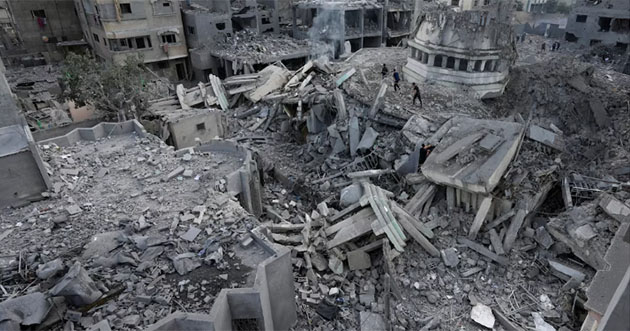
Gaza City, Oct 11: Collapsed buildings, mangled infrastructure, streets turned into fields of rubble.

Scenes of violence and destruction in the long-blockaded Gaza Strip have filled the world’s airwaves throughout four wars and countless rounds of hostilities between Israel and Hamas. But this conflict, Palestinians say, is different.

On Tuesday, following a night of intense bombardment, residents were struggling to grasp the sheer scale of damage inflicted on Gaza City’s upscale Rimal neighborhood, with its shopping malls, restaurants, residential buildings and offices belonging to aid groups and international media far from the territory’s hard-hit border towns and impoverished refugee camps.

Israel has hit Rimal, also home to Hamas government ministries, in the 2021 war, but never like this.

Israeli bombs blew out walls and ripped off roofs of upper-class apartment towers. They toppled trees that had lined the sidewalks. They uprooted streets that had teemed with businessmen hustling to work and vendors hawking roasted nuts. They leveled mosques and university buildings and wrecked high-rise offices of companies and organizations like Gaza’s main telecommunications company and Bar Association.

Among those broad boulevards full of beauty salons, falafel shops and pizzerias beat the heart of Gaza City. For many, the magnitude of the devastation there, affecting the territory’s middle and upper classes, had symbolic significance.

“Israel has destroyed the center of everything,” said Palestinian businessman Ali Al-Hiyak from his home near Rimal. “That is the space of our public life, our community.”

“They are breaking us,” he added.

After Gaza’s Hamas rulers mounted the deadliest attack on Israel in decades, killing over 1,000 people and taking dozens hostage in a multi-pronged offensive, Israel unleashed what Gaza residents described as the most intense bombing campaign in recent memory, with hundreds of airstrikes Monday night.

“These sounds are different,” 30-year-old Saman Ashour in Gaza City texted as she lay awake in a neighborhood north of Rimal, listening to the roar of explosions. “It’s the sound of revenge.”

Residents said the Israeli military struck some buildings without first firing warning missiles as a precaution. The civilian death toll has been rapidly rising. Overall, Gaza health officials have reported the airstrikes have killed over 800 people and wounded thousands more. Israel has also cut off Gaza’s water supplies and electricity, worsening the territory’s already abysmal humanitarian conditions.

The Israeli military’s Arabic spokesperson, Avichay Adraee, said that Israel was trying to “evacuate civilian populations from areas where Hamas has a military presence” before unleashing “powerful destruction.”

That tactic is evident from staggering drone footage that shows vast swaths of central Gaza City reduced to nothing but dirt craters and ruins from demolished buildings.

But most Palestinian civilians did not evacuate. There are no bomb shelters. Israel and Egypt tightly control the enclave’s borders and have not let anyone out. UN shelters are rapidly filling up.

After the Hamas’ unprecedented attack on Israeli civilians and soldiers, which stunned and terrorized a country long seen as invincible, analysts said it was clear the group bet all of its chips no matter the consequences. Israel was now waging a war not to repel Hamas, like in past rounds, but to destroy it.

“The strategic prospect is to annihilate, destroy and demolish the military capacity of Hamas,” said Kobi Michael, a senior fellow at the Institute for National Security Studies, an Israeli think tank. “Hamas brought this on the heads of the Gazans.”

“If Israel is not aggressive enough,” he added, “that will only drag us to another front and to another conflict.”

But Palestinians in Gaza see the Israeli military’s wrath as collective punishment.

“We’re talking about damage to hospitals that can’t even run without fuel, the total demolition of homes and infrastructure,” said Iyad Bozum, spokesman for Gaza’s Interior Ministry. “At the end of this there will be nothing left to even reconstruct. It will be impossible to live here.”

The strikes on Rimal early Tuesday killed ordinary residents like shopkeepers and local journalists and destroyed dozens of homes.

Issa Abu Salim, 60, was seething as he stood amid the debris of his home, his clothes filthy with the dust of the destruction.

“Our money is gone. My identity cards are lost. The entire house, all four floors, is lost,” he said. “The most beautiful area, they destroyed it.”


Comments

Add new comment

  • Coastaldigest.com reserves the right to delete or block any comments.
  • Coastaldigset.com is not responsible for its readers’ comments.
  • Comments that are abusive, incendiary or irrelevant are strictly prohibited.
  • Please use a genuine email ID and provide your name to avoid reject.
News Network
January 23,2026

oscar.jpg

The Voice of Hind Rajab, inspired by the tragic final moments of a young Palestinian girl killed by Israeli fire in Gaza, has been nominated for an Academy Award in the Best International Feature Film category.

Directed by Tunisian filmmaker Kaouther Ben Hania, the film recounts the true story of five-year-old Hind Rajab, who lost her life in January 2024 while fleeing Israeli bombardment with her family.

The film features the real audio of Hind’s desperate call to the Palestinian Red Crescent Society, where she pleaded for help moments before the vehicle she was in was struck by 355 bullets.

The haunting narrative begins with a brief call made from the besieged Tel al-Hawa neighborhood of Gaza, where gunfire and armored vehicles drowned out every sound.

After witnessing the brutal killing of her family, she made a trembling call, her voice reduced to a whisper as she spoke of the massacre and her unbearable loneliness as the sole survivor.

Premiering at the Venice International Film Festival in September 2025, The Voice of Hind Rajab garnered widespread acclaim, receiving a record-setting 23-minute standing ovation and the Silver Lion Grand Jury Prize, the festival’s second-highest honor.

In her acceptance speech, Ben Hania dedicated the film to humanitarian workers and first responders in Gaza, emphasizing that Hind's voice symbolizes countless civilians affected by war.

She aims to give voice to victims often reduced to mere statistics, highlighting the broader suffering of civilians in war zones.

The film’s Oscar nomination underscores its powerful storytelling and ethical approach to depicting real-life tragedy, making it a crucial piece of contemporary cinema.

It serves not only as a narration of individual tragedy but also as an artistic and documentary response to the silence and censorship that often overshadow West Asian struggles and wars.

Using an innovative method she calls docufiction, Ben Hania bridges unvarnished reality and narrative structure, creating a work that is both artistically valuable and socially impactful.

Born in 1977 in Sidi Bouzid—later the epicenter of the Arab revolution—her background profoundly influenced her worldview and artistic approach.

She is a graduate of the Higher School of Audiovisual Arts of Tunis, Pantheon-Sorbonne University, and La Fémis in Paris, where her studies equipped her with the technical and theoretical tools needed to address complex subjects. 

Comments

Add new comment

  • Coastaldigest.com reserves the right to delete or block any comments.
  • Coastaldigset.com is not responsible for its readers’ comments.
  • Comments that are abusive, incendiary or irrelevant are strictly prohibited.
  • Please use a genuine email ID and provide your name to avoid reject.
News Network
January 31,2026

Roy.jpg

Bengaluru: The shooting incident involving CJ Roy, founder of the Confident Group, has once again put the spotlight on a businessman whose life has swung between flamboyant global success and persistent controversy at home.

Though Roy’s business interests extended across continents, his roots lay firmly in Karnataka. An alumnus of Christ School in Bengaluru, he later moved to Tumakuru to pursue an engineering degree. Those familiar with his early years describe him as intensely ambitious, beginning his career as a salesman at a small electronics firm dealing in computers.

Roy’s entry into large-scale real estate came through the Crystal Group, where he worked closely with Latha Namboothiri and rose from manager to director. However, the launch of the Confident Group in 2005 was clouded by industry speculation. Insiders speak of a fallout involving alleged “benami” properties and claims of deception that ultimately led to his independent venture—an episode Roy spent years trying to distance himself from, according to associates.

A tale of two cities

Roy’s professional trajectory diverged sharply across geographies.

In Dubai, he built a reputation as a bold and efficient developer, completing massive luxury residential projects in record time—some reportedly within 11 months. His rapid project delivery and lavish lifestyle in the Emirates earned him admiration and visibility in the real estate sector.

In Bengaluru, however, his image remained far more fractured. Sources say Roy stayed away from the city for several years amid disputes over unpaid dues to vendors and suppliers. Several projects were allegedly stalled, with accusations of unfulfilled commitments to cement and steel suppliers continuing to follow him.

Roy’s return to Bengaluru’s business and social circles began around 2018, marked by a conscious attempt at rebranding. His appointment as Honorary Consul of the Slovak Republic added diplomatic legitimacy, which he complemented with visible CSR initiatives, including ambulance donations and high-profile charity events.

Heavy police presence in Langford Town

Following the incident, police personnel from the Central division were deployed outside the Confident Group building in Langford Town, which also houses the Slovak Honorary Consulate in Bengaluru.

The otherwise busy premises near Hosur Road wore a deserted look on Friday, reflecting the shock and uncertainty that followed the tragedy.

Comments

Add new comment

  • Coastaldigest.com reserves the right to delete or block any comments.
  • Coastaldigset.com is not responsible for its readers’ comments.
  • Comments that are abusive, incendiary or irrelevant are strictly prohibited.
  • Please use a genuine email ID and provide your name to avoid reject.
News Network
January 20,2026

Mangaluru: In a major step towards strengthening rural innovation, the Office of the Principal Scientific Adviser (PSA) to the Government of India is supporting the establishment of RuTAGe Smart Village Centres (RSVCs) across the country through collaborations with academic institutions, civil society organisations and philanthropic partners.

As part of this national initiative, Nitte (Deemed to be University) will set up the first RSVCs in the region at Nitte GP in Udupi district and at the Nitte Health Centre, Sevanjali Trust, Farangipete, in Dakshina Kannada district. The centres will be inaugurated on January 21. In South India, the programme is being implemented by the Section Infin-8 Foundation (SI-8).

Speaking to reporters on Monday, SI-8 founder-director Vishwas US said experts from Nitte University and SI-8 would work closely with farmers, students, youth and local entrepreneurs to adapt and deploy technologies tailored to local needs.

Project head Prof Iddya Karunasagar, representing Nitte DU, said the RSVCs at Nitte and Farangipete would serve as demonstration hubs for a wide range of agriculture, energy, skill-development and assistive technologies. These include solar dryers for fruits, vegetables and crops; soil-testing solutions; power weeders and women-friendly farm tools; wind-powered devices for rural artisans; grain storage systems; grass-cutting and tree-climbing equipment; and liquid fertiliser production using cowshed waste.

SI-8 CEO Aravind C Kumar said the centres would also provide access to digital and knowledge-based platforms such as ISRO applications, government scheme portals, market linkage tools and gamified learning resources, along with assistive technologies for persons with visual impairments.

Highlighting the broader impact of the initiative, Principal Scientific Adviser Prof Ajay Kumar Sood said it demonstrated how applied research could bridge the rural–urban divide and help create self-reliant, technology-enabled villages.

The initiative has been made possible through philanthropic support from Dr NC Murthy of ACM Business Solutions, LLC, USA. Dr Sapna Poti, Director (Strategic Alliances) at the Office of the Principal Scientific Adviser, said the long-term objective is to build self-sufficient, technology-driven communities capable of generating sustainable livelihoods on their own.

Comments

Add new comment

  • Coastaldigest.com reserves the right to delete or block any comments.
  • Coastaldigset.com is not responsible for its readers’ comments.
  • Comments that are abusive, incendiary or irrelevant are strictly prohibited.
  • Please use a genuine email ID and provide your name to avoid reject.