Urgency and Equity in South Asia's Environmental Justice Struggle against Climate Colonialism

Press Release
December 13, 2023

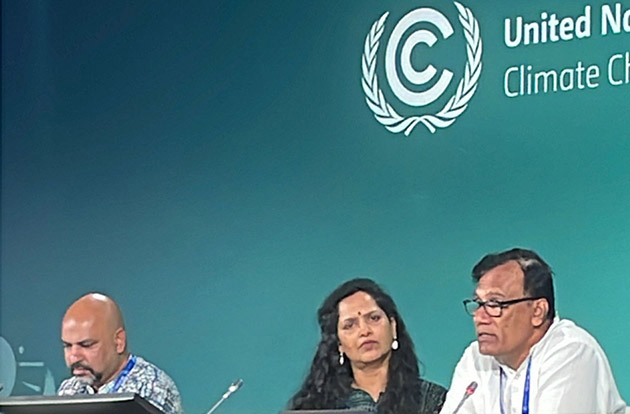
Dubai2.jpg

Dubai: The culmination of the Just Transition in South Asia press conference, which took place on December 11, 2023, at COP-28 in Dubai, has illuminated the pressing need for immediate action to confront the impending climate crisis. The event delivered a stark call for decisive decisions and collaborative endeavors by major economies to ensure an equitable and just transition in South Asia.

Key insights from the conference include a global south's call for urgent action, emphasizing concrete decisions to curb excessive emissions and meet the 1.5-degree goal by 2050, as outlined in the Paris Agreement. The conference underscored that 83% of the carbon budget has already been exhausted, leaving a precarious 50:50 chance of achieving the Paris Agreement goals by 2030.

Further, the Climate Risk Index revealed that six South Asian nations, including Bangladesh, India, Nepal, Pakistan, and Sri Lanka, are among the top 10 most vulnerable countries impacted by climate change. The region bore witness to the devastating impact of seven cyclones in 2023 alone, resulting in loss of lives, destruction of homes, and severe economic repercussions.

Hasan Mehedi from CLEAN (Coastal Livelihood and Environmental Action Network), Bangladesh, firmly stated, "The people of South Asia are bearing the brunt of climate change impacts, and their plea for urgent action is a call to the global community. The decisions we make today will determine the fate of vulnerable communities and the sustainability of our planet."

Recognizing the challenges faced by South Asian countries, representing a quarter of the global population and nearly a third of the world's poor, the conference shed light on the intricacies of energy poverty. The imperative to decarbonize the energy sector is acknowledged, yet challenges persist in meeting basic electricity needs and overcoming economic crises, particularly in Sri Lanka, Pakistan, and Bangladesh.

A positive development emerged with the signing of the Global Renewables and Energy Efficiency Pledge (GREEP) by 123 countries, including Bangladesh, Bhutan, and Maldives. However, concerns were voiced about the adequacy of the target, considering the escalating global electricity demand and the need for more ambitious goals to achieve a just transition by 2030.

The event underscored challenges such as the concentration of renewable energy technologies in specific countries, giving rise to a form of 'Climate Colonialism.' The dominance of large corporations in renewable energy projects, notably hydropower, raised serious environmental and human rights issues, with indigenous communities facing the imminent threat of displacement.

Hemantha Withanage from the Centre for Environmental Justice (CEJ), Sri Lanka, shared, "South Asian nations face a delicate balancing act: meeting the basic electricity needs of their citizens while navigating economic challenges. Big economies must acknowledge and support our transition efforts, ensuring a just and equitable pathway towards sustainability."

Opposition was against false solutions like hydrogen, ammonia, and carbon capture and storage (CCS) technologies. The conference emphasized the need for proven, affordable, and sustainable alternatives, rejecting the promotion of unproven technologies.

In the aftermath of the conference, key demands were outlined to address the climate crisis in South Asia. Organizers called for an ambitious target to generate at least 60% of global electricity demand from renewable sources, a cut-off date for using coal, gas, and petroleum in the power sector, cessation of financing for LNG as a transition fuel, and support for South Asian countries in building national renewable energy institutions. 

"The concentration of renewable energy technologies in specific countries is a form of 'Climate Colonialism.' We must shift focus towards community-owned decentralized systems to ensure not just environmental sustainability but also uphold the rights of local communities," says Vidya Dinker of Growthwatch, India,

Furthermore, the demands included financing for community-owned distributed renewable energy systems, ensuring local communities' human and environmental rights during the energy transition, and discontinuing the promotion of false solutions like hydrogen, ammonia, and CCS technologies.
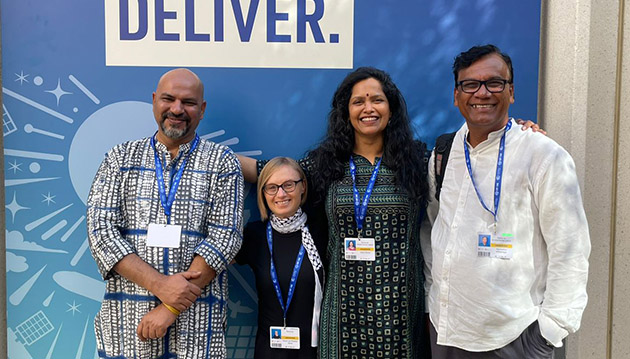

Dubai.jpg

Comments

Add new comment

  • Coastaldigest.com reserves the right to delete or block any comments.
  • Coastaldigset.com is not responsible for its readers’ comments.
  • Comments that are abusive, incendiary or irrelevant are strictly prohibited.
  • Please use a genuine email ID and provide your name to avoid reject.
News Network
January 19,2026

New Delhi: Setting speculation to the rest, the CPI(M) has made it clear that it is open to have an electoral understanding with the Congress “to defeat” the Trinamool Congress and the BJP in West Bengal Assembly election even as it is all set to take on the grand old party in Kerala accusing it of “found wanting” in fighting the Hindutva forces.

The CPI(M) also said that it will contest the Tamil Nadu election “with DMK and its allies to defeat the BJP and its allies”, amid a section in the Congress triggering confusion about its participation in the M K Stalin-led coalition over demand over power-sharing and more seats. It is also willing to join hands with Congress and others in Assam and Puducherry to defeat the BJP.

The decisions came at a three-day meeting of the CPI(M) Central Committee in Thiruvananthapuram, which ended on Sunday after reviewing the poll preparations in the poll-bound states.

The CPI(M)'s decision came even as a section led by West Bengal Congress president Subhankar Sarkar is averse to tying up with the Left Front, claiming that their party is not benefitted by the electoral understanding. Both Congress and CPI(M)-led Left Front had electoral understanding in 2016 and 2021 Assembly elections and 2024 Lok Sabha polls.

Congress and the Left Front fought together for the first time in 2016 when Congress won 44 seats and the CPI(M) got 26. In 2021, the Left Front and the Congress drew a blank. In the 2024 Lok Sabha polls, Congress managed to win one seat while the Left did not win any. In the 2019 Lok Sabha polls, both fought against each other with Congress winning two and the Left none.

“In Bengal, the party will work for the defeat of both the TMC and the BJP, which are trying to polarise the society. We will try to rally all the forces that are ready to work against them,” the CPI(M) said in a statement without naming Congress by name. Senior leaders said there is no change in its strategy of pooling all non-BJP, non-TMC votes.

However, the party was critical of the Congress in Kerala where both will fight against each other.

The CPI(M) said it would "expose the BJP-led Union government’s denial of rightful dues to Kerala, the fiscal constraints imposed and the overall attack on federalism" as also "expose the failure of the Congress to effectively counter this attack on federalism, as the largest opposition party in the Parliament".

"The Congress, especially in Kerala, was found wanting in the fight against communal RSS-BJP, ideologically and this will also be exposed before the people," it added.

In Assam, it said, the CPI(M) will work for the mobilisation of all the anti-BJP parties and forces and defeat the rabidly communal and divisive BJP government. The Left parties are cooperating with Congress in the north-eastern state. In Puducherry, it said it will work for the defeat of the BJP alliance government.

Comments

Add new comment

  • Coastaldigest.com reserves the right to delete or block any comments.
  • Coastaldigset.com is not responsible for its readers’ comments.
  • Comments that are abusive, incendiary or irrelevant are strictly prohibited.
  • Please use a genuine email ID and provide your name to avoid reject.
News Network
January 23,2026

modIKERALA.jpg

Prime Minister Narendra Modi, during his visit to Thiruvananthapuram on Friday, January 23, indicated that the Bharatiya Janata Party (BJP) is aiming to expand its political footprint in Kerala ahead of the Assembly elections scheduled in the coming months.

Speaking at a BJP-organised public meeting, Modi drew parallels between the party’s early electoral gains in Gujarat and its recent victory in the Thiruvananthapuram Municipal Corporation. The civic body win, which ended decades of Left control, was cited by the Prime Minister as a possible starting point for the party’s broader ambitions in the state.

Recalling BJP’s political trajectory in Gujarat, Modi said the party was largely insignificant before 1987 and received little media attention. He pointed out that the BJP’s first major breakthrough came with its victory in the Ahmedabad Municipal Corporation that year.

“Just as our journey in Gujarat began with one city, Kerala’s journey has also started with a single city,” Modi said, suggesting that the party’s municipal-level success could translate into wider electoral acceptance.

The Prime Minister alleged that successive governments led by the Left Democratic Front (LDF) and the United Democratic Front (UDF) had failed to adequately develop Thiruvananthapuram. He accused both fronts of corruption and neglect, claiming that basic infrastructure and facilities were denied to the capital city for decades.

According to Modi, the BJP’s control of the civic body represents a shift driven by public dissatisfaction with the existing political alternatives. He asserted that the BJP administration in Thiruvananthapuram had begun working towards development, though no specific details or timelines were outlined.

Addressing the gathering at Putharikandam Maidan, Modi said the BJP intended to project Thiruvananthapuram as a “model city,” reiterating his party’s commitment to governance-led change.

The Prime Minister’s visit to Kerala also included the inauguration of several development projects and the flagging off of new train services, as the BJP intensifies its political outreach in the poll-bound state.

Comments

Add new comment

  • Coastaldigest.com reserves the right to delete or block any comments.
  • Coastaldigset.com is not responsible for its readers’ comments.
  • Comments that are abusive, incendiary or irrelevant are strictly prohibited.
  • Please use a genuine email ID and provide your name to avoid reject.
coastaldigest.com news network
January 19,2026

rizwanzameer.jpg

Bengaluru: As the dust settles on the recent legislative session, the corridors of Vidhana Soudha are buzzing with more than just policy talk. A high-stakes game of political musical chairs has begun, exposing a deepening rift within the Congress party’s Muslim leadership as a major Cabinet reshuffle looms.

With the party hierarchy signaling a "50% refresh" to gear up for the 2028 Assembly elections, the race to fill three projected Muslim ministerial berths has transformed from a strategic discussion into an all-out turf war.

The "Star Son" Spark

The internal friction turned public this week following provocative remarks by Zaid Khan, actor and son of Wakf Minister Zameer Ahmed Khan. Zaid’s claim—that his father "helped" secure a ticket for Shivajinagar MLA Rizwan Arshad in 2023—has acted as a lightning rod for resentment.

Rizwan’s camp was quick to fire back, dismissing the comment as a desperate attempt by Zameer to manufacture seniority. "Rizwan’s political pedigree was forged in the NSUI and Youth Congress long before Zameer even stepped into the party," a supporter noted, highlighting Rizwan’s tenure as an AICC secretary and his two-term presidency of the State Youth Congress.

A Tale of Two Loyalists

While both Zameer Ahmed Khan and Rizwan Arshad are staunch allies of Chief Minister Siddaramaiah and represent Bengaluru strongholds, their political DNA could not be more different:

•    Zameer Ahmed Khan: A four-time MLA who crossed over from JD(S) in 2018. Known for his "overzealous" and often polarizing outreach during communal flashpoints—from the DJ Halli riots to the recent Wakf land notice controversy—his style has frequently left the Congress high command in a state of "discomfort."

•    Rizwan Arshad: A homegrown organizational man. Seen as a "quiet performer," Arshad represents the sophisticated, moderate face of the party, preferred by those who find Zameer’s brand of politics too volatile.

The Outsiders Looking In

The bickering isn't limited to a duo. The "Beary" community, represented by leaders like N A Haris and Saleem Ahmed, is demanding its pound of flesh. Saleem Ahmed, the Chief Whip in the Legislative Council, has dropped the veil of diplomacy, openly declaring his ministerial aspirations.

"I was the only working president not included in the Cabinet last time," Saleem noted pointedly, signaling that the "loyalty quota" is no longer enough to keep the peace.

As Chief Minister Siddaramaiah prepares to finalize the list, he faces a delicate balancing act: rewarding the aggressive grassroots mobilization of Zameer’s camp without alienating the organizational stalwarts and minority sub-sects who feel increasingly sidelined by the "Chamarajpet-Shivajinagar" binary.

Comments

Add new comment

  • Coastaldigest.com reserves the right to delete or block any comments.
  • Coastaldigset.com is not responsible for its readers’ comments.
  • Comments that are abusive, incendiary or irrelevant are strictly prohibited.
  • Please use a genuine email ID and provide your name to avoid reject.