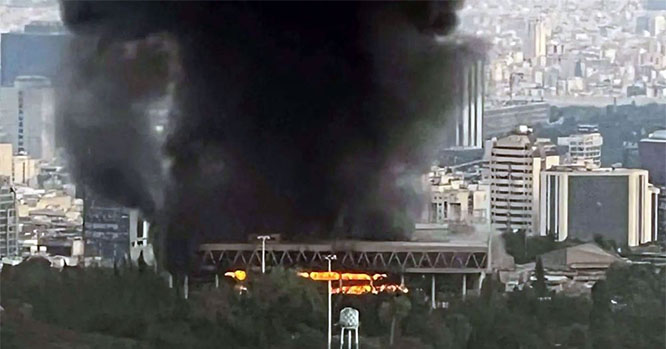
War enters Day 5 as Israel bombs hospitals, media offices in Tehran; 3.3 lakh ordered to evacuate

News Network
June 17, 2025

bloodyisraeli.jpg

Tehran / Tel Aviv, June 17: As the Israeli aggression on Iran entered its fifth day, Zionist army’s air offensive intensified with direct strikes on civilian infrastructure killing scores of children and women. 

Israel also has bombed hospitals, media centers, and residential areas in Tehran. Iran has called the escalation “a war on civilians,” as humanitarian agencies warn of a growing catastrophe in the heart of the Iranian capital.

Here’s a step-by-step breakdown of major developments:

1. Israel Strikes Civilian Infrastructure in Tehran

•    In a marked shift from earlier military-only targets, Israeli warplanes struck key civilian infrastructure in Tehran early Monday.

•    Two hospitals – including a maternity unit – were damaged, with casualties reported among medical staff, women, and children, according to Iran’s health ministry.

•    Iran’s state-run broadcaster IRIB was also targeted, with live footage showing a news anchor abandoning her studio mid-broadcast as the building shook.

•    Several journalists are feared dead or injured. The Iranian Journalists Union condemned what it called “a blatant attack on press freedom and civilian safety.”

2. Mass Evacuations Ordered in Central Tehran

•    Iranian authorities ordered the evacuation of nearly 330,000 residents from central Tehran as fresh air raids were expected.

•    The evacuation zone includes the state broadcaster’s headquarters, major police offices, and densely populated residential areas.

•    Footage showed thousands fleeing with belongings, amid rising panic and reports of power and communication outages.

3. Smoke and Blasts Reported in Other Cities

•    Thick smoke was seen rising over the city of Tabriz in northwestern Iran after a large explosion was reported around 8:45am local time.

•    Meanwhile, Israeli cities, including Tel Aviv and Herzliya, experienced air raid sirens and reported damage due to what appears to be Iranian retaliatory strikes.

•    Jerusalem also reported loud explosions as sirens wailed across the country.

4. Israel Claims Killing Top Iranian Commander

•    The Israeli military announced the assassination of Lt. Gen. Ali Shadmani, head of Iran’s Khatam al-Anbiya Central Headquarters – a top Islamic Revolutionary Guard Corps (IRGC) official.

•    Shadmani had assumed the role after the earlier killing of Gen. Gholam Ali Rashid just three days prior.

•    Israel described him as “the most senior Iranian commander” and said he was close to Supreme Leader Ayatollah Ali Khamenei.

•    Iran has not yet officially confirmed the killing.

5. Netanyahu Makes Provocative Statement on Khamenei

•    Israeli PM Benjamin Netanyahu said killing Iran’s Supreme Leader would not escalate the conflict but rather “end it.”

•    International observers and rights groups condemned the remarks as reckless, warning against deliberate targeting of heads of state under international law.

6. Trump Calls for Tehran Evacuation, Pushes for Talks

•    Former US President Donald Trump, posting on his social platform, called for “immediate evacuation” of Tehran, writing: “IRAN CANNOT HAVE A NUCLEAR WEAPON.”

•    According to Axios, Washington is pushing for a diplomatic breakthrough.

•    Sources said talks are being explored between US envoy Steve Witkoff and Iranian Foreign Minister Abbas Araghchi to discuss both a nuclear deal and a ceasefire.

7. Humanitarian Toll Rising, Global Concern Grows

•    The UN and several human rights groups have raised alarms over the targeting of civilian areas, hospitals, and media institutions.

•    A UN official said: “These strikes risk breaching the Geneva Conventions and escalating an already volatile regional crisis.”

•    Rescue teams in Tehran reported difficulties in operating due to ongoing airstrikes, blocked roads, and damaged infrastructure.


Comments

Add new comment

  • Coastaldigest.com reserves the right to delete or block any comments.
  • Coastaldigset.com is not responsible for its readers’ comments.
  • Comments that are abusive, incendiary or irrelevant are strictly prohibited.
  • Please use a genuine email ID and provide your name to avoid reject.
News Network
December 7,2025

SHRIMP.jpg

Mangaluru, Dec 7: A rare bamboo shrimp has been rediscovered on mainland India more than 70 years after it was last reported, confirming for the first time the presence of Atyopsis spinipes in the country. The find was made by researchers from the Centre for Climate Change Studies at Sathyabama Institute of Science and Technology, Chennai, during surveys in Karnataka and Odisha.

The team — shrimp expert Dr S Prakash, PhD scholar K Kunjulakshmi, and Mangaluru-based researcher Maclean Antony Santos — combined field surveys, ecological assessments and DNA analysis to identify the elusive species. Their findings, published in Zootaxa, resolve decades of taxonomic confusion stemming from a 1951 report that misidentified the species as Atyopsis moluccensis without strong evidence.

The shrimp has now been confirmed at two locations: the Mulki–Pavanje estuary near Mangaluru and the Kuakhai River in Bhubaneswar. Historical specimens from the Andaman Islands, previously labelled as A. moluccensis, were also found to be misidentified and actually belong to A. spinipes.

The rediscovery began after an aquarium hobbyist in Odisha spotted a shrimp in 2022, prompting systematic surveys across Udupi, Karwar and Mangaluru. Four female specimens were collected in Mulki and one in Odisha, all genetically matching.

Researchers warn the species may exist in very small, vulnerable populations as freshwater habitats face increasing pressure from pollution, sand mining and infrastructure development. All verified specimens have been deposited with the Zoological Survey of India for future reference.

Comments

Add new comment

  • Coastaldigest.com reserves the right to delete or block any comments.
  • Coastaldigset.com is not responsible for its readers’ comments.
  • Comments that are abusive, incendiary or irrelevant are strictly prohibited.
  • Please use a genuine email ID and provide your name to avoid reject.
News Network
December 13,2025

New Delhi: School-going children are picking up drug and smoking habits and engaging in consumption of alcohol, with the average age of introduction to such harmful substances found to be around 13 years, suggesting a need for earlier interventions as early as primary school, a multi-city survey by AIIMS-Delhi said.

The findings also showed substance use increased in higher grades, with grade XI/XII students two times more likely to report use of substances when compared with grade VIII students. This emphasised the importance of continued prevention and intervention through middle and high school.

The study led by Dr Anju Dhawan of AIIMS's National Drug Dependence Treatment Centre, published in the National Medical Journal of India this month, looks at adolescent substance use across diverse regions.

The survey included 5,920 students from classes 8, 9, 11 and 12 in urban government, private and rural schools across 10 cities -- Bengaluru, Chandigarh, Delhi, Dibrugarh, Hyderabad, Imphal, Jammu, Lucknow, Mumbai, and Ranchi. The data were collected between May 2018 and June 2019.

The average age of initiation for any substance was 12.9 (2.8) years. It was lowest for inhalants (11.3 years) followed by heroin (12.3 years) and opioid pharmaceuticals (without prescription; 12.5 years).

Overall, 15.1 per cent of participants reported lifetime use, 10.3 per cent reported past year use, and 7.2 per cent reported use in the past month of any substance, the study found.

The most common substances used in the past year, after tobacco (4 per cent) and alcohol (3.8 per cent), were opioids (2.8 per cent), followed by cannabis (2 per cent) and inhalants (1.9 per cent). Use of non-prescribed pharmaceutical opioids was most common among opioid users (90.2 per cent).

On being asked, 'Do you think this substance is easily available for a person of your age' separately for each substance category, nearly half the students (46.3 per cent) endorsed that tobacco products and more than one-third of the students (36.5 per cent) agreed that a person of their age can easily procure alcohol products.

Similarly, for Bhang (21.9 per cent), ganja/charas (16.1 per cent), inhalants (15.2 per cent), sedatives (13.7 per cent), opium and heroin (10 per cent each), the students endorsed that these can be easily procured.

About 95 per cent of the children, irrespective of their grade, agreed with the statement that 'drug use is harmful'.

The rates of substance use (any) among boys were significantly higher than those of girls for substance use (ever), use in the past year and use in the past 30 days. Compared to grade VIII students, grade IX students were more likely, and grade XI/XII students were twice as likely to have used any substance (ever).

The likelihood of past-year use of any substance was also higher for grade IX students and for grade XI/XII students as compared to grade VIII students.

About 40 per cent of students mentioned that they had a family member who used tobacco or alcohol each. The use of cannabis (any product) and opioid (any product) by a family member was reported by 8.2 per cent and 3.9 per cent of students, respectively, while the use of other substances, such as inhalants/sedatives by family was 2-3 per cent, the study found.

A relatively smaller percentage of students reported use of tobacco or alcohol among peers as compared to among family members, while a higher percentage reported inhalants, sedatives, cannabis or opioid use among peers.

Children using substances (past year) compared to non-users reported significantly higher any substance use by their family members and peers.

There were 25.7 per cent students who replied 'yes' to the question 'conflicts/fights often occur in your family'. Most students also replied affirmatively to 'family members are aware of how their time is being spent' and 'damily members are aware of with whom they spend their time'.

Comments

Add new comment

  • Coastaldigest.com reserves the right to delete or block any comments.
  • Coastaldigset.com is not responsible for its readers’ comments.
  • Comments that are abusive, incendiary or irrelevant are strictly prohibited.
  • Please use a genuine email ID and provide your name to avoid reject.
News Network
December 3,2025

indigo.jpg

IndiGo, India’s largest airline, is battling one of its worst operational disruptions in recent years, with hundreds of delays and cancellations throwing domestic travel into chaos.

Government data on Tuesday showed its on-time performance plunging to 35%, an unusual dip for a carrier long associated with punctuality.

By Wednesday afternoon, airports in Delhi, Mumbai, Bengaluru and Hyderabad had collectively reported close to 200 cancellations, stranding travellers across the country.

Crew Shortage After New Duty Norms

A major trigger behind the meltdown is a severe crew shortage, especially among pilots, following the rollout of revised Flight Duty Time Limitation (FDTL) norms last month.

The rules mandate longer rest hours and more humane rosters — a shift IndiGo has struggled to incorporate across its vast network.

Sources said several flights were grounded due to lack of cabin crew, while some delays stretched upwards of eight hours.

With IndiGo controlling over 60% of India’s domestic aviation market, the ripple effect has impacted airports nationwide.

IndiGo Issues Apology, Lists “Compounding Factors”

In a statement, IndiGo acknowledged the large-scale disruption:

“We sincerely apologise to customers. A series of unforeseen operational challenges — technology glitches, winter schedule changes, adverse weather, system congestion and updated FDTL norms — created a compounding impact that could not have been anticipated.”

To stabilise operations, the airline has begun calibrated schedule adjustments for the next 48 hours, aiming to restore punctuality. Affected passengers are being offered refunds or alternate travel arrangements, IndiGo said.

What the FDTL Rules Require

The FDTL norms, designed to reduce pilot fatigue, cap duty and flying hours as follows:
•    Maximum 8 hours of flying per day
•    35 hours per week
•    125 hours per month
•    1,000 hours per year

Crew must also receive rest equalling twice the flight duration, with a minimum 10-hour rest period in any 24-hour window.

The DGCA introduced these limits to enhance flight safety.

Hyderabad: 33 Flights Cancelled, Long Queues Reported

Hyderabad’s Rajiv Gandhi International Airport saw heavy early-morning crowds as 33 IndiGo flights (arrivals and departures) were cancelled.

The airport clarified on X that operations were normal, advising passengers to contact IndiGo directly for latest flight status.

Cancellations included flights to and from Visakhapatnam, Goa, Ahmedabad, Delhi, Bengaluru, Chennai, Madurai, Hubli, Bhopal and Bhubaneswar.

Bengaluru: 42 Flights Disrupted

Bengaluru’s Kempegowda International Airport recorded 42 cancellations — 22 arrivals and 20 departures — affecting routes to Delhi, Mumbai, Chennai, Hyderabad, Goa, Kolkata and Lucknow.

Passengers Vent on Social Media

Irate travellers took to X to share their experiences. One passenger stranded in Hyderabad wrote: “I have been here since 3 a.m. and missed an important meeting.”

Another said: “My flight was pushed from 1:55 PM to 2:55 PM and now 4:35 PM. I was informed only three minutes before entering the airport.”

Delhi Airport Hit by Tech Glitch

At Delhi Airport, the disruption deepened due to a slowdown in the Amadeus system — used for reservations, check-ins and departure control.

The technical issue led to longer queues and sluggish processing, adding to delays already worsened by staff shortages.

Comments

Add new comment

  • Coastaldigest.com reserves the right to delete or block any comments.
  • Coastaldigset.com is not responsible for its readers’ comments.
  • Comments that are abusive, incendiary or irrelevant are strictly prohibited.
  • Please use a genuine email ID and provide your name to avoid reject.