What’s the situation on ground after U.S. bombardment of Iran’s key nuclear sites?

News Network
June 22, 2025

bombsUS.jpg

The United States has launched a direct military attack on Iran’s nuclear infrastructure, bombing three key facilities at Fordow, Natanz, and Isfahan. The move, ordered by U.S. President Donald Trump, comes just days after Israel initiated an unprecedented offensive on Iran.

“We have completed our very successful attack on the three nuclear sites in Iran,” Trump declared on Truth Social, referring to the strikes as a “spectacular military success.” The U.S. Air Force deployed stealth B-2 bombers armed with 13,000 kg bunker-busting bombs, while U.S. Navy submarines reportedly fired cruise missiles at strategic targets.

The sudden escalation has triggered alarm across the globe, evoking memories of the 2003 U.S. invasion of Iraq and raising fears of a wider regional war.

What Exactly Did the U.S. Bomb?

The targets were three of Iran’s most significant nuclear sites:

•    Fordow: A deeply buried underground uranium enrichment facility near Qom, heavily fortified and previously considered nearly impervious to aerial attack.

•    Natanz: Iran’s largest and most well-known enrichment complex. It was previously hit by Israeli strikes on June 13 and has long been seen as the heart of Iran’s nuclear ambitions.

•    Isfahan: A vital research and uranium conversion center that plays a key role in processing nuclear materials for reactor use.
According to U.S. media, the attack involved a combination of bunker buster bombs and cruise missiles, marking the first known combat use of the U.S. military’s GBU-57 Massive Ordnance Penetrator — capable of piercing dozens of meters of concrete.

How Much Damage Was Done?

President Trump claimed Iran’s enrichment capabilities were “completely and totally obliterated.” However, Iran offered a sharply different account.

Iranian officials said the Fordow facility had been evacuated in advance, minimizing any potential damage. The Atomic Energy Organization of Iran (AEOI) confirmed that no radiation leaks had occurred, and that field surveys found no contamination near any of the targeted sites.

Iranian authorities dismissed the attack as largely symbolic and vowed to continue their nuclear program, calling it the result of the sacrifices of the country’s “nuclear martyrs.”

The International Atomic Energy Agency (IAEA) also reported no rise in off-site radiation levels. Director Rafael Grossi announced that the agency would hold an emergency meeting on Monday to assess the full scope of the strikes.

Will Iran Retaliate Against the U.S.?

Iran has condemned the strikes as an act of war. Its Foreign Ministry called the attack a “dangerous escalation” and declared that Iran reserves the right to respond with full force to protect its sovereignty.

“The Islamic Republic of Iran considers it its right to stand against U.S. military aggression and defend national interests,” a statement said.

Military experts say retaliation is highly likely. Iran could:

•   Target U.S. military bases in the region — many of which are within range of Iranian drones and missiles.

•   Disrupt global shipping in the Persian Gulf, threatening oil supply routes.

•   Activate proxy forces in Iraq, Syria, and Lebanon to strike U.S. or allied targets.

•   Consider withdrawing from the Nuclear Non-Proliferation Treaty (NPT) — a move that could further escalate global tensions.

Iran has already signaled its intent by deploying the Kheibar Shekan missile, one of its most advanced, in a retaliatory strike on Israel.

Global Reaction: A Region on Edge

UN Secretary-General Antonio Guterres said he was “gravely alarmed,” warning that the U.S. strikes posed a direct threat to international peace and security.

“This is a dangerous escalation in a region already on the edge,” Guterres said. “There is a growing risk that this conflict could spiral out of control, with catastrophic consequences.”

Analysts believe the U.S. move might entangle it in a long-term conflict. Stephen Zunes, a Middle East expert at the University of San Francisco, said Iran has several “painful” options at its disposal and warned of a broad regional backlash.

Adam Weinstein, from the Quincy Institute, warned that this could be just the beginning. “The U.S. is now at risk of being pulled into a war of choice with Iran. What started as a single strike could become an open-ended escalation,” he said.

The Road Ahead

While the U.S. may have delivered a powerful military blow, the long-term consequences remain uncertain. Iran insists its nuclear program will continue. The region remains on high alert. And the prospect of a wider conflict now looms larger than ever.

As the dust settles, the world is watching closely — not just to assess the damage, but to see what comes next.

Comments

Add new comment

  • Coastaldigest.com reserves the right to delete or block any comments.
  • Coastaldigset.com is not responsible for its readers’ comments.
  • Comments that are abusive, incendiary or irrelevant are strictly prohibited.
  • Please use a genuine email ID and provide your name to avoid reject.
News Network
November 29,2025

DKSsiddu.jpg

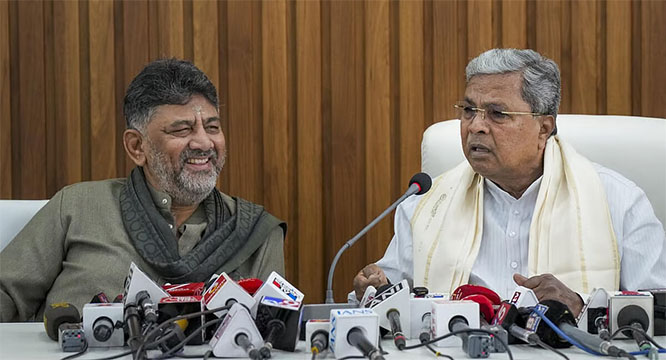
New Delhi: Karnataka chief minister Siddaramaiah and deputy CM DK Shivakumar on Saturday put up a dramatic display of unity at a closely watched joint press briefing, firmly dismissing weeks of speculation about a power-sharing tussle within the Congress. With the high command nudging both leaders to sit together and settle the dust, the meeting became a political spectacle, ending with the duo declaring that there was “no confusion, no differences.”

Calling the reports of a rift “manufactured confusion,” Siddaramaiah said the talks had gone smoothly, even joking about their breakfast. “Breakfast was very good. All three of us enjoyed it,” he said. “We want to end this confusion once and for all. For local elections and for 2028, our mission is clear — Congress must return to power. There is no difference between me and DKS, not now, not before.”

He blamed the media for fuelling rumours and reiterated absolute adherence to the party leadership. “From tomorrow, let there be no confusion. What the high command says, we will follow.”

Siddaramaiah also assured that the Assembly session starting December 8 would run smoothly and vowed that Congress would take on the BJP and JD(S) “together.”

Shivakumar echoed the chief minister word for word, stressing loyalty and discipline. “People have given us a massive mandate. It is our duty to deliver,” he said. “This government was formed under Siddaramaiah’s leadership. We both have complete trust in the high command. If they tell me to wait, I will wait.”

He added that the two leaders had discussed strategy for the 2028 Assembly elections. “Whatever the CM says, I agree. We are loyal soldiers of the party. The party may be facing challenges nationally, but we will keep it strong in Karnataka.”

Shivakumar also said Siddaramaiah would soon visit his home for lunch or dinner — another symbolic gesture meant to underline their unity.

Both leaders later posted on social media describing the breakfast meeting as “productive” and focused on “Karnataka’s priorities.”

The BJP, however, rejected the show of camaraderie as “pure bunkum,” accusing Congress of trying to paper over an internal power struggle. But Siddaramaiah and Shivakumar insisted their united front would continue — and that there was “no confusion” within the state leadership.

Comments

Add new comment

  • Coastaldigest.com reserves the right to delete or block any comments.
  • Coastaldigset.com is not responsible for its readers’ comments.
  • Comments that are abusive, incendiary or irrelevant are strictly prohibited.
  • Please use a genuine email ID and provide your name to avoid reject.
News Network
November 24,2025

israelsyra.jpg

Israeli forces have pushed over the Syrian frontier, erecting a checkpoint and stopping vehicles in the southwestern city of Quneitra, in yet another breach of the Arab country’s sovereignty.

The violation took place on Sunday, when the troops made their way across the border, setting up the outpost near the Ain al-Bayda junction in northern Quneitra, Syrian outlets reported.

According to the al-Ikhbariya paper, an Israeli detachment positioned itself at the junction, halting cars and conducting searches.

The Syrian Arab News Agency (SANA) reported that three Israeli military vehicles then moved further into the northern countryside, deploying between the town of Jubata al-Khashab and the villages of Ofaniya and Ain al-Bayda. The agency added that a separate Israeli unit mounted a new incursion in the central region, approaching the villages of Umm Batina and al-Ajraf.

Residents said such activities have surged in recent months, pointing to Israeli advances onto farmland, leveling of extensive forested areas, arrests, and spread of mobile checkpoints.

The Israeli regime began markedly increasing its military aggression against Syria last year.

The escalation coincided with increasingly ferocious onslaughts throughout the country by the so-called Hay'at Tahrir al-Sham (HTS) Takfiri terrorist group, which the government of President Bashar al-Assad had confined to northwestern Syria. The HTS, however, managed to overthrow the government as the Israeli attacks would pummel the country’s civilian and defensive infrastructure.

Various reports have shown that, during the escalation, the regime conducted more than 1,000 airstrikes on the Syrian territory and over 400 ground raids into the south.

Following the collapse of the Assad government, Tel Aviv also widened its grip over the occupied Golan Heights by taking control of a demilitarized buffer zone, in defiance of a 1974 Disengagement Agreement. Earlier this month, senior Israeli officials, including Prime Minister Benjamin Netanyahu, visited the buffer zone, prompting expressions of alarm on the part of the United Nations.

The United States, the regime’s biggest ally, has, meanwhile, been fraternizing the HTS head Abu Mohammed al-Jolani amid the widely reported prospect of rapprochement with Tel Aviv.

Comments

Add new comment

  • Coastaldigest.com reserves the right to delete or block any comments.
  • Coastaldigset.com is not responsible for its readers’ comments.
  • Comments that are abusive, incendiary or irrelevant are strictly prohibited.
  • Please use a genuine email ID and provide your name to avoid reject.
News Network
December 3,2025

arrival.jpg

Mangaluru, Dec 3: A group of Congress workers gathered at the Mangaluru International Airport on Wednesday to welcome AICC general secretary K C Venugopal, but the reception quickly turned into a display of support for Deputy Chief Minister D K Shivakumar.

Venugopal arrived in the city to participate in the centenary commemoration of the historic dialogue between Mahatma Gandhi and Narayana Guru. The event, organised by the Sivagiri Mutt, Varkala, in association with the Mangalore University Sri Narayana Guru Study Chair, is being held on the university’s Konaje campus.

KPCC general secretary Mithun Rai and several party workers had assembled at the airport to receive Venugopal. However, the moment he stepped out, workers began raising slogans backing Shivakumar.

The university programme will be inaugurated by Chief Minister Siddaramaiah.

This show of support comes just a day after Siddaramaiah remarked that Shivakumar would lead the government “when the high command decides.” The chief minister made the comment after a breakfast meeting at Shivakumar’s residence—another public display of camaraderie between the two leaders amid ongoing attempts by the party high command to downplay their leadership rivalry.

Comments

Add new comment

  • Coastaldigest.com reserves the right to delete or block any comments.
  • Coastaldigset.com is not responsible for its readers’ comments.
  • Comments that are abusive, incendiary or irrelevant are strictly prohibited.
  • Please use a genuine email ID and provide your name to avoid reject.