



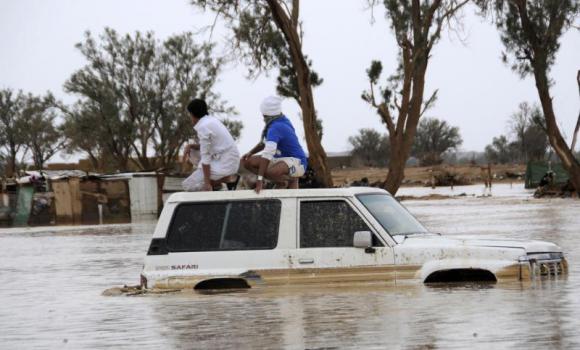
Kingdom ravaged by rain, dust storms

January 29, 2013

People_sit

Jeddah, Jan 29: Torrential rains and dust storms have swept the Kingdom, resulting in evacuations from wadis and other threatened areas of Tabuk and the closure of Tabuk schools on Monday.

Weather forecasters are saying that the bad weather could stay around for the next couple of days.

Clearly, the hardest hit area was Tabuk where schools were also closed for the week out of concern for the safety of children and teachers.

“Due to the heavy rain in the region, we decided to suspend school classes for the safety of our students,” said Mohammad bin Abullah Al-Lhedan, general director of education in Tabuk.

At least, one death has been attributed to the weather. A baby boy died in Wadi Rawafa when he fell from the hands of his mother after the family’s car was trapped in floodwaters. Civil Defense rescued the family and recovered the child’s body, according to Prince Fahd bin Sultan, governor of Tabuk.

Some roads leading into flooded valleys in the region have been closed and residents of the southern district of Tabuk evacuated in anticipation of heavy rains. Twenty-five cars and three school buses were saved by Civil Defense, the buses as they were about to be swept away to the Salw Valley. Numerous agricultural roads connecting villages in the region were also flooded.

Col. Mamdouh Al-Anazi, spokesman for Civil Defense, said his forces had rescued 23 people, including women and children in Damj district, using helicopters on Sunday.

Al-Anazi said the civil defense had called for evacuation of the southern districts of Abu Sabaa, Kuraim and Abu Dumaik. “We have received reports of some 273 people and cars trapped in floods,” he said. The worst hit districts were Abu Sabaa, Kuraim, Raheel, Rwuaieyat and Waha. Civil Defense forces and Red Crescent officers have been camping in these areas to help victims.

At the port of Dhuba, all cruises were stopped and Naval Guards there issued warnings to fishermen and vacationers not to venture out into the sea.

Mahmoud Al-Huwaiti from Dhuba said the situation in the city has become worse as a result of the heavy rains. He urged government agencies to put more effort into containing the situation, which is on the verge of catastrophe. The Sharma Dam has collapsed and many roads have become unusable, he added.

Although Jeddah managed to avoid rainstorms yesterday, the city was swept by brisk winds and enveloped in a dust cloud that cut visibility to just a few hundred meters in some sections of the city. Rain is expected to fall on Jeddah today.

According to Hussain Al-Qahtani, spokesman for PME, the expected rains will be "at the medium level for Jeddah.”

The weather is a result of a cold air mass to the north that began exerting its influence in the north and west of the Kingdom yesterday, according to PME. Winds are expected to shift to northeasterly, which could result in temperatures falling some 5 to 10 degrees Celsius. In the northern areas of the Kingdom, temperatures could plummet to 0 degree Celsius.

PME is forecasting continued dusty weather in Makkah and Madinah for today.

In the event that power outages occur, the Saudi Electric Company warned customers to use caution and ensure the safety of all electrical devices once power is restored.

Comments

Add new comment

  • Coastaldigest.com reserves the right to delete or block any comments.
  • Coastaldigset.com is not responsible for its readers’ comments.
  • Comments that are abusive, incendiary or irrelevant are strictly prohibited.
  • Please use a genuine email ID and provide your name to avoid reject.
News Network
November 24,2025

israelsyra.jpg

Israeli forces have pushed over the Syrian frontier, erecting a checkpoint and stopping vehicles in the southwestern city of Quneitra, in yet another breach of the Arab country’s sovereignty.

The violation took place on Sunday, when the troops made their way across the border, setting up the outpost near the Ain al-Bayda junction in northern Quneitra, Syrian outlets reported.

According to the al-Ikhbariya paper, an Israeli detachment positioned itself at the junction, halting cars and conducting searches.

The Syrian Arab News Agency (SANA) reported that three Israeli military vehicles then moved further into the northern countryside, deploying between the town of Jubata al-Khashab and the villages of Ofaniya and Ain al-Bayda. The agency added that a separate Israeli unit mounted a new incursion in the central region, approaching the villages of Umm Batina and al-Ajraf.

Residents said such activities have surged in recent months, pointing to Israeli advances onto farmland, leveling of extensive forested areas, arrests, and spread of mobile checkpoints.

The Israeli regime began markedly increasing its military aggression against Syria last year.

The escalation coincided with increasingly ferocious onslaughts throughout the country by the so-called Hay'at Tahrir al-Sham (HTS) Takfiri terrorist group, which the government of President Bashar al-Assad had confined to northwestern Syria. The HTS, however, managed to overthrow the government as the Israeli attacks would pummel the country’s civilian and defensive infrastructure.

Various reports have shown that, during the escalation, the regime conducted more than 1,000 airstrikes on the Syrian territory and over 400 ground raids into the south.

Following the collapse of the Assad government, Tel Aviv also widened its grip over the occupied Golan Heights by taking control of a demilitarized buffer zone, in defiance of a 1974 Disengagement Agreement. Earlier this month, senior Israeli officials, including Prime Minister Benjamin Netanyahu, visited the buffer zone, prompting expressions of alarm on the part of the United Nations.

The United States, the regime’s biggest ally, has, meanwhile, been fraternizing the HTS head Abu Mohammed al-Jolani amid the widely reported prospect of rapprochement with Tel Aviv.

Comments

Add new comment

  • Coastaldigest.com reserves the right to delete or block any comments.
  • Coastaldigset.com is not responsible for its readers’ comments.
  • Comments that are abusive, incendiary or irrelevant are strictly prohibited.
  • Please use a genuine email ID and provide your name to avoid reject.
News Network
November 22,2025

gaza.jpg

The Israeli regime’s forces have killed two Palestinian children in the Gaza Strip every day since the ceasefire began in early October, UNICEF has warned.

The UN children’s agency said on Friday that Israeli forces continue to attack Palestinians in Gaza even though the agreement was meant to stop the killing.

“Since 11 October, while the ceasefire has been in effect, at least 67 children have been killed in conflict-related incidents in the Gaza Strip. Dozens more have been injured. That is an average of almost two children killed every day since the ceasefire took effect,” UNICEF spokesperson Ricardo Pires said in Geneva, reminding that each number in the statistics represents a child whose life had ended violently.

“These are not statistics,” he said. “Each child had a story, a family, and a future that was stolen from them.”

Data from Palestinian factions, human rights groups, and government bodies recorded since the US-brokered ceasefire deal went into effect on October 10 show that Israeli forces have carried out numerous attacks, each constituting a separate ceasefire violation.

UNICEF teams say they repeatedly continue to witness heart-wrenching scenes of fearful Palestinian children sleeping outdoors with amputated limbs, while others live as orphans in flooded, makeshift shelters.

“I saw this myself in August. There is no safe place for them. The world cannot normalize their suffering,” Pires said, lamenting that the UN could “do a lot more if the aid that is really needed was entering faster.”

The UNICEF spokesperson warned that with the advent of winter, the risks for hundreds of thousands of displaced children will increase.

He warned, “The stakes are incredibly high” for children as winter acts as a threat multiplier, where children have no heating, no insulation, and few blankets. He said respiratory infections rise.

“Too many children have already paid the highest price,” Pires said. “Too many are still paying it, even under a ceasefire. The world promised them it would stop and that we would protect them.”

“Now we must act like it,” the UNICEF spokesperson added.

Since the Israeli regime launched its genocidal war against Palestinians in Gaza in October 2023, it has killed nearly 70,000 people in the territory, most of them women and children, and injured over 170,000 more, while reducing most of the structures in the enclave to rubble.

Comments

Add new comment

  • Coastaldigest.com reserves the right to delete or block any comments.
  • Coastaldigset.com is not responsible for its readers’ comments.
  • Comments that are abusive, incendiary or irrelevant are strictly prohibited.
  • Please use a genuine email ID and provide your name to avoid reject.