



Income tax on the cards for high income earners in Oman

Agencies
February 13, 2021

Image result for Oman

Dubai, Feb 13: International Monetary Fund (IMF) has reiterated that Oman is planning to introduce income tax on high income earners as part of its medium-term fiscal balance plan.

The Fund welcomed the fiscal balance plan and said introducing value-added tax (VAT) in 2021, a personal income tax on high-income earners being developed, and full-year impact of the expansion of the excise tax base in 2020 are key to reinforcing fiscal sustainability and alleviate financial pressure. In addition, containing the wage bill via civil service reforms; targeting energy subsidies to the most vulnerable groups; streamlining capital expenditure; and broad-based improvements in expenditure efficiency are also key to reforms.

When introduced, Oman will be the first country in the GCC to levy income tax in the region. It is expected that Oman can introduce income tax in 2022.

Oman aims to bring fiscal deficit down to 1.7 per cent of gross domestic product by 2024, from a preliminary deficit of 15.8 per cent this year.

“These policies would also help mitigate structural weaknesses in public finances, notably heavy reliance on hydrocarbon revenue and rigidities in expenditure. Given the impact of fiscal consolidation on economic activity and household incomes, sustained commitment and active outreach to build broad support to the proposed measures would be needed to successfully implement the plan.

“Inadequate implementation of the fiscal adjustment plan could trigger a negative shift in investor sentiment, heightening financing risks. Finally, establishing a sound medium term fiscal framework and a clear fiscal anchor would help in achieving the targeted consolidation, and the IMF stands ready to provide technical assistance in this area,” it said.

Economy shrinks 6.4% in 2020

Oman’s economy likely shrank 6.4 per cent in 2020 due to the coronavirus crisis and low oil prices putting a strain on the state’s coffers.

That would be a narrower contraction than the 10 per cent fall the IMF forecast for Oman last year. But the sultanate’s economy was still hit hard, with its non-hydrocarbon GDP estimated to have reduced by 10 per cent.

The construction, hospitality, and wholesale and retail trade sectors experienced the heaviest toll, the fund said, while inflation turned slightly negative, owing to less demand.

The IMF forecast a 2020 global contraction of 4.4 per cent in its last World Economic Outlook, an improvement over a 5.2 per cent contraction predicted in June 2020, but said it was still the worst economic crisis since the 1930s Great Depression.

Oman’s fiscal deficit widened to 17.3 per cent of gross domestic product (GDP) and was financed by external bond issuance, drawdown of deposits and sovereign funds, and privatization proceeds, the Fund said.

“As a result, central government debt rose to 81 per cent of GDP, from 60 per cent in 2019,” it said.

The IMF said a modest recovery of 1.8 per cent was anticipated for 2021, with more growth expected over the medium term, despite continuing uncertainty.

The vaccine roll-out campaign and the easing of social distancing restrictions meant a mild recovery of 1.5 per cent was projected for non-oil GDP growth in 2021, rising to 4 per cent by 2026.

The Fund said that a successful implementation of Oman’s fiscal adjustment plans “is key to reinforcing fiscal sustainability and alleviating financing pressures”.

Those plans include the introduction of a 5% value added tax this year and envisage a personal income tax on high-income earners, a first in the Gulf.

The Fund also recommended the development of a sovereign asset and liability management framework, given eroding financial buffers and rising contingent liabilities.

As public debt rises and foreign assets decline, “it will be important to manage potential mismatches in the financial characteristics of sovereign assets and liabilities to safeguard the sovereign balance sheet from risks of interest rate and exchange rate fluctuations,” the Fund said.

Comments

Add new comment

  • Coastaldigest.com reserves the right to delete or block any comments.
  • Coastaldigset.com is not responsible for its readers’ comments.
  • Comments that are abusive, incendiary or irrelevant are strictly prohibited.
  • Please use a genuine email ID and provide your name to avoid reject.
News Network
November 21,2025

israel.jpg

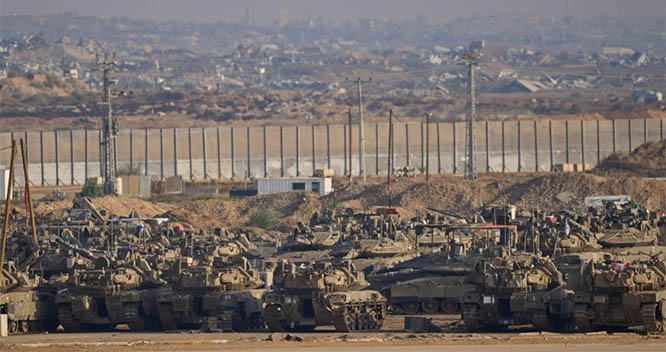
Local authorities say the Israeli military has expanded the so-called “yellow line” truce demarcation in Gaza City and repositioned its forces deeper into the territory in violation of a ceasefire agreement that came into force on October 10, besieging dozens of Palestinian families.

Gaza’s Government Media Office announced in a statement on Thursday that Israeli forces widened the boundary by shifting the markers, and advanced roughly 300 meters (984 feet) into the neighborhoods of Ash-Shaaf, An-Nazzaz and Baghdad Street.

The move pushed further into civilian areas, trapping families who were unable to flee as tanks rolled forward, it added.

“The fate of many of these families remains unknown amidst the shelling that targeted the area,” the office said, adding that the expansion of the yellow line shows a “blatant disregard” for the ceasefire deal.

On Friday, sources said the Israeli military carried out continued air and artillery strikes inside the so-called “yellow line” east of Khan Younis in the southern Gaza Strip.

According to the reports, Israeli warplanes and tanks targeted areas within the zone. One Palestinian was reported killed and several others wounded in the strikes, the sources said.

The fresh aggression came only a day after 25 Palestinians were killed in Israeli airstrikes on Gaza City and Khan Younis on Wednesday.

The media office reported that Israel has consistently violated the truce deal since its implementation last month, with near-daily attacks by air, artillery and direct shootings.

The office said over 400 violations have been documented. These breaches have resulted in the deaths of more than 300 Palestinians and left hundreds injured.

The Government Media Office in Gaza urged the guarantors of the ceasefire — the US, Egypt, Qatar and Turkey — to take swift action to halt the ongoing violations and facilitate the delivery of food, shelter materials, medical aid, and infrastructure equipment.

The so-called “yellow line,” set out in the agreement between Israel and Hamas resistance movement, refers to a non-physical partition where the Israeli military repositioned itself when the truce deal took effect.

It has allowed Israel, which routinely fires at Palestinians who approach the line, to retain control over more than half of the Gaza Strip.

International bodies, including the UN Independent International Commission of Inquiry, the International Association of Genocide Scholars, Amnesty International, Human Rights Watch, B’Tselem, and other rights groups, have concluded that the Israeli war on Gaza amounts to genocide.

In the attacks in Gaza since October 2023, Israel has killed at least 69,546 people and injured 170,833 others, leveling large swaths of the territory and displacing almost all of the population. 

Comments

Add new comment

  • Coastaldigest.com reserves the right to delete or block any comments.
  • Coastaldigset.com is not responsible for its readers’ comments.
  • Comments that are abusive, incendiary or irrelevant are strictly prohibited.
  • Please use a genuine email ID and provide your name to avoid reject.
News Network
November 28,2025

fire.jpg

Several Syrians were killed and more than two dozen others injured in Israeli strikes on the outskirts of Damascus, amid intensified incursions by the occupying regime since the fall of former president Bashar al-Assad and the rise of Hayat Tahrir al-Sham (HTS) rule.

Syrian state TV reported that the casualties occurred during an overnight Israeli assault involving helicopters and drones on the town of Beit Jinn in the Damascus countryside. The attack followed an Israeli military unit’s entry into the town, where they were surrounded by local residents, leading to gunfire and direct confrontations.

According to the report, “The occupation army’s helicopters and artillery shelled Beit Jinn, located at the foothills of Mount Hermon, resulting in 13 martyrs and 25 injured civilians.” The broadcaster did not specify the full extent of damage.

Al-Ikhbariyah Syria confirmed that the shelling coincided with Israeli soldiers entering Beit Jinn, while artillery pounded surrounding areas. The broadcaster stated that the escalation began after local residents clashed with an Israeli patrol that had infiltrated the southern town and “kidnapped” three young men.

Following a two-hour exchange of heavy fire, Israeli forces withdrew and repositioned on the hill of Butt al-Warda at the town’s outskirts.

Israeli media acknowledged that six soldiers were wounded in the clashes—three of them seriously—describing the confrontation as a “sudden ambush” that forced the deployment of reserve units and air support to secure an exit route. No further details were provided.

The aggression has fueled renewed displacement from Beit Jinn, with residents fleeing to nearby villages amid increasingly frequent Israeli attacks.

The raid came just a day after Israeli troops carried out another ground incursion into Umm al-Luqas village in Quneitra province. According to SANA, an Israeli unit in four vehicles entered the village, raided several homes, and later withdrew.

Syria condemned the repeated incursions as violations of the 1974 Disengagement Agreement and UN resolutions, urging the international community to enforce compliance and pressure Israel to halt its operations and withdraw fully.

Israel has expanded its attacks across Syrian territory following the collapse of the Assad government last year. Prime Minister Benjamin Netanyahu has reportedly instructed his forces to push deeper into Syrian territory and seize strategic positions.

Meanwhile, critics say the HTS-led interim government’s inaction and growing normalization gestures toward Israel have emboldened Tel Aviv to intensify its military operations. HTS, formerly linked to al-Qaeda, seized control of Damascus last December, formally ending Assad’s rule.

Comments

Add new comment

  • Coastaldigest.com reserves the right to delete or block any comments.
  • Coastaldigset.com is not responsible for its readers’ comments.
  • Comments that are abusive, incendiary or irrelevant are strictly prohibited.
  • Please use a genuine email ID and provide your name to avoid reject.