
Evidence of 'lost' river that ran through Thar Desert 172,000 years ago found

Agencies
October 21, 2020

desert-1603274441.jpg

Bikaner, Oct 21: Researchers have found the evidence of a "lost" river that ran through the central Thar Desert, near Bikaner, as early as 172 thousand years ago, and may have been a life-line to human populations enabling them to inhabit the region.

The findings, published in the journal Quaternary Science Reviews, represent the oldest directly dated phase of river activity at Nal Quarry in the central Thar Desert.

The study by researchers from The Max Planck Institute for the Science of Human History in Germany, Anna University in Tamil Nadu, and IISER Kolkata indicates that Stone Age populations lived in a distinctly different Thar Desert landscape than we encounter today.

This evidence indicates a river flowed with phases of activity dating to approximately up to 172 thousand years ago, nearby to Bikaner, Rajasthan, which is over 200 kilometres away from the nearest modern river.

These findings predate evidence for activity in modern river courses across the Thar Desert as well as dried up course of the Ghaggar-Hakra River, the researchers said.

The presence of a river running through the central Thar Desert would have offered a life-line to Paleolithic populations, and potentially an important corridor for migrations, they said.

The researchers noted that the potential importance of 'lost' rivers for earlier inhabitants of the Thar Desert have been overlooked.

"The Thar Desert has a rich prehistory, and we've been uncovering a wide range of evidence showing how Stone Age populations not only survived but thrived in these semi-arid landscapes," said Jimbob Blinkhorn from The Max Planck Institute for the Science of Human History.

"We know how important rivers can be to living in this region, but we have little detail on what river systems were like during key periods of prehistory," Blinkhorn said.

Studies of satellite imagery have shown a dense network of river channels crossing the Thar Desert, according to the researchers.

"These studies can indicate where rivers and streams have flowed in the past, but they can't tell us when," explained Professor Hema Achyuthan of Anna University.

"To demonstrate how old such channels are, we had to find evidence on the ground for river activity in the middle of the desert," Achyuthan said.

The team studied a deep deposit of river sands and gravels, which had been exposed by quarrying activity near the village of Nal.

The researchers were able to document different phases of river activity by studying the different deposits.

"We immediately saw evidence for a substantial and very active river system from the bottom of the fluvial deposits, which gradually decreased in power through time," Achyuthan said.

The researchers used a method called luminescence dating to understand when quartz grains in the river sands were buried.

The results indicated that the strongest river activity at Nal occurred at approximately 172 and 140 thousand years ago, at a time when the monsoon was much weaker than today in the region.

River activity continued at the site between 95 to 78 thousand years ago, after which only limited evidence for the presence of a river at the site, with evidence for a brief reactivation of the channel 26 thousand years ago, the study found.

The river was flowing at its strongest during a phase of weak monsoonal activity in the region, and may have been a life-line to human populations enabling them to inhabit the Thar Desert, the researchers said.

The timeframe over which this river was active also overlaps with significant changes in human behaviour in the region, which have been linked with the earliest expansions of Homo sapiens from Africa into India, they said.

"This river flowed at a critical timeframe for understanding human evolution in the Thar Desert, across South Asia and beyond," said Blinkhorn.

"This suggests a landscape in which the earliest members of our own species, Homo sapiens, first encountered the monsoons and crossed the Thar Desert may have been very different to the landscape we can see today," he added.

Comments

Add new comment

  • Coastaldigest.com reserves the right to delete or block any comments.
  • Coastaldigset.com is not responsible for its readers’ comments.
  • Comments that are abusive, incendiary or irrelevant are strictly prohibited.
  • Please use a genuine email ID and provide your name to avoid reject.
News Network
November 21,2025

israel.jpg

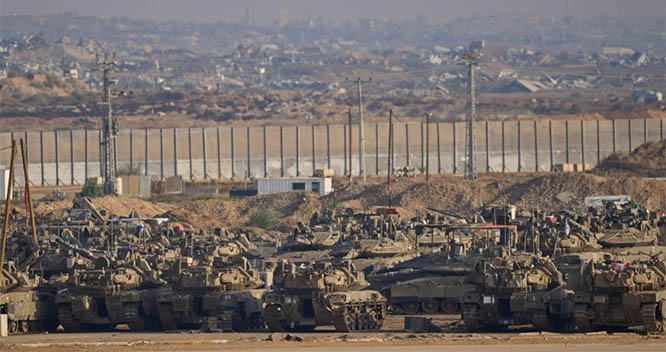
Local authorities say the Israeli military has expanded the so-called “yellow line” truce demarcation in Gaza City and repositioned its forces deeper into the territory in violation of a ceasefire agreement that came into force on October 10, besieging dozens of Palestinian families.

Gaza’s Government Media Office announced in a statement on Thursday that Israeli forces widened the boundary by shifting the markers, and advanced roughly 300 meters (984 feet) into the neighborhoods of Ash-Shaaf, An-Nazzaz and Baghdad Street.

The move pushed further into civilian areas, trapping families who were unable to flee as tanks rolled forward, it added.

“The fate of many of these families remains unknown amidst the shelling that targeted the area,” the office said, adding that the expansion of the yellow line shows a “blatant disregard” for the ceasefire deal.

On Friday, sources said the Israeli military carried out continued air and artillery strikes inside the so-called “yellow line” east of Khan Younis in the southern Gaza Strip.

According to the reports, Israeli warplanes and tanks targeted areas within the zone. One Palestinian was reported killed and several others wounded in the strikes, the sources said.

The fresh aggression came only a day after 25 Palestinians were killed in Israeli airstrikes on Gaza City and Khan Younis on Wednesday.

The media office reported that Israel has consistently violated the truce deal since its implementation last month, with near-daily attacks by air, artillery and direct shootings.

The office said over 400 violations have been documented. These breaches have resulted in the deaths of more than 300 Palestinians and left hundreds injured.

The Government Media Office in Gaza urged the guarantors of the ceasefire — the US, Egypt, Qatar and Turkey — to take swift action to halt the ongoing violations and facilitate the delivery of food, shelter materials, medical aid, and infrastructure equipment.

The so-called “yellow line,” set out in the agreement between Israel and Hamas resistance movement, refers to a non-physical partition where the Israeli military repositioned itself when the truce deal took effect.

It has allowed Israel, which routinely fires at Palestinians who approach the line, to retain control over more than half of the Gaza Strip.

International bodies, including the UN Independent International Commission of Inquiry, the International Association of Genocide Scholars, Amnesty International, Human Rights Watch, B’Tselem, and other rights groups, have concluded that the Israeli war on Gaza amounts to genocide.

In the attacks in Gaza since October 2023, Israel has killed at least 69,546 people and injured 170,833 others, leveling large swaths of the territory and displacing almost all of the population. 

Comments

Add new comment

  • Coastaldigest.com reserves the right to delete or block any comments.
  • Coastaldigset.com is not responsible for its readers’ comments.
  • Comments that are abusive, incendiary or irrelevant are strictly prohibited.
  • Please use a genuine email ID and provide your name to avoid reject.
News Network
November 21,2025

malpe.jpg

Udupi: The Malpe Police have arrested two men from Uttar Pradesh for allegedly sharing classified information related to Indian Navy vessels with individuals in Pakistan, posing a serious threat to national security.

According to a complaint filed by the CEO of Udupi Cochin Shipyard, Malpe—an institution under the Union Ministry of Ports, Shipping and Waterways—the prime accused, Rohit (29), was working as an insulator through subcontractor M/S Shushma Marine Pvt Ltd. He had earlier served at Cochin Shipyard Limited in Kochi, Kerala, where naval ships are under construction.

Udupi SP Hariram Shankar said the accused had unlawfully shared, via WhatsApp, confidential identification numbers of Navy-related ships and other classified details while working in Kerala, allegedly for illegal gains.

After joining the Malpe shipyard unit, Rohit reportedly continued collecting sensitive information through a friend in Kochi and circulated it to unauthorised individuals, violating national security protocols and potentially endangering India’s sovereignty, unity, and integrity.

Based on the complaint, Malpe Police registered a case under Section 152 of the Bharatiya Nyaya Sanhita (BNS) and Sections 3 and 5 of the Official Secrets Act, 1923.

A police team led by Karkala Subdivision Assistant Superintendent of Police Harsha Priyamvada—along with PSI Anil Kumar D, ASI Harish, and PC Ravi Jadhav—conducted the investigation and arrested the two accused, identified as Rohit (29) and Santri (37), both residents of Sultanpur district, Uttar Pradesh.

The duo was produced before the court, which remanded them in judicial custody till December 3. Further investigation is in progress.

Comments

Add new comment

  • Coastaldigest.com reserves the right to delete or block any comments.
  • Coastaldigset.com is not responsible for its readers’ comments.
  • Comments that are abusive, incendiary or irrelevant are strictly prohibited.
  • Please use a genuine email ID and provide your name to avoid reject.