



Modi slams Shinde’s directive on arrest of Muslim youth for terror

January 13, 2014

Modi-Goa
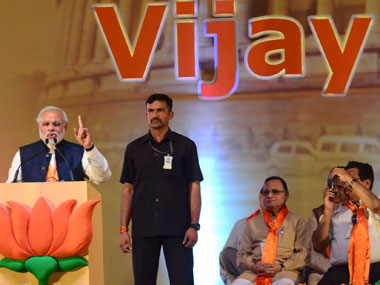
New Delhi, Jan 13: Narendra Modi has long associated Delhi with all the negative facets of the Congress led UPA regime. With the Aam Aadmi Party’s success in the national capital and the buzz around its electoral potential on a national scale, the BJP prime ministerial candidate referred to`Delhi’ in a different perspective – to question media obsession, (television news in particular) towards the new party and talking about how it was blind to the good work being done by the BJP chief ministers elsewhere, particularly in Goa, where he said chief minister Manohar Parikar stood taller than the much talked about Arvind Kejriwal.

Modi’s massive public rally in Goa, is more significant than being a simple voter mobilisation in the scenic coastal state. Goa after all sends only two MPs to the Lok Sabha. It was instead, important for the national perspective of the party. Given that the state receives visitors from all parts of the country and also various parts of the world, Modi wants to portray Goa, along with Gujarat, as a model BJP ruled state and also project Goa chief minister Manohar Parrikar, an IIT Bombay alumnus, in direct opposition to Kejriwal, for his honesty, integrity, simplicity, firm and people friendly approach.

Modi said “Goa should act as messenger to the country”. Though he didn’t name the Aam Aadmi Party or Kejriwal, his reference to it was loud and clear.

The BJP's Prime Ministerial candidate knows that he has already taken the campaign against the Congress to a certain level and has been successful in both creating and encashing on the rising exasperation against 10 years of Congress rule at the centre. Modi only had to keep going strong vis-à-vis the Grand Old Party but he realises that he can no longer afford to ignore the new kid on the block which has been gaining lot of traction in some of his social constituents. “Those acting as a shield of the Congress are equally guilty”, he said.

By talking about Parrikar’s credentials, and then his own, Modi tried to convince the people not to vote for “television faces” which were neither tried nor tested. “Imagine what would happened had Manohar Parrikar had been in Delhi. The country would have known about his good work but what can we do, he is in Goa and media can’t see anything beyond Delhi. I have been working so hard, serving the people of Gujarat for the last 12 years but I have always been portrayed as vanquished in TV and newspapers. I could never make a place for good. Leading the country needs a big vision and implementation of the right policies. The country could advance only if it is led by leaders who have a tried and tested track record and experience. TV faces can’t do that well.”

The Aam Aadmi Party has begun expanding nationally with an aggressive membership drive. Kumar Vishwas created a buzz on Sunday by his visit to Congress president Rahul Gandhi's bastion of Amethi, while Yogendra Yadav made a foray into Haryana.

If Modi chose his public rally to attack Aam Aadmi credentials, other party leaders are taking different other routes to question the young party’s capabilities. His trusted party colleague, Leader of Opposition in the Rajya Sabha Arun has made a strong and direct pitch against AAP. “The AAP government has so far confused substantive governance with style of governance. It may be entitled to its unconventional style of governance. The unconventional style is not a substitute for substantive governance. Publicity without any substantive governance is simply gimmickry. Responsible governance has a long lasting impact. Gimmickry is always short lived", he said.

Kejriwal’s experiments to hold a Janata Darbar on the streets of Delhi and subsequent chaotic scenes have raised questions about their ideas of governance.

Though Modi for a change did not directly target Rahul Gandhi, he went after Jayanti Natrajan, a Gandhi-Nehru family loyalist, who was the environment and forest ministry. “We had heard of Income Tax, Sales Tax but in Delhi a new kind tax, Jayanti (Natrajan) tax was being levied. A file in the environment ministry would not move without payment of the Jayanti tax.” He then went on to say how the UPA government disallowed a decision to lease mining rights in Gujarat through auction.

Former Environment and forest minister Jayanti Natrajan’s resignation had officially been publicised as her desire to work for the party than as a removal from the government on charges of money making for clearing or keeping files on hold in perpetuity.

The BJP leader is also making home minister Sushilkumar Shinde’s directive to states to review terrorism related cases against arrested Muslim youth under various criminal offences a big electoral issue, which can have socially polarising effects.

Though Modi was cautious enough to also clarify that criminals have no religion and law does not discriminate between accused on basis of their religion, he did make it political by accusing Congress of vote bank politics. “See the audacity of the home minister. He writes to us in the states to ensure that Muslims are not arrested for involvement in criminal acts. The state functions on one philosophy -punishment of the guilty and justice to the innocent. Moreover law and order is a state subject. How can the home minister dictate to states?”

Goa has been lucky for Modi. First in 2002 it was the venue where his chief ministerial position was saved, and then in June 2013 when he was officially made the face of the party’s 2014 campaign.

Now after this sudden AAP challenge Modi will hope that Goa yet again proves lucky for him.

Comments

Add new comment

  • Coastaldigest.com reserves the right to delete or block any comments.
  • Coastaldigset.com is not responsible for its readers’ comments.
  • Comments that are abusive, incendiary or irrelevant are strictly prohibited.
  • Please use a genuine email ID and provide your name to avoid reject.
News Network
December 16,2025

jordan.jpg

Prime Minister Narendra Modi on Monday held talks with Jordan’s King Abdullah II in Amman, during which the two leaders discussed ways to further strengthen bilateral relations, with the Prime Minister outlining an eight-point vision covering key areas of cooperation.

Describing the meeting as “productive”, PM Modi said he shared a roadmap focused on trade and economy, fertilisers and agriculture, information technology, healthcare, infrastructure, critical and strategic minerals, civil nuclear cooperation, and people-to-people ties.

In a post on social media platform X, the Prime Minister praised King Abdullah II’s personal commitment to advancing India–Jordan relations, particularly as both countries mark the 75th anniversary of the establishment of diplomatic ties this year.

“Held productive discussions with His Majesty King Abdullah II in Amman. His personal commitment towards vibrant India-Jordan relations is noteworthy. This year, we are celebrating the 75th anniversary of our bilateral diplomatic relations,” PM Modi said.

The meeting took place at the Al Husseiniya Palace, where the two leaders also exchanged views on regional and global issues of mutual interest. According to the Ministry of External Affairs (MEA), both sides agreed to further deepen cooperation in areas including trade and investment, defence and security, counter-terrorism and de-radicalisation, fertilisers and agriculture, infrastructure, renewable energy, tourism, and heritage.

The MEA said both leaders reaffirmed their united stand against terrorism.

PM Modi arrived in Amman earlier on Monday and was received by Jordanian Prime Minister Jafar Hassan, who accorded him a formal welcome. Following the talks, King Abdullah II hosted a banquet dinner in honour of the Prime Minister, reflecting the warmth of bilateral ties.

Jordan is the first leg of PM Modi’s three-nation tour. From Amman, the Prime Minister will travel to Ethiopia at the invitation of Prime Minister Abiy Ahmed Ali, marking his first official visit to the African nation. The tour will conclude with a visit to Oman.

Comments

Add new comment

  • Coastaldigest.com reserves the right to delete or block any comments.
  • Coastaldigset.com is not responsible for its readers’ comments.
  • Comments that are abusive, incendiary or irrelevant are strictly prohibited.
  • Please use a genuine email ID and provide your name to avoid reject.
News Network
December 6,2025

pilot.jpg

New Delhi: IndiGo, India’s largest airline, faced major operational turbulence this week after failing to prepare for new pilot-fatigue regulations issued by the Directorate General of Civil Aviation (DGCA). The stricter rules—designed to improve flight safety—took effect in phases through 2024, with the latest implementation on November 1. IndiGo has acknowledged that inadequate roster planning led to widespread cancellations and delays.

Below are the key DGCA rules that affected IndiGo’s operations:

1. Longer Mandatory Weekly Rest

Weekly rest for pilots has been increased from 36 hours to 48 hours.

The government says the extended break is essential to curb cumulative fatigue. This rule remains in force despite the current crisis.

2. Cap on Night Landings

Pilots can now perform only two night landings per week—a steep reduction from the earlier limit of six.

Night hours, defined as midnight to early morning, are considered the least alert period for pilots.

Given the disruptions, this rule has been temporarily relaxed for IndiGo until February 10.

3. Reduced Maximum Night Flight Duty

Flight duty that stretches into the night is now capped at 10 hours.

This measure has also been kept on hold for IndiGo until February 10 to stabilize operations.

4. Weekly Rest Cannot Be Replaced With Personal Leave

Airlines can no longer count a pilot’s personal leave as part of the mandatory 48-hour rest.

Pilots say this closes a loophole that previously reduced actual rest time.

Currently, all airlines are exempt from this rule to normalise travel.

5. Mandatory Fatigue Monitoring

Airlines must submit quarterly fatigue reports along with corrective actions to DGCA.

This system aims to create a transparent fatigue-tracking framework across the industry.

The DGCA has stressed that these rules were crafted to strengthen flight safety and align India with global fatigue-management standards. The temporary relaxations are expected to remain until February 2025, giving IndiGo time to stabilise its schedules and restore normal air travel.

Comments

Add new comment

  • Coastaldigest.com reserves the right to delete or block any comments.
  • Coastaldigset.com is not responsible for its readers’ comments.
  • Comments that are abusive, incendiary or irrelevant are strictly prohibited.
  • Please use a genuine email ID and provide your name to avoid reject.

